Rejoignez-nous pour un voyage dans le monde des livres!
Ajouter ce livre à l'électronique
Grey
Ecrivez un nouveau commentaire Default profile 50px
Grey
Abonnez-vous pour lire le livre complet ou lisez les premières pages gratuitement!
All characters reduced
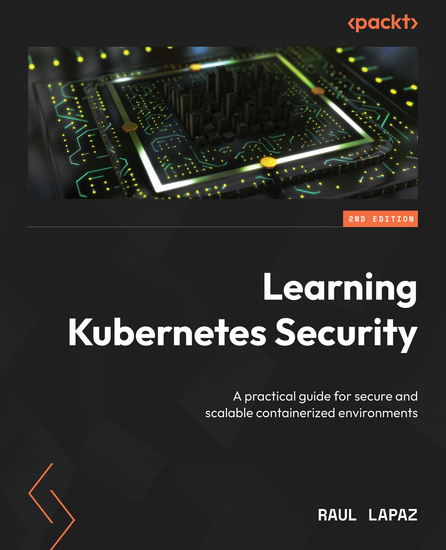
Learning Kubernetes Security - A practical guide for secure and scalable containerized environments - cover

Learning Kubernetes Security - A practical guide for secure and scalable containerized environments

Raul Lapaz

Maison d'édition: Packt Publishing

  • 0
  • 0
  • 0

Synopsis

With readily available services, support, and tools, Kubernetes has become a foundation for digital transformation and cloud-native development, but it brings significant security challenges such as breaches and supply chain attacks.
This updated edition equips you with defense strategies to protect your applications and infrastructure while understanding the attacker mindset, including tactics like container escapes and exploiting vulnerabilities to compromise clusters. The author distills his 25+ years of experience to guide you through Kubernetes components, architecture, and networking, addressing authentication, authorization, image scanning, resource monitoring, and traffic sniffing. You’ll implement security controls using third-party plugins (krew) and tools like Falco, Tetragon, and Cilium. You’ll also secure core components, such as the kube-apiserver, CoreDNS, and kubelet, while hardening images, managing security contexts, and applying PodSecurityPolicy. Through practical examples, the book teaches advanced techniques like redirecting traffic from misconfigured clusters to rogue pods and enhances your support incident response with effective cluster monitoring and log analysis.
By the end of the book, you'll have a solid grasp of container security as well as the skills to defend your clusters against evolving threats.
Disponible depuis: 30/06/2025.
Longueur d'impression: 390 pages.


D'autres livres qui pourraient vous intéresser

  • Walleye - A Beautiful Fish of the Dark - cover

    Walleye - A Beautiful Fish of...

    Paul J. Radomski

    • 0
    • 0
    • 0
    Among the more than 34,000 species of fish, few have the walleye's following—among anglers and diners, states conferring official status on the fish, and towns battling for recognition as the Walleye Capital of the World. And among those passionate fans, few know the walleye as well as Paul J. Radomski does—a fisheries biologist, lake ecology scientist, and old fisherman. In Walleye: A Beautiful Fish of the Dark he unspools the mysteries of this fascinating fish. 


    Radomski looks at walleye from every angle, with something to say to the curious naturalist, committed ecologist, and avid fishing enthusiast. People who view walleye as the "lion of the lakes" might be surprised to learn that rivers are their ancestral habitat. Some might wonder about the name "wall-eye," a nod to an evolutionary adaptation to dark water environments. Others might ask: what are they, where do they exist, how do they survive, and how have people come to depend on them? Radomski discusses the principles and pitfalls of managing this predator of the twilight and shares his informed perspective on when and where stocking is prudent. He also explores three of the best walleye lakes. 


    From the simple pleasures of fishing for walleye to the most pressing questions about how this species survives, this book is the best word on this beautiful fish of the dark.
    Voir livre
  • Age of Fire and Plastic The: Living Through the Anthropocene - cover

    Age of Fire and Plastic The:...

    Alex Southwick

    • 0
    • 0
    • 0
    We live in a world built by fire and wrapped in plastic — a planet reshaped by our own invention. From the first flicker of flame to the glow of the digital screen, humanity’s genius has transformed the Earth’s systems in ways no species has ever done before. 
    In The Age of Fire and Plastic, Alex Southwick traces the story of the Anthropocene — the era in which humans became a geological force. Through vivid storytelling and sharp insight, Southwick reveals how our tools of progress — oil, metal, concrete, and polymer — have left indelible marks in the air, sea, and soil. 
    But this is not merely a tale of ruin. It’s also a meditation on what it means to live consciously in a world of our own making. How do we find awe, responsibility, and meaning when the natural and artificial are now one and the same? 
    Sweeping in scope yet deeply personal, The Age of Fire and Plastic is an essential journey through humanity’s defining century — and a call to shape the next one with intention rather than accident.
    Voir livre
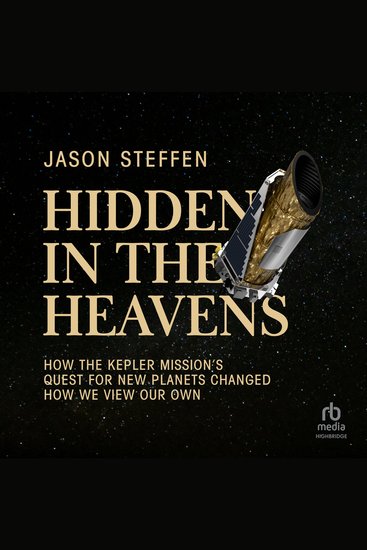
  • Hidden in the Heavens - How the Kepler Mission’s Quest for New Planets Changed How We View Our Own - cover

    Hidden in the Heavens - How the...

    Jason Steffen

    • 0
    • 0
    • 0
    Are we alone in the universe? It's a fundamental question for Earth-dwelling humankind. Are there other worlds like ours, out there somewhere? In Hidden in the Heavens, Jason Steffen, a former scientist on NASA's Kepler mission, describes how that mission searched for planets orbiting Sun-like stars—especially Earth-like planets circulating in Earth-like orbits. What the Kepler space telescope found, Steffen reports, contradicted centuries of theoretical and observational work and transformed our understanding of planets, planetary systems, and the stars they orbit. Kepler discovered thousands of planets orbiting distant stars—a bewildering variety of celestial bodies, including rocky planets being vaporized by the intense heat of their host star; super-Earths and sub-Neptunes; gas giants several times the size and mass of Jupiter; and planets orbiting in stellar systems that had only been imagined in science fiction. 


    Steffen offers a unique, inside account of the work of the Kepler science team (and the sometimes chaotic interactions among team members), mapping the progress of the mission from the launch of the rocket that carried Kepler into space to the revelations of the data that began to flow to the supercomputer back at NASA—evidence of strange new worlds unlike anything found in our own solar system.
    Voir livre
  • ChatGPT - Is the future already here? - cover

    ChatGPT - Is the future already...

    Rodrigo Serzedello

    • 0
    • 0
    • 0
    Have you heard about this new buzz word: ChatGPT? 
    If you have not, it is one of the most interesting topics in technology and artificial intelligence (AI) in the last decade. Even Microsoft invested about $10 billion dollars in it. 
    Learn how this solution is being used by most companies to improve their operations as well as how people can use it in their day-to-day lives. 
    This audiobook is a great resource to understand what this technology is and how far we can go with it. Listen to use cases, limitations and ethical considerations. 
    Welcome to the future of AI. 
    I hope you enjoy!
    Voir livre
  • Computer Architecture and Organization - Design Principles of Hardware Components - cover

    Computer Architecture and...

    Bright Mills

    • 0
    • 0
    • 0
    Computer Architecture and Organization is a foundational subject in computer science and engineering that explores the internal structure and functioning of computer systems. It encompasses the design principles of hardware components, how these components interact, and the organizational methods used to optimize performance, efficiency, and functionality. This detailed document explores the critical concepts of computer architecture and organization, from basic logic gates to complex processor pipelines. Topics include the von Neumann model, instruction set architecture (ISA), CPU organization, memory hierarchy, input/output systems, control units, pipelining, RISC vs CISC, parallelism, and modern trends like multi-core systems, GPU architectures, and quantum computing potentials. The document also discusses the distinctions between architecture (the conceptual design and fundamental operational structure) and organization (the realization and implementation of architecture), illustrating their interdependence.
    Voir livre
  • The Great American Transit Disaster - A Century of Austerity Auto-Centric Planning and White Flight - cover

    The Great American Transit...

    Nicholas Dagen Bloom

    • 0
    • 0
    • 0
    A potent re-examination of America’s history of public disinvestment in mass transit. 
      
    Many a scholar and policy analyst has lamented American dependence on cars and the corresponding lack of federal investment in public transportation throughout the latter decades of the twentieth century. But as Nicholas Dagen Bloom shows in The Great American Transit Disaster, our transit networks are so bad for a very simple reason: we wanted it this way. 
      
    Focusing on Baltimore, Atlanta, Chicago, Detroit, Boston, and San Francisco, Bloom provides overwhelming evidence that transit disinvestment was a choice rather than destiny. He pinpoints three major factors that led to the decline of public transit in the United States: municipal austerity policies that denied most transit agencies the funding to sustain high-quality service; the encouragement of auto-centric planning; and white flight from dense city centers to far-flung suburbs. As Bloom makes clear, these local public policy decisions were not the product of a nefarious auto industry or any other grand conspiracy—all were widely supported by voters, who effectively shut out options for transit-friendly futures. With this book, Bloom seeks not only to dispel our accepted transit myths but hopefully to lay new tracks for today’s conversations about public transportation funding.
    Voir livre