Join us on a literary world trip!
Add this book to bookshelf
Grey
Write a new comment Default profile 50px
Grey
Subscribe to read the full book or read the first pages for free!
All characters reduced
Memoirs of Service Afloat During the War Between the States - Enriched edition - cover

Memoirs of Service Afloat During the War Between the States - Enriched edition

Raphael Semmes

Publisher: DigiCat

  • 0
  • 0
  • 0

Summary

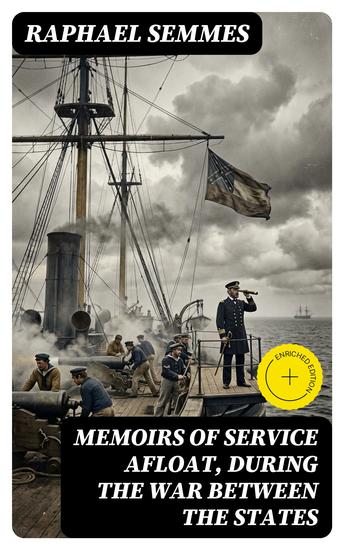
In "Memoirs of Service Afloat, During the War Between the States," Raphael Semmes offers a profound and meticulously detailed account of his experiences as a commander in the Confederate Navy. Through a blend of personal anecdotes and strategic insights, Semmes captures the complexities of naval warfare amidst the tumult of the American Civil War. His prose, marked by its clarity and vigor, reflects not only the challenges faced by the Confederate forces but also the broader political and social upheavals of the era. As a primary historical document, it enriches our understanding of naval tactics, the dynamics of maritime conflicts, and the human cost of war. Semmes, a skilled naval officer and lawyer, was deeply influenced by his Southern upbringing and commitment to the Confederate cause. His experiences aboard the infamous cruiser CSS Alabama, along with his interactions with key military figures, inform his vivid recollections of battles fought on the high seas. This memoir not only serves as a historical record but also reflects Semmes' passionate defense of his actions and beliefs during a pivotal time in American history. For readers interested in Civil War history, maritime strategy, or the personal narratives of military leaders, Semmes' memoir is indispensable. It provides an intimate glimpse into the life of a Confederate naval officer and is a testament to the trials and tribulations faced during one of the most consequential conflicts in American history.

In this enriched edition, we have carefully created added value for your reading experience:
- A succinct Introduction situates the work's timeless appeal and themes.
- The Synopsis outlines the central plot, highlighting key developments without spoiling critical twists.
- A detailed Historical Context immerses you in the era's events and influences that shaped the writing.
- A thorough Analysis dissects symbols, motifs, and character arcs to unearth underlying meanings.
- Reflection questions prompt you to engage personally with the work's messages, connecting them to modern life.
- Hand‐picked Memorable Quotes shine a spotlight on moments of literary brilliance.
- Interactive footnotes clarify unusual references, historical allusions, and archaic phrases for an effortless, more informed read.
Available since: 05/28/2022.
Print length: 814 pages.


Other books that might interest you

  • The Ethics of Technology - Moral Challengers - cover

    The Ethics of Technology - Moral...

    Craig Dames

    • 0
    • 0
    • 0
    In an age where technology permeates nearly every aspect of our lives, understanding the ethical foundations behind its development and use has never been more critical. Tech ethics, at its core, explores the moral principles that guide our decisions regarding the design, implementation, and impact of technology. As digital tools become increasingly powerful and integrated into society, they bring with them profound questions about responsibility, fairness, and the human consequences of innovation. 
    The roots of technology ethics can be traced back to classical moral philosophy. Thinkers like Aristotle, Kant, and Mill laid the groundwork for how we approach right and wrong, justice, and duty. These age-old theories—virtue ethics, deontology, and utilitarianism—are still highly relevant in today's tech-driven world. For instance, when we ask whether a self-driving car should prioritize the life of a passenger over a pedestrian, we are invoking these very moral frameworks to guide the decision-making process. In this way, ethical theory provides a lens through which we can evaluate the choices we make as developers, users, and regulators of technology. 
    Modern concerns surrounding tech ethics often revolve around issues that were unimaginable even a few decades ago. Digital privacy, algorithmic bias, and autonomous systems challenge us to reinterpret traditional moral values in new contexts. This requires a dynamic understanding of ethics—one that can evolve alongside technological change. Unlike in the past, where tools were relatively neutral and required human operation, today's technologies often act with a degree of independence, raising the stakes of their ethical implications. Machines that learn, adapt, and decide are not just tools; they become agents of action whose behavior must be morally accountable.
    Show book
  • The Stillwater Tragedy - cover

    The Stillwater Tragedy

    Thomas Bailey Aldrich

    • 0
    • 0
    • 0
    "The Stillwater Tragedy" by Thomas Bailey Aldrich is a fictional novel likely written in the late 19th century. The story delves into the dark and mysterious atmosphere surrounding a murder in the seemingly idyllic village of Stillwater. As the narrative unfolds, it reveals the tumultuous and often harsh lives of the townsfolk, with a particular focus on several key characters, including the recently deceased wealthy man, Mr. Lemuel Shackford, and his estranged cousin, Richard Shackford. 
    The story opens with a chilling tone just before daybreak in Stillwater, where the body of Mr. Shackford lies dead, the victim of a violent crime. As the sun rises, the village awakens to its daily rhythm while grappling with the shock of the murder. Young Mary Hennessey, whose delayed milk delivery leads her to discover the crime scene, unwittingly becomes the center of attention as gossip spreads throughout the town. 
    Shortly after the discovery, the townspeople gather in anxiety and suspicion, prompting an investigation led by local authorities. Through vivid descriptions and evocative character portrayals, the beginning of the novel establishes an unsettling mood as it explores themes of violence, greed, and the fragile nature of community bonds in the face of tragedy.
    Show book
  • Willy Brandt: A short biography - 5 Minutes: Short on time – long on info! - cover

    Willy Brandt: A short biography...

    5 Minutes, 5 Minute Biographies,...

    • 0
    • 0
    • 0
    Willy Brandt, German chancellor and Nobel Peace Prize laureate: Life and work in a short biography! Everything you need to know, brief and concise. Infotainment, education and entertainment at its best!
    Show book
  • The First King of England - Æthelstan and the Birth of a Kingdom - cover

    The First King of England -...

    David Woodman

    • 0
    • 0
    • 0
    The First King of England is a foundational biography of Æthelstan (d. 939), the early medieval king whose territorial conquests and shrewd statesmanship united the peoples, languages, and cultures that would come to be known as the “kingdom of the English.”Set against the backdrop of warring powers in early medieval Europe, The First King of England sheds new light on Æthelstan’s early life, his spectacular military victories and the innovative way he governed his kingdom, his fostering of the church, the deft political alliances he forged with Europe’s royal houses, and his death and enduring legacy. It begins with the reigns of Alfred the Great and Edward the Elder, Æthelstan’s grandfather and father, describing how they consolidated and expanded the “kingdom of the Anglo-Saxons.” But it was Æthelstan who would declare himself the first king of all England when, in 927, he conquered the viking kingdom at York, required the submission of a Scottish king, and secured an annual tribute from the Welsh kings.The First King of England is the most comprehensive, up-to-date biography of Æthelstan available, bringing a magisterial richness of detail to the life of a consequential British monarch whose strategic and political sophistication was unprecedented for his time.
    Show book
  • The Illusionist - The True Story of the Man Who Fooled Hitler - cover

    The Illusionist - The True Story...

    Robert Hutton

    • 0
    • 0
    • 0
    Cairo, 1942: If you had asked a British officer who Colonel Clarke was, they would have been able to point him out. Always ready with a drink and a story, Clarke was a well-known figure in Cairo social circles and nightlife. If you then asked what he did, you would have less success. Those who knew didn't tell—and almost no one really knew at all. 


    Clarke thought of himself as developing a new kind of weapon. Its components? Rumor, stagecraft, a sense of fun. Its target? The mind of Erwin Rommel, Hitler's greatest general. Throughout history, military commanders have sought to mislead their opponents. Dudley Clarke set out to do it on a scale no one had imagined before. Even afterwards, almost no one understood the magnitude of his achievement. 


    Drawing on recently released documents and hugely expanding on the louche portrait of Clarke as seen in SAS: Rogue Warriors, journalist and historian Robert Hutton reveals the amazing story of Clarke's "A Force," the invention of the SAS and the Commandos, and the masterful hoodwinking of the Desert Fox at the battle of El Alamein. The Illusionist tells for the first time the dazzling tale of how, at a pivotal moment in the war, British eccentricity and imagination combined to thwart the Nazis and save innumerable lives—on both sides.
    Show book
  • RMS Titanic Lifeboat No 6 - The Story of Julia Cavendish who Survived - cover

    RMS Titanic Lifeboat No 6 - The...

    William Cavendish

    • 0
    • 0
    • 0
    Tyrell and Julia booked to travel on the Titanic with their two sons to introduce them to their American grandfather, but the children were too ill to travel. Julia persisted in going without them. The fatal and tragic decision not only led to the unnecessary loss of her husband, it was to haunt her for the next fifty years. Why was she so determined to go? In a letter written to her sons, as her death approached, she claimed the purpose of the visit was 'to gain her wealthy father's support for his son-in-law's ambition to stand as a Member of Parliament.' Yet Tyrell had shown no enthusiasm for making the journey, as Julia had already made the trip alone, the previous year quite safely. From the Carpathia Julia cabled her father, Henry Siegel, to have clothes from his department stores ready for the Titanic's survivors. In 1992 and 2002 her son and grandson learnt from chance encounters with New Yorkers of Julia's father's shocking fall from grace, the grandfather who owned a famous department store with a 'soda fountain meeting place'. Now can be revealed the true reason for her mission.
    Show book