Join us on a literary world trip!
Add this book to bookshelf
Grey
Write a new comment Default profile 50px
Grey
Subscribe to read the full book or read the first pages for free!
All characters reduced
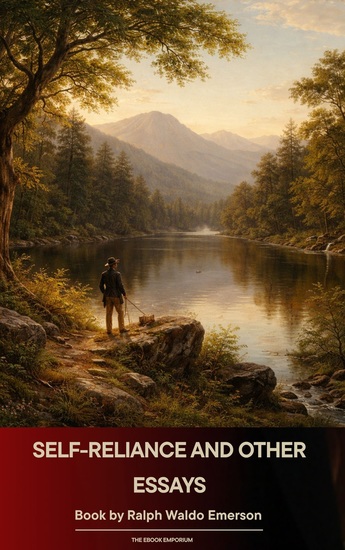
Self-Reliance and Other Essays - cover

Self-Reliance and Other Essays

Ralph Waldo Emerson

Publisher: The Ebook Emporium

  • 0
  • 0
  • 0

Summary

What if trusting yourself was the most powerful act of all?

Self-Reliance and Other Essays presents the essential writings of Ralph Waldo Emerson, one of America's most influential thinkers and the leading voice of Transcendentalism. In these enduring essays, Emerson urges readers to trust their own judgment, resist conformity, and live according to inner truth.

Through works such as Self-Reliance, Nature, The American Scholar, and other landmark essays, Emerson explores individuality, moral courage, creativity, and the relationship between humanity and the natural world. His ideas helped shape American philosophy and continue to inspire readers seeking clarity, purpose, and independence of thought.

Clear, direct, and deeply motivating, these essays speak across generations—challenging readers to think freely and live authentically.

Inside this eBook, you'll explore:

Emerson's most influential essays in one collection

Foundational texts of American Transcendentalism

Timeless insights on individuality, conscience, and self-trust

A cornerstone of American philosophical and literary history

Read by students, leaders, and independent thinkers for nearly two centuries, Emerson's essays remain as relevant today as ever.

Trust your voice. Think boldly. Buy now and experience Self-Reliance and Other Essays.
Available since: 01/28/2026.
Print length: 194 pages.

Other books that might interest you

  • The Pharaoh's Cities - Urban Development and Architecture in Ancient Egypt - cover

    The Pharaoh's Cities - Urban...

    Omar Khalil

    • 0
    • 0
    • 0
    The emergence of ancient Egyptian cities was a direct result of environmental, political, and cultural forces that converged around the Nile River. The geography of Egypt—with its fertile riverbanks and harsh surrounding deserts—encouraged people to settle in concentrated areas where water and arable land were accessible. These early settlements began as small agricultural communities but gradually expanded into organized urban centers. 
    The Nile River played an essential role in this transformation. It provided not only irrigation for crops but also a natural transportation route that linked various parts of the country. The regular flooding of the Nile deposited nutrient-rich silt onto the land, ensuring a reliable agricultural cycle. This dependable environment allowed food surpluses to develop, leading to population growth and the specialization of labor—both critical components for urbanization. 
    As Egypt became unified under strong rulers, cities took on new roles beyond agriculture. Administrative centers emerged to coordinate the collection of taxes, the management of resources, and the oversight of large-scale projects like irrigation canals and temple construction. Memphis, established as the first capital of a unified Egypt, became a powerful political and religious hub. Likewise, Thebes rose in prominence as a center of worship and royal authority, especially during the Middle and New Kingdoms.
    Show book
  • Scimitar into Stanley - One Soldier's Falklands War - cover

    Scimitar into Stanley - One...

    Roger Field

    • 0
    • 0
    • 0
    In May 1982, Captain Roger Field, The Blues and Royals, attached to HQ 5th Infantry Brigade, sailed on the Queen Elizabeth 2 as part of the second wave to liberate the Falkland Islands. Surprised by what he saw at Brigade HQ, he started writing a diary. 
    His journey took him to Fitzroy as the Argentinean aircraft struck the landing ships Sir Galahad and Sir Tristram. A chance meeting led him to fighting alongside the Commanding Officer of 2 Para at the Battle of Wireless Ridge. When the commander of one of the four attached armoured cars of The Blues and Royals was knocked out part way through the battle, Roger took command of that Scimitar. Next day his Scimitar was at the very tip of the spear as 2 Para and The Blues and Royals led the victorious charge into Port Stanley. 
    ‘Revisionist’ in places and always refreshingly candid, this account is unique as it describes the War from the viewpoint of a staff officer, infanteer and armoured vehicle commander. A gripping listen.
    Show book
  • Parables & Wisdom From the Apocrypha - Sirach Odes of Solomon and Other Hidden Classics of Moral Insight - cover

    Parables & Wisdom From the...

    Various Ancient Writers, Tim...

    • 0
    • 0
    • 0
    What if ancient wisdom, once hidden, could illuminate your life today? 
    Parables & Wisdom From the Apocrypha unveils profound moral teachings and poetic devotion from texts outside the traditional Bible.  
    From the sagely reflections of Sirach to the ecstatic praise of the Odes of Solomon, these writings offer deep clarity and spiritual resonance. 
    What you'll hear inside: 
    •	Wisdom of Solomon & Sirach – Practical and philosophical wisdom on virtue, justice, and godly living. 
    •	Odes of Solomon & Psalms of Solomon – Sacred hymns that evoke wonder, purity, and divine love. 
    •	Testaments of the Twelve Patriarchs (Selected) – Patriarchal wisdom offering ethical guidance to generations. 
    Ideal for listeners seeking meaning, purpose, and ethical clarity, this audiobook connects ancient voices with modern hearts. 
    Start listening now and rediscover the sacred echoes of forgotten wisdom.
    Show book
  • How to Recognize Toxic Relationships - cover

    How to Recognize Toxic...

    Olivia Werner

    • 0
    • 0
    • 0
    [How to Recognize Toxic Relationships] delves into the intricate psychological landscape of modern relationships with unflinching precision and rare emotional intelligence. Written in lyrical prose that cuts straight to the heart, this groundbreaking exploration examines the subtle ways toxicity infiltrates our closest connections, offering readers a profound understanding of the quiet violence of emotional manipulation. Through masterfully crafted chapters that weave together psychological insight with intimate narrative, the book illuminates the often-invisible patterns of control, gaslighting, and identity erosion that characterize toxic relationships. With its keen observations of digital-age dynamics and the ways technology can amplify relationship dysfunction, this work speaks directly to contemporary readers while touching on timeless themes of human connection and self-preservation.
    Show book
  • Enviroment in Times of War - Climate and Energy Challenges in the Post-Soviet Region - cover

    Enviroment in Times of War -...

    Aldo Ferrari, Eleonora Tafuro...

    • 0
    • 0
    • 0
    The impact of Russia's war against Ukraine has been devastating both politically and environmentally. On top of the environmental damage directly caused by military operations, the invasion has put an abrupt end to the EU-Russia "green cooperation", which had previously raised many hopes. At the same time, it has also shifted international attention away from climate and environmental concerns, which are particularly acute in the post-Soviet region.
    This Report analyses some of the main climate change and environmental issues in the post-Soviet space, providing an initial assessment of the invasion's impact. The bulk of the latest scholarly and policy production on these matters focuses on Russia – given the country's geopolitical and energy relevance. However, this analysis finds that environmental disasters such as the desertification of the Aral Sea transcend state borders and require a broader approach both from an analytic and policy standpoint.
    Show book
  • The Myth of Enlightenment - An Interview with OM C Parkin - cover

    The Myth of Enlightenment - An...

    OM C. Parkin

    • 0
    • 0
    • 0
    "All desires are a disguise covering up one real desire: the desire to be free."In this conversation, the biggest misconceptions about enlightenment are exposed. OM talks about the distinction between awakening experiences and enlightenment, which are often lumped together. The essential focus is to distinguish whether something is a fleeting, short-lived experience, or an enduring, permanent state.He shares from his wealth of experience about his own awakening process. He names various pitfalls that spiritual seekers repeatedly fall into on their quest."All practice is directed into the future, but Enlightenment is NOW!"Why are there so few truly awakened people? It is true that the awareness of suffering has always been the great driving force behind the search for realisation. It is also true that since the beginning of the great religions there have only been a handful of enlightened people.The so-called New Age movement and its various forms of expression are also scrutinised. It shows that most people are simply interested in feeling good and having intense, mystical, angelic experiences of happiness. The catch is that these experiences are not permanent. And, unsurprisingly, they have nothing to do with true bliss.Light is also shed on the guru. Who actually is the guru? In what form can he manifest himself? And how do I recognise a true teacher from a false one?
    Show book