Begleiten Sie uns auf eine literarische Weltreise!
Buch zum Bücherregal hinzufügen
Grey
Einen neuen Kommentar schreiben Default profile 50px
Grey
Jetzt das ganze Buch im Abo oder die ersten Seiten gratis lesen!
All characters reduced
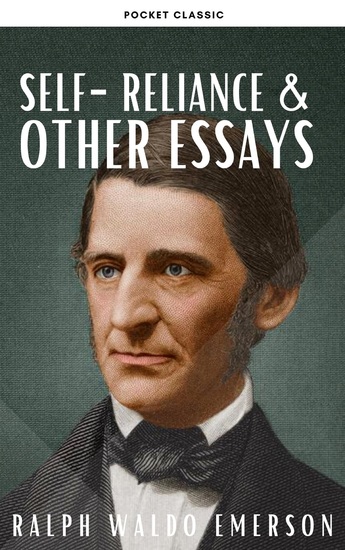
Self-Reliance and Other Essays - cover

Self-Reliance and Other Essays

Ralph Waldo Emerson, Pocket Classic

Verlag: Pocket Classic

  • 0
  • 0
  • 0

Beschreibung

Essayist, poet, and philosopher, Ralph Waldo Emerson (1803–1882) propounded a transcendental idealism emphasizing self-reliance, self-culture, and individual expression. The six essays and one address included in this volume, selected from Essays, First Series (1841) and Essays, Second Series (1844), offer a representative sampling of his views outlining that moral idealism as well as a hint of the later skepticism that colored his thought.
Contents : 
Essays (First Series)
Ralph Waldo Emerson
History
Self-Reliance
Compensation
Spiritual Laws
Love
Friendship
Prudence
Heroism
The Over-Soul
Circles
Intellect
Art
Essays (Second Series)
Ralph Waldo Emerson
The Poet
Experience
Character
Manners
Gifts
Nature
Politics
Nominalist and Realist
New England Reformers
Verfügbar seit: 13.06.2022.
Drucklänge: 250 Seiten.

Weitere Bücher, die Sie mögen werden

  • Does Coffee Cause Cancer? - And 8 More Myths About the Food We Eat - cover

    Does Coffee Cause Cancer? - And...

    Dr. Christopher Labos

    • 0
    • 0
    • 0
    In this fascinating, refreshingly clarifying book about food, food myths, and how sloppy science perpetuates misconceptions about food, a medical doctor on his way to a conference gets drawn into conversations that answer the following questions: Does vitamin C prevent the common cold? And if it works, why does it only work in Canadian soldiers, ultramarathon runners, and skiers? Was red meat really declared a carcinogen by the WHO? Does that mean I should become a vegetarian? And who decides what gets labeled as red meat and white meat? Is salt really not that bad for you and did a group of researchers really want to experiment on prisoners to prove the point? Does coffee cause cancer or heart attacks? Why did a California court say coffee needed a warning label? Is red wine really good for your heart, and what makes the French Paradox such a paradox? Why did the New England Journal of Medicine link eating chocolate with winning a Nobel Prize? Why were eggs once bad for you but now good for you again? Does that mean I don't need to worry about cholesterol? Should I be taking vitamin D?
    Zum Buch
  • Battle of Saipan The: The History and Legacy of the Pacific D-Day - cover

    Battle of Saipan The: The...

    Editors Charles River

    • 0
    • 0
    • 0
    Just over one week after the landings in Normandy, American troops took part in a massive amphibious invasion of Saipan, but intense public interest in operations in Europe meant that this invasion received less media coverage at the time, and it has been the subject of far less interest from historians and writers since. Part of the reason seems to be the different perception of the war in the Pacific. During the war in Europe, Allied troops were, for the most part, welcomed as liberators by the inhabitants of the countries they occupied. Combat was generally conducted according to the accepted rules of war, with troops who surrendered becoming prisoners of war.  
    	In the Pacific Theater, combat was very different. The clash between American and Japanese troops was not just a battle between two modern nations; it was a conflict between two very different cultures and ideologies. Many Japanese soldiers fought according to the tenets of Bushido, the ancient warrior code first employed by the Samurai. This held that death was infinitely preferable to surrender, and that suicide was regarded as a legitimate and even praiseworthy act. The Japanese soldiers who did surrender were regarded with contempt, and enemy soldiers who fell into Japanese hands were treated with extreme cruelty. To American soldiers, the Japanese troops they encountered seemed to fight with fanatical zeal.  
    	As a result, the fighting on Saipan was bloody and intense. Although the battle lasted less than one month, almost 50,000 soldiers died or became casualties on the island, and many Japanese soldiers chose death, either through suicide or assaults on the enemy that had no real prospect of success. Civilians also suffered horrendous casualties on Saipan - more than 20,000 died, with many committing suicide rather than becoming prisoners of the Americans. 
    Zum Buch
  • The Great American Transit Disaster - A Century of Austerity Auto-Centric Planning and White Flight - cover

    The Great American Transit...

    Nicholas Dagen Bloom

    • 0
    • 0
    • 0
    A potent re-examination of America’s history of public disinvestment in mass transit. 
      
    Many a scholar and policy analyst has lamented American dependence on cars and the corresponding lack of federal investment in public transportation throughout the latter decades of the twentieth century. But as Nicholas Dagen Bloom shows in The Great American Transit Disaster, our transit networks are so bad for a very simple reason: we wanted it this way. 
      
    Focusing on Baltimore, Atlanta, Chicago, Detroit, Boston, and San Francisco, Bloom provides overwhelming evidence that transit disinvestment was a choice rather than destiny. He pinpoints three major factors that led to the decline of public transit in the United States: municipal austerity policies that denied most transit agencies the funding to sustain high-quality service; the encouragement of auto-centric planning; and white flight from dense city centers to far-flung suburbs. As Bloom makes clear, these local public policy decisions were not the product of a nefarious auto industry or any other grand conspiracy—all were widely supported by voters, who effectively shut out options for transit-friendly futures. With this book, Bloom seeks not only to dispel our accepted transit myths but hopefully to lay new tracks for today’s conversations about public transportation funding.
    Zum Buch
  • European Imperialism in China: The History and Legacy of the European Powers’ Attempts to Establish Chinese Trade Routes - cover

    European Imperialism in China:...

    Editors Charles River

    • 0
    • 0
    • 0
    During the 15th century, China had become economically and technologically advanced compared to civilizations in Europe at the time, and its fleet, which had reached a total of 3,500 ships, was unmatched by any other world power. Nevertheless, after conducting several trade expeditions with the massive fleet, the Chinese ships were either burned in the docks or left to rot. With that, China began to revert to the xenophobic policies of its past and reduce its presence in other lands. By 1525, the largest naval fleet in the world had essentially been destroyed or dismantled by China itself.  
    While China was in the process of isolating itself from the rest of the world, the European explorers were beginning to discover new lands, such as North America and South America. Among the countries doing the most exploring during this time were the Portuguese. The Portuguese had reached India in 1498, and by 1509 they had established part of their empire in India. This allowed the Portuguese to have a base of operations to further expand east into Asia. In 1511, the Portuguese captured the large spice trading center of Malacca in Malaysia, and like their base in India, Malacca allowed the Portuguese to have a foothold, thereby providing access to China and Southeast Asia. 
    The location of Macau was beneficial and strategically chosen by the Portuguese, as it was in close communication with Guangzhou and connected via a river system. In contrast to their earlier dealings with the Chinese, the Portuguese attempted to appear more humble and comply with the wishes of the Chinese rather than with force. As it turned out, the policy, in conjunction with increased European activities in the region, would help the Portuguese Empire hold on to Macau even as its fortunes dwindled everywhere else across the world.
    Zum Buch
  • Without Exception - Reclaiming Abortion Personhood and Freedom - cover

    Without Exception - Reclaiming...

    Pam Houston

    • 0
    • 0
    • 0
    Without Exception is an unflinching call for freedom by way of abortion rights. 


    "A story told with honesty. I thank Pam Houston for this timely and timeless book" —CAMILLE T. DUNGY, Soil: The Story of a Black Mother's Garden 


    Written with equal parts candor and lyricism, Pam Houston illuminates the interconnected histories of abortion in the United States and in her own life during the decades when Roe v. Wade was the law of the land. Houston guides us through the shifting landscapes of politics, the law, and self-determination in a country where access to medical care and the power to determine your own destiny are increasingly—and once again—dependent on geography and circumstance.
    Zum Buch
  • The Fall of Communism - Understanding the Collapse of the Soviet Union and Its Impact - cover

    The Fall of Communism -...

    Arlo Holders

    • 0
    • 0
    • 0
    The origins of communism can be traced back to the mid-19th century, largely shaped by the theories of Karl Marx and Friedrich Engels. Marx's writings, particularly The Communist Manifesto (1848), presented a vision for a classless society where the working class, or proletariat, would overthrow the capitalist bourgeoisie and establish a dictatorship of the proletariat. Marx believed this revolution would lead to the eventual abolition of private property, creating a system where resources and wealth were shared equally among all people. Engels, Marx’s collaborator, helped to spread these ideas, laying the theoretical foundation for communism as a political ideology. 
    In the early 20th century, the ideas of Marxism found fertile ground in Russia, where economic disparity and social unrest were widespread. The Russian Empire, under Tsar Nicholas II, faced increasing pressure from industrialization, a growing working class, and a largely disenfranchised peasantry. The Russian Revolution of 1917, led by the Bolshevik Party under Vladimir Lenin, marked the beginning of communism’s practical implementation. The Bolsheviks sought to establish a socialist state where the working class would control the means of production and dismantle the old Tsarist monarchy. 
    Following the revolution, the Soviet Union was formed in 1922, uniting the Russian Federation and several other Soviet republics under a single communist government. The new government, however, faced significant challenges, including civil war, foreign intervention, and the task of restructuring a country that had been predominantly agrarian into a socialist industrialized state. Lenin’s death in 1924 led to the rise of Joseph Stalin, who consolidated power through brutal purges and policies such as forced collectivization and rapid industrialization.
    Zum Buch