Join us on a literary world trip!
Add this book to bookshelf
Grey
Write a new comment Default profile 50px
Grey
Subscribe to read the full book or read the first pages for free!
All characters reduced
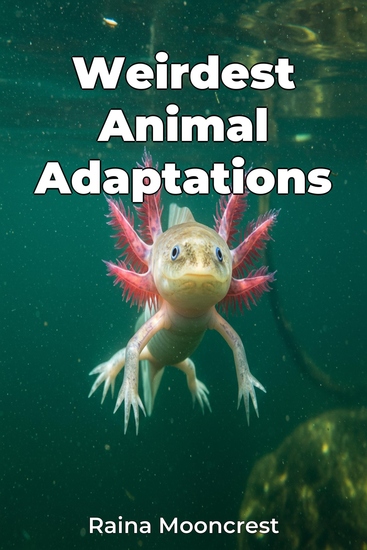
Weirdest Animal Adaptations - cover

Weirdest Animal Adaptations

Raina Mooncrest

Translator A AI

Publisher: Publifye

  • 0
  • 0
  • 0

Summary

"Weirdest Animal Adaptations" explores the extraordinary ways animals have evolved to survive, focusing on extreme environments and deceptive strategies. It reveals how creatures have adapted to conditions that would be lethal to humans, such as environments lacking oxygen or with extreme temperatures. For example, the axolotl's ability to regenerate lost limbs and the tardigrade's tolerance of extreme conditions highlight the remarkable limits of life. The book also delves into camouflage and mimicry, showcasing how animals evade predators or deceive prey through sophisticated adaptations. The leaf-tailed gecko's perfect resemblance to foliage and the viceroy butterfly's mimicry of the monarch butterfly demonstrate the evolutionary arms race between predator and prey. By examining these unusual adaptations, the book emphasizes evolution as an ongoing force shaping life on Earth. Structured in three parts, the book introduces adaptation and evolution, explores survival in extreme environments, and examines camouflage and mimicry. It integrates genetics, ecology, and evolutionary biology, using peer-reviewed data and engaging stories to present a comprehensive and accessible overview. This approach aims to deepen the reader's appreciation for natural selection and the resilience of living organisms, with implications for biodiversity conservation.
Available since: 03/31/2025.
Print length: 67 pages.

Other books that might interest you

  • Wings of Beauty - cover

    Wings of Beauty

    Nicole Howell

    • 0
    • 0
    • 0
    The story is about a little girl and her caterpillar friend. As the butterfly grows and discovers its beauty, so does the little girl. This is a positive story about the beauty in nature, self-love, and a lesson about the life cycle of a caterpillar to a butterfly.•	A gentle storytime to teach a child about nature and metamorphosis•	A heartwarming story to teach a child that they are beautiful inside and out. •	A story about friendship Children's audiobook ages 3-8.©2020 Nicole Howell (P)2021 Howell Digital Publishing
    Show book
  • Hubris - The Rise Fall and Future of Humanity - cover

    Hubris - The Rise Fall and...

    Thomas Trappe, Johannes Krause

    • 0
    • 0
    • 0
    Humans are the most intelligent beings this planet has ever produced. But how is it that we find ourselves faced with an existential crisis that threatens to overwhelm us? 


    Leading archaeogeneticist Johannes Krause and journalist Thomas Trappe investigate what DNA can tell us about how we got where we are and what our future might be. They show how the first humans were defeated again and again and suffered fatal setbacks, and how Homo sapiens succeeded in conquering continents, overcoming natural borders, and bringing other species under its control. But the genetic blueprint that enabled us to get to the place where we are today had one flaw: it didn't factor in planetary boundaries. Now that we are approaching those boundaries for the first time after millions of years of evolution, an urgent question arises: can we learn to live within the planetary limits, or are we doomed by our DNA to continue to expand, consume, and absorb the resources around us to the point of exhaustion, consigning ourselves and other species to extinction? 


    While the looming climate crisis does not augur well for humanity's capacity to adapt to the new situation in which it finds itself, we are not at the mercy of our DNA—or at least we don't have to be. But can we harness the lessons of the past to survive the present?
    Show book
  • Chemical Phenomena in Life - cover

    Chemical Phenomena in Life

    Frederick Czapek

    • 0
    • 0
    • 0
    Published in 1911 as part of the "Harper's Library of Living Thought," this volume presents an introduction to the chemistry of cells in the context of plant physiology and gives an interesting overview of the field of biochemistry and related sciences at the time. The author, Frederick Czapek, was a Czech botanist and professor of Plant Physiology at the University of Prague. He is perhaps best known for his two-volume work on Plant Physiology, "Biochemie der Pflanzen" and for Czapek solution agar or Czapek-Dox medium, a culture medium for cultivation of fungus species such as Aspergillus and Penicillium molds. ( Summary by J. M. Smallheer )
    Show book
  • So What Does It All Mean? - The Secrets of Life: From Big Bang to Trump - cover

    So What Does It All Mean? - The...

    Ss O'Connor

    • 0
    • 0
    • 0
    Why are humans neither 'good' nor 'bad'? How can so much chaos and confusion in the world actually lead to order? Why are we so often wrong when we're asked if the world's getting better? In this, the last book in The Secrets of Life quartet, SS O'Connor pulls together the threads of genetic and cultural evolution, and then adds to these the conclusions of evolutionary game theory. As he does this, he ends with an intertwined narrative that explains why so many of the phenomena of our existence may not be the mysteries we think they are, but could in fact have the same underlying logic to them. By examining the great currents at work in our collective story, the role that competition and cooperation have always played in the development of the world, and why each behavioural strategy is rational in what it's attempting to achieve, the book shows that the same cycles of collaboration and destruction have been present since time began. But while the success of these strategies may ebb and flow, it is their interaction that results in the balance and order we see around us. This current is also the consistent vector of our human history. Although we may have animal origins, and are also driven by the same need to respond to the profound Laws of Thermodynamics, we have developed our culture to the point where we can now choose to overrule so many of the instructions of our genes. Why do we do this? What are the problems that arise from our free will? How have we come to realise that self-interest is quite different from selfishness? Why have we become obsessed with the need for fairness and trust in our societies? And how have these forces resulted in us making the world a better place? Few of us believe this can be the case. But as the evidence of our progress becomes ever clearer, the series concludes by showing us why we are often wrong in our view of each other, and why we're so frequently mistaken in our pessimism about the future.
    Show book
  • Cloud Computing's Next Horizon - Redefining Business Operations: A Comprehensive Guide to Cloud Solutions - cover

    Cloud Computing's Next Horizon -...

    John Anderson

    • 0
    • 0
    • 0
    The book "Cloud Computing's Next Horizon: Redefining Business Operations: A Comprehensive Guide to Cloud Solutions" delves deeply into the revolutionary potential of cloud computing and how important it is to contemporary business. Business executives, IT specialists, and decision-makers who want to understand cloud technology and use it to their advantage will find this extensive reference helpful. 
    This book, divided into six in-depth parts, starts by outlining the development of cloud computing, emphasizing significant turning points, and examining its relevance in the current business environment. The strategic value of cloud adoption will become clearer to readers, who will also learn how to tailor cloud solutions to their unique company requirements and comprehend the crucial elements of cloud security and compliance. 
    The book shows how cloud solutions may spur innovation and corporate success while addressing more pragmatic issues like controlling cloud expenses and performance optimization. It examines cutting-edge technology from a forward-looking viewpoint and offers doable tactics for future-proofing your company in a rapidly changing digital landscape. 
    "Cloud Computing's Next Horizon" gives you the information and resources to stay ahead of the curve, whether you are just starting with cloud computing or want to improve your current approach. With the help of this indispensable guide, get ready to transform your company's operations and realize the full promise of cloud computing.
    Show book
  • Ultimate Google Professional Cloud Architect Certification Guide - Build Real-World Enterprise-Ready Solutions on Google Cloud Platform and Ace the Google Professional Cloud Architect Exam - cover

    Ultimate Google Professional...

    Shounak Acharya

    • 0
    • 0
    • 0
    Architect Google Cloud Solutions That Go Beyond Certification
    Key Features? Master core GCP services, including Compute, Storage, and Networking.? Apply GCP design patterns to real-world enterprise architecture.? Prepare with exam-focused guidance, diagrams, and case scenarios.
    Book Description
    In today’s cloud-first world, the Google Cloud Professional Cloud Architect certification stands as one of the most respected credentials in enterprise IT. Ultimate Google Professional Cloud Architect Certification Guide is your companion to achieving that goal.
    This book goes far beyond exam preparation. It is a hands-on, real-world companion that walks you through every architectural decision-making point you will face on Google Cloud Platform (GCP). You will begin with the building blocks, such as Compute Engine, Autoscaling, Load Balancing, and Storage. From there, you will navigate through advanced networking, managed services like App Engine, and orchestration, using Google Kubernetes Engine (GKE).
    Table of Contents
    1. GCP Compute Engine
    2. Autoscaling and Load Balancing
    3. GCP Storage Infrastructure (Block, File, and Object)
    4. GCP Networking
    5. Introduction to Managed Services on GCP and App Engine
    6. Google Kubernetes Engine
    7. Serverless Google Run Functions and Google Cloud Run
    8. Introduction to Asynchronous Communication in GCP
    9. Databases in GCP Overview
    10. Relational, NoSQL, and Caching Databases
    11. Authentication with Google Cloud IAM
    12. Exploring IAM, Project Organization, and Encryption
    13. Exploring Data Warehousing and Data Lifecycle on GCP
    14. Google Cloud Operations Suite
    15. Agile, DevOps, SRE, SDLC, and Other Important GCP Topics       
    
    Index
    Show book