Junte-se a nós em uma viagem ao mundo dos livros!
Adicionar este livro à prateleira
Grey
Deixe um novo comentário Default profile 50px
Grey
Assine para ler o livro completo ou leia as primeiras páginas de graça!
All characters reduced
Labor Day Chronicles - Women Work and the Fight for Equality - cover
LER

Labor Day Chronicles - Women Work and the Fight for Equality

Rafat Allam

Editora: Al-Mashreq eBookstore

  • 0
  • 0
  • 0

Sinopse

"Labor Day: A Celebration of Work, Progress, and Equality" dives into the rich history, powerful stories, and evolving significance of a holiday that honors the backbone of society—the workers. From the courageous strikes that shaped labor rights to the unique ways communities celebrate today, this book takes you on a journey across time and borders, revealing the struggles and triumphs of workers from all walks of life. Discover personal reflections, inspiring tales of advocacy, and a call to action that challenges us to rethink what Labor Day truly stands for in our modern world. Perfect for anyone curious about the past, present, and future of the labor movement.
Disponível desde: 12/09/2024.
Comprimento de impressão: 280 páginas.
Outros livros que poderiam interessá-lo

  • House of Bush House of Saud - The Birth of Modern Terrorism - cover

    House of Bush House of Saud -...

    Craig Unger

    • 0
    • 0
    • 0
    In 2001, the 9/11 attacks awoke the world to the military-style threat of Islamism. Due to the White House, the nationality of fifteen Saudis among the nineteen suicide bombers remained cast in shadows. In this exceptional tour-de-force, Craig Unger meticulously pieces together the US role in the birth of modern terrorism by relying on research and interviews with those who would prefer to deny the truth.The acclaimed account of the link between modern terrorism and Saudi and corporate greed whose first UK publisher cancelled for fear of libel, and which several online retailers dared not stock.'Excellent.'—Sunday Times'A notably intelligent piece of investigative reporting which lights the blue touch-paper.'—Observer'A forensic examination.'—Daily Telegraph'Very powerful.'—Guardian, book of the week'Hard-hitting.'—Independent on Sunday'An explosive book.'—Scotland on Sunday'None can match this.'—Irish Times'Well-sourced... cool, calm and collected.'—Times Higher Education Supplement'As chilling as it is gripping.'—Belfast Telegraph'Craig Unger has done America and the world a huge favor.'—Michael Moore, Director of Fahrenheit 9/11, the movie inspired by House of Bush House of Saud'Unger's meticulously researched book raises troubling questions about the ties between the Bush family and the Saudi royal family, especially in the aftermath of 9/11. It's a provocative read that challenges conventional narratives.'—The Washington Post'Craig Unger's House of Bush, House of Saud is a compelling and disturbing account of the intertwining interests of two powerful families. While some may dismiss it as conspiracy theory, the depth of research demands attention.'—The Washington Post'Unger's book is a gripping and unsettling exploration of the Bush-Saudi nexus. It's a damning indictment of how personal and financial interests can overshadow national security.'—The Guardian'Craig Unger's House of Bush, House of Saud is a meticulously documented account of the symbiotic relationship between two of the world's most powerful families. It's a chilling read that raises more questions than it answers.'—The Independent'Unger's book is a riveting and deeply researched exposé that sheds light on the shadowy connections between the Bush family and the Saudi elite. It's a sobering reminder of the complexities of global power dynamics.'—The Sydney Morning Herald'Craig Unger's House of Bush, House of Saud is a provocative and eye-opening investigation into the ties that bind American politics and Saudi wealth. It's a must-read for anyone interested in the hidden forces behind global events.'—Le Monde'Unger's book is a meticulously researched and deeply unsettling account of the Bush-Saudi relationship. It's a powerful critique of the intersection of politics, oil, and terrorism.'—Der Spiegel'Craig Unger's House of Bush, House of Saud is a provocative and deeply researched account of the intricate ties between the Bush family and the Saudi royal family. While some of its claims are controversial, the book provides valuable insights into the intersection of oil, politics, and terrorism.'—Foreign Affairs'Unger's book is a bold and controversial examination of the ties between the Bush family and the Saudi royal family. While some may question its conclusions, the depth of research and the questions it raises make it a valuable contribution to the field.'—International Affairs
    Ver livro
  • How We Got Our Antiracist Constitution - Canonizing Brown v Board of Education in Courts and Minds - cover

    How We Got Our Antiracist...

    Jesse Merriam

    • 0
    • 0
    • 0
    Over the past decade, several American cities have been rocked by race riots. With each passing year, a new racial agenda emerges—from police defunding to education reform to reparations—inciting more and more division and radicalization along racial lines. What started all of this? The roots of this pathology run much deeper than the recent symptoms suggest. The civil rights revolution unleashed an assault on the US Constitution, and the sacralization of that revolution, marked by the canonization of Brown v. Board of Education (1954), has transformed our constitutional order. A system once rooted in local self-governance and natural rights now operates along new moral axes, entirely foreign to the American way of life. The choice is increasingly obvious: Either the traditional American order or the new civil rights regime will prevail.
    Ver livro
  • Social Democracy 101: Jack London at Yale - The Roots of Socialism in the United States - cover

    Social Democracy 101: Jack...

    Shane Irvine, Alexander Irvine,...

    • 0
    • 0
    • 0
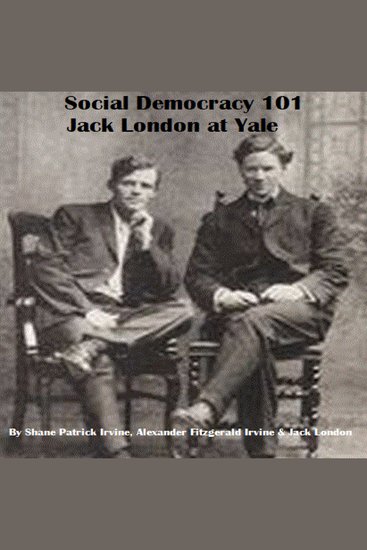
    In 1906, my great-grandfather Dr. Alexander Fitzgerald Irvine was the secretary of the Socialist Party of Connecticut and a fellow at Yale University where he taught studies in divinity. He sought to shed some light on the subject of social protection. He had first-hand experience as a reverend in the New Haven religious community. He became very aware of parishioner stealing and other forms of skulduggery used to acquire the most prosperous benefactors. He despised the practice of selectively seeking profitable parishioners while ignoring the plight of the downtrodden. He felt that this practice was in conflict with Jesus’ teachings. He thereafter invited Jack London to speak at Yale on the subject of socialism. This book is derivative of my great-grandfather's book, Jack London at Yale. 
    My great-grandfather further believed that, due to this hypocrisy involving the church’s duty to the poor, the government needed to take an active role in offering a hand up to those in need. He strongly advocated that it should not be assumed that the church and pity be the sole final resources for those in need, and the government needed to take an active role in providing social networks. 
    Health, education, and welfare are major barriers to entrepreneurial opportunity. Without forms of social democracy such as universal healthcare and education, the potential for mass enterprise is squandered. People are precluded by these basic economic barriers from reaching their potential. It is these issues that have continued to plague workers worldwide, and people of all persuasions and walks of life are affected by this ongoing class struggle. We need individualism and a free market society, and we also need it to be tamed with a fairness that, along with prosperity, provides protections for the vulnerable and opportunity for all. Health, education, and welfare are just as important as a strong military. All of them are forms of social democracy. 
    Ver livro
  • Libertarianism and Its Practices - Exploring Libertarian Policies and Their Real-World Application (2 in 1) - cover

    Libertarianism and Its Practices...

    Arlo Holders

    • 0
    • 0
    • 0
    This book contains the following two topics: 
      - The Libertarian Ideal: Libertarianism is a political philosophy that places individual liberty at its core, emphasizing the importance of personal freedom, limited government, and voluntary cooperation. Rooted in centuries of intellectual thought, libertarianism advocates for a society in which individuals are free to pursue their own goals and aspirations as long as they respect the rights of others. This emphasis on freedom and responsibility makes libertarianism distinct from other political ideologies, which often prioritize collective goals or centralized authority. 
      - Libertarian Policies: Rooted in the principles of classical liberalism, libertarianism advocates for a limited government whose primary role is to protect individual rights and maintain peace. It emphasizes personal responsibility, free markets, and the belief that voluntary exchange is the foundation of a prosperous society. At its core, libertarianism seeks to protect the rights of individuals to live as they see fit, free from the coercive power of the state. The history of libertarian thought can be traced back to influential philosophers such as John Locke, who argued for the natural rights of individuals to life, liberty, and property. His ideas formed the intellectual groundwork for the concept of limited government, which would later be expanded by thinkers like Adam Smith, who promoted the idea of free markets. The Enlightenment era, with its focus on reason, individualism, and skepticism of authority, provided a fertile ground for the development of libertarian ideas. In the 20th century, libertarianism gained further prominence through the works of economists such as Friedrich Hayek and Milton Friedman, who critiqued the expansion of government power and emphasized the importance of individual liberty in economic affairs.
    Ver livro
  • American Presidents in Diplomacy and War - Statecraft Foreign Policy and Leadership - cover

    American Presidents in Diplomacy...

    Thomas R. Parker

    • 0
    • 0
    • 0
    American Presidents in Diplomacy and War chronicles the major foreign policy crises faced by twelve American presidents in order to uncover the reoccurring patterns of successful and less successful uses of diplomatic, economic, and military power. In this book, Thomas R. Parker reveals how America's most successful leaders manage events instead of allowing events to control them. 


    Parker explores how the U.S. presidency, from the days of the early Republic to the present, shaped the world. Ranging from George Washington to George H. W. Bush, Parker shows how successful statecraft requires the understanding of complex situations, the prudent evaluation of various courses of action, the ability to adapt and to anticipate, and personal determination. Parker compares each of these leaders to their contemporaries—reasonable political leaders who nonetheless made serious mistakes, such as Thomas Jefferson and Barack Obama—to examine the dangers of being unable to strike the right balance of aggressiveness and caution and to examine the costs of inexperience and ambivalence toward military power. The book concludes by discussing the increasingly complex international situation of today, particularly the manifold challenges posed by China and Russia to U.S. foreign policy, and the continued necessity of effective statecraft.
    Ver livro
  • The Man Behind The Fascist Doctrine - cover

    The Man Behind The Fascist Doctrine

    Benito Mussolini

    • 0
    • 0
    • 0
    “It’s better to live one day as a lion than 100 years as a sheep.” 
     
    "I am the most terrible animal that's ever existed." 
     
    "Democracy is beautiful in theory; in practice, it is a fallacy. You in America will see that someday." 
     
    "It's good to trust others but, not to do so is much better." 
     
    “I feel, when we have no friends upon whom to lean, or to look for moral guidance." (Mussolini) 
     
    The Doctrine of Fascism" is an essay attributed to Benito Mussolini. In truth, the first part of the essay, entitled "Idee Fondamentali", was written by the Italian philosopher Giovanni Gentile, while only the second part is the work of Mussolini himself. 
     
    Benito Amilcare Andrea Mussolini, born on July 29, 1883, who went by the nickname “Il Duce” (“the Leader”), was a deeply unbalanced tyrannical Italian dictator who created the dreaded Fascist Party in 1919. Eventually, he held all power in Italy as the country’s prime minister from 1922 to 1943. An ardent socialist as a youth, Mussolini followed in his father's political footsteps but was expelled by the party for his overt support of World War I. As an evil dictator during World War II (even murdering his own son by lethal injection) he greatly overextended his forces and was eventually killed by his own people in Mezzegra, Italy. Here, for the first time, are the words of the great dictator himself in his twisted manifesto on the political movement he started and is still so feared to this very day. A rare audiobook adventure in politics, history, and outrage!
    Ver livro