Join us on a literary world trip!
Add this book to bookshelf
Grey
Write a new comment Default profile 50px
Grey
Subscribe to read the full book or read the first pages for free!
All characters reduced
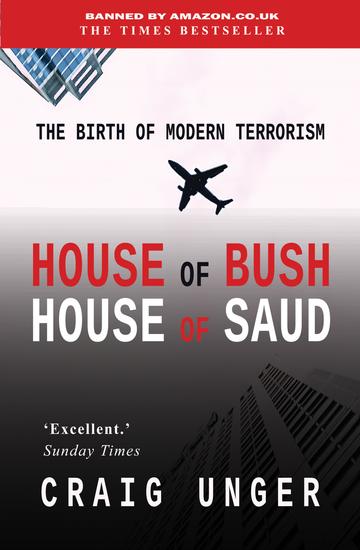
House of Bush House of Saud - The Birth of Modern Terrorism - cover

House of Bush House of Saud - The Birth of Modern Terrorism

Craig Unger

Publisher: Gibson Square

  • 0
  • 0
  • 0

Summary

In 2001, the 9/11 attacks awoke the world to the military-style threat of Islamism. Due to the White House, the nationality of fifteen Saudis among the nineteen suicide bombers remained cast in shadows. In this exceptional tour-de-force, Craig Unger meticulously pieces together the US role in the birth of modern terrorism by relying on research and interviews with those who would prefer to deny the truth.The acclaimed account of the link between modern terrorism and Saudi and corporate greed whose first UK publisher cancelled for fear of libel, and which several online retailers dared not stock.'Excellent.'—Sunday Times'A notably intelligent piece of investigative reporting which lights the blue touch-paper.'—Observer'A forensic examination.'—Daily Telegraph'Very powerful.'—Guardian, book of the week'Hard-hitting.'—Independent on Sunday'An explosive book.'—Scotland on Sunday'None can match this.'—Irish Times'Well-sourced... cool, calm and collected.'—Times Higher Education Supplement'As chilling as it is gripping.'—Belfast Telegraph'Craig Unger has done America and the world a huge favor.'—Michael Moore, Director of Fahrenheit 9/11, the movie inspired by House of Bush House of Saud'Unger's meticulously researched book raises troubling questions about the ties between the Bush family and the Saudi royal family, especially in the aftermath of 9/11. It's a provocative read that challenges conventional narratives.'—The Washington Post'Craig Unger's House of Bush, House of Saud is a compelling and disturbing account of the intertwining interests of two powerful families. While some may dismiss it as conspiracy theory, the depth of research demands attention.'—The Washington Post'Unger's book is a gripping and unsettling exploration of the Bush-Saudi nexus. It's a damning indictment of how personal and financial interests can overshadow national security.'—The Guardian'Craig Unger's House of Bush, House of Saud is a meticulously documented account of the symbiotic relationship between two of the world's most powerful families. It's a chilling read that raises more questions than it answers.'—The Independent'Unger's book is a riveting and deeply researched exposé that sheds light on the shadowy connections between the Bush family and the Saudi elite. It's a sobering reminder of the complexities of global power dynamics.'—The Sydney Morning Herald'Craig Unger's House of Bush, House of Saud is a provocative and eye-opening investigation into the ties that bind American politics and Saudi wealth. It's a must-read for anyone interested in the hidden forces behind global events.'—Le Monde'Unger's book is a meticulously researched and deeply unsettling account of the Bush-Saudi relationship. It's a powerful critique of the intersection of politics, oil, and terrorism.'—Der Spiegel'Craig Unger's House of Bush, House of Saud is a provocative and deeply researched account of the intricate ties between the Bush family and the Saudi royal family. While some of its claims are controversial, the book provides valuable insights into the intersection of oil, politics, and terrorism.'—Foreign Affairs'Unger's book is a bold and controversial examination of the ties between the Bush family and the Saudi royal family. While some may question its conclusions, the depth of research and the questions it raises make it a valuable contribution to the field.'—International Affairs
Available since: 02/14/2025.
Print length: 356 pages.

Other books that might interest you

  • Proposed Roads to Freedom - cover

    Proposed Roads to Freedom

    Bertrand Russell

    • 0
    • 0
    • 0
    In this work, Russell presents his views on the problems of modern society and offers his proposals for a better future. He critiques both capitalism and socialism as inadequate solutions, and instead advocates for a system based on guild socialism, where workers control the means of production and are organized into functional groups. Russell argues that the ultimate goal of society should be the development of the individual, and proposes a society that is organized around individual freedom and fulfillment rather than material wealth. He advocates for the abolition of the wage system and the establishment of a system of economic cooperation and communal ownership. He also discusses the role of education in a free society, arguing that it should be aimed at cultivating creativity, critical thinking, and individuality. Read in English, unabridged.
    Show book
  • Where Tyranny Begins - The Justice Department the FBI and the War on Democracy - cover

    Where Tyranny Begins - The...

    David Rohde

    • 0
    • 0
    • 0
    Over the course of his presidency, Donald Trump intimidated, silenced, and bent to his will Justice Department and FBI officials. He sowed public doubt in both agencies so successfully that when he tried to overturn the results of the 2020 election, he paid little political cost and, despite an unprecedented array of criminal indictments, easily won the Republican nomination for the 2024 presidential election. 


    In Where Tyranny Begins, Pulitzer Prize–winning journalist David Rohde investigates the strategies Trump systematically used to turn the country's two most powerful law-enforcement agencies into his personal political weapons. Rohde also reveals how, during the Biden years, Justice Department non-partisan 1970s norms that Attorney General Merrick Garland reinforced inadvertently helped Trump, and could fail to deliver a trial and legal accountability by Election Day 2024. 


    Where Tyranny Begins exposes how ill-suited both the DOJ and FBI are to serve as checks on abuses of presidential power. A round of historic reforms equivalent to the post-Watergate reforms that stabilized American democracy in the 1970s are immediately needed. A five-word warning coined by the English philosopher John Locke in 1689 captures the stakes in 2024: "Where-ever law ends, tyranny begins."
    Show book
  • The Inevitable Revolution - cover

    The Inevitable Revolution

    Leo Tolstoy

    • 0
    • 0
    • 0
    The Inevitable Revolution is an essay about abolishing the law of violence and replacing it with the law of love. It is a text on civil disobedience, pacifism, and anarchism, and it is Tolstoy's last non-fiction work detailing his final opinions on political, economic, and religious issues.
    
    In it, he criticizes prisons, parliaments, wars, conscription, capitalism, theft, revolutionary violence, and taxes, and praises Christianity's message of love as the solution to these problems; although he also recognizes the law of love in other religions. Tolstoy asked people not to directly commit any violence, not to take part in violence, and not to approve of violence.
    Show book
  • The Tech Coup - How to Save Democracy from Silicon Valley - cover

    The Tech Coup - How to Save...

    Marietje Schaake

    • 0
    • 0
    • 0
    Under the cover of "innovation," technology companies have successfully resisted regulation and have even begun to seize power from governments themselves. Facial recognition firms track citizens for police surveillance. Cryptocurrency has wiped out the savings of millions and threatens the stability of the global financial system. Spyware companies sell intelligence tools to anyone who can afford them. This new reality—where unregulated technology has become a forceful instrument for autocrats worldwide—is terrible news for democracies and citizens. 


    In The Tech Coup, Marietje Schaake explains how technology companies crept into nearly every corner of our lives and our governments. She takes us beyond the headlines to high-stakes meetings with human rights defenders, business leaders, computer scientists, and politicians to show how technologies have gone from being heralded as utopian to undermining the pillars of our democracies. To reverse this existential power imbalance, Schaake outlines solutions to empower elected officials and citizens alike. Democratic leaders can—and must—resist the influence of corporate lobbying and reinvent themselves as dynamic, flexible guardians of our digital world. Schaake offers a frightening look at our modern tech-obsessed world—and a clear-eyed view of how democracies can build a better future before it is too late.
    Show book
  • Illegitimate Authority - Facing the Challenges of Our Time - cover

    Illegitimate Authority - Facing...

    Noam Chomsky

    • 0
    • 0
    • 0
    A wide-ranging and incisive collection of interviews with Noam Chomsky, addressing the urgent questions of this tumultuous moment. 


    In these informative interviews, conducted for Truthout by C. J. Polychroniou, Noam Chomsky addresses the rapid deterioration of democracy in the United States and rising tensions globally. He examines the crumbling social fabric and fractures of the Biden era, including the halting steps toward a Green New Deal; the illegitimate authority of the Supreme Court, in particular its decision to overturn Roe vs. Wade; and the ongoing fallout from COVID-19. Chomsky also untangles the roots of the War in Ukraine, the diplomatic tensions among the United States, China, and Russia, and considers the need for climate action on an international scale. 


    Throughout, Chomsky "remains . . . a beacon of hope in the darkest of times" (Sarah Jaffe).
    Show book
  • Competing for the Global South - Asia and the Quest for Leadership in a Multipolar World - cover

    Competing for the Global South -...

    Filippo Fasulo, Nicola Missaglia

    • 0
    • 0
    • 0
    As the world transitions into a multipolar era, an increasing number of nations are challenging Western dominance and reshaping the global order. Central to this shift is the rise of the Global South, led by Asia's powerhouses – India and China. These two nations, each offering distinct governance, development, and security models, are in a growing competition for influence. Countries across the Global South are advocating for a more equitable international system, demanding debt restructuring, climate action, and solutions to emerging security challenges. What strategies will India and China propose to address these demands? And how will their rivalry shape the future of the Global South as a unified force on the world stage?
    Show book