Join us on a literary world trip!
Add this book to bookshelf
Grey
Write a new comment Default profile 50px
Grey
Subscribe to read the full book or read the first pages for free!
All characters reduced
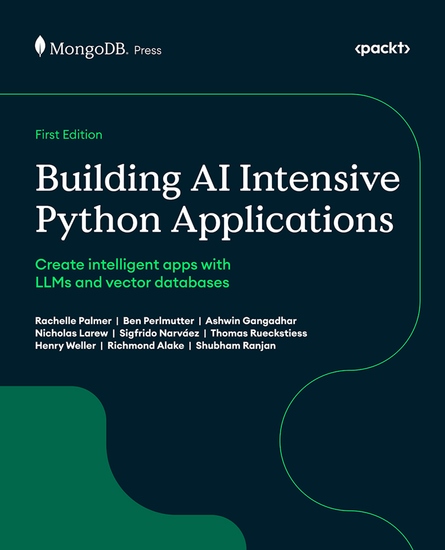
Building AI Intensive Python Applications - Create intelligent apps with LLMs and vector databases - cover

Building AI Intensive Python Applications - Create intelligent apps with LLMs and vector databases

Rachelle Palmer, Shubham Ranjan, Ben Perlmutter, Ashwin Gangadhar, Nicholas Larew, Sigfrido Narváez, Thomas Rueckstiess, Henry Weller, Richmond Alake

Publisher: Packt Publishing

  • 0
  • 0
  • 0

Summary

The era of generative AI is upon us, and this book serves as a roadmap to harness its full potential. With its help, you’ll learn the core components of the AI stack: large language models (LLMs), vector databases, and Python frameworks, and see how these technologies work together to create intelligent applications.The chapters will help you discover best practices for data preparation, model selection, and fine-tuning, and teach you advanced techniques such as retrieval-augmented generation (RAG) to overcome common challenges, such as hallucinations and data leakage. You’ll get a solid understanding of vector databases, implement effective vector search strategies, refine models for accuracy, and optimize performance to achieve impactful results. You’ll also identify and address AI failures to ensure your applications deliver reliable and valuable results. By evaluating and improving the output of LLMs, you’ll be able to enhance their performance and relevance.By the end of this book, you’ll be well-equipped to build sophisticated AI applications that deliver real-world value.
Available since: 09/06/2024.
Print length: 298 pages.

Other books that might interest you

  • Data Structures and Algorithms for Beginners - Elevating Your Coding Skills with Data Structures and Algorithms - cover

    Data Structures and Algorithms...

    SAM CAMPBELL

    • 0
    • 0
    • 0
    Dive into the world of data structures and algorithms with this comprehensive guide tailored for Python programmers. "Data Structures and Algorithms with Python: Elevating Your Coding Skills with Data Structures and Algorithms" is an essential resource for anyone looking to deepen their understanding of computational methods and enhance their problem-solving skills. 
    Key Features:Comprehensive Coverage: From basic data types and control structures in Python to advanced topics like graph algorithms and dynamic programming, this book covers a wide range of fundamental and complex concepts.Hands-On Learning: Each chapter includes Python code examples, exercises, and challenges that encourage active participation and reinforce learning.Complexity Analysis: Understand how to evaluate the efficiency of algorithms and data structures using Big O notation, enabling you to select the most appropriate tool for your coding projects.Real-World Applications: Discover how data structures and algorithms are applied in various fields such as web development, data analysis, machine learning, and more, through case studies and projects.Resources for Further Learning: An extensive list of resources, including books, online courses, and tutorials, is provided to support continued learning and exploration beyond the book. 
    "Data Structures and Algorithms with Python" is more than just a book; it's a pathway to enhancing your coding expertise, improving your analytical thinking, and solving complex computational problems with confidence. Embark on this educational journey to unlock new possibilities in your programming career or hobbyist endeavors.
    Show book
  • Straight To Deep Sleep: A Guided Sleep Hypnosis To Help You Fall Into A Deep Restful Healing Sleep - cover

    Straight To Deep Sleep: A Guided...

    European Center for Sleep Disorders

    • 0
    • 0
    • 0
    Would you like to fall asleep faster, sleep more deeply, and easily? 
     
    - ... reduce stress and manage anxiety? 
    - ... take back control over your life 
    - ... learn how to navigate through loss, a relationship ending, and narcissistic relationship behaviours? 
     
    Discover how this deep sleep hypnosis can help you naturally overcome your insomnia. 
     
    No longer do you need to toss and turn endlessly stuck in overthinking cycles, knowing you won’t get any sleep that night. 
    All you need to do is put on your headphones, listen to this meditation and let our narrator do the rest! 
     
    Here’s a tiny example of what’s inside: 
    Gentle guided sleep hypnosis,Soothing nature sounds,Calming Binaural Music for better sleep,Positive thoughts you can listen to anytime you want to retrain your subconscious for lasting results. 
     
    Listen to this program on a low volume to ensure uninterrupted sleep once you drift off, for at least 21 consecutive days to ensure the best possible effect. We recommend using headphones, because this audiobook combines many acoustic levels that enhance the effect. 
     
    Trouble sleeping does not have to be a norm for you. If sleeping problems plague you, it's time to try this all-natural sleep aid and put this guided sleep meditation to work for you. Soon sleeplessness will be a distant memory as you doze off, sleep well, and wake up refreshed.
    Show book
  • Much Ado About Numbers - Shakespeare’s Mathematical Life and Times - cover

    Much Ado About Numbers -...

    Rob Eastaway

    • 0
    • 0
    • 0
    Shakespeare's era was abuzz with mathematical progress, from the new concept of "zero" to Galileo's redraft of the heavens. Now, Rob Eastaway uncovers the many surprising ways math shaped Shakespeare's plays—and his world—touring astronomy, code-breaking, color theory, navigation, music, sports, and more. 


    ● How reliable was a pocket sundial? 


    ● Was math illusionist John Dee the real-life Prospero? 


    ● How long was a Scottish mile, and what could you buy for a groat? 


    ● How did ordinary people use numbers day to day? 


    ● And might Shakespeare have tried that game-changing invention—the pencil? 


    Full of delights for devotees of both Tudor history and the Bard, Much Ado About Numbers is proof that the arts and sciences have always danced together.
    Show book
  • Father Nature - The Science of Paternal Potential - cover

    Father Nature - The Science of...

    James K. Rilling

    • 0
    • 0
    • 0
    We all know the importance of mothers. They are typically as paramount in the wild as they are in human relationships. But what about fathers? In most mammals, fathers have little to no involvement in raising their offspring—and sometimes even kill the offspring sired by other fathers. How, then, can we explain modern fathers having the capacity to be highly engaged parents? In Father Nature, James Rilling explores how humans have evolved to endow modern fathers with this potential and considers why this capacity evolved in humans. 


    Paternal caregiving is advantageous to children and to society at large, yet variable both across and within human societies. Rilling considers how to explain this variability and what social and policy changes might be implemented to increase positive paternal involvement. Along the way, Father Nature also covers the impact fathers have on children's development, the evolution of paternal caregiving, how natural selection adapted male physiology for caregiving, and what lessons an expecting father can take away from the book, as well as what benefits they themselves get from raising children, including increased longevity and "younger" brains. 


    A beautifully written book by a father himself, Father Nature is a much-needed—and deeply rewarding—look at the science behind "good" paternal behavior in humans.
    Show book
  • Natural Language Processing for Beginners - Comprehensive Introduction to Language and Technology - cover

    Natural Language Processing for...

    Steve Abrams

    • 0
    • 1
    • 0
    Dive into the fascinating world of Natural Language Processing (NLP) with "Natural Language Processing for Beginners: Comprehensive Introduction to Language and Technology," a thorough and accessible guide designed to introduce beginners to the rich field of NLP and its myriad applications. This book serves as a bridge between theoretical concepts and practical applications, offering readers a solid foundation in both the linguistic and computational aspects of NLP. 
    Starting with a clear explanation of what NLP is and its significance in today's digital age, the book covers essential linguistic principles and computational techniques. Readers will learn about the historical evolution of NLP, key components like syntax, semantics, and machine learning algorithms that enable computers to understand and generate human language. The guide simplifies complex ideas such as tokenization, neural networks, and deep learning, making them accessible to those without a background in computer science or linguistics. 
    Practicality is at the heart of this book, which includes step-by-step tutorials on using popular NLP libraries such as NLTK, SpaCy, and frameworks like TensorFlow and PyTorch. These tools are illustrated through exciting projects like building a sentiment analyzer, developing a conversational chatbot, and creating a multilingual translator. 
    "Natural Language Processing for Beginners" also addresses contemporary challenges and ethical considerations in NLP, discussing bias, fairness, and the future potential of NLP technology. Whether you are a student, a budding data scientist, or a curious tech enthusiast, this book will equip you with the knowledge and skills you need to start your journey into NLP, opening the door to a world of possibilities where language and technology meet. 
     
    Show book
  • Invisibility - The History and Science of How Not to Be Seen - cover

    Invisibility - The History and...

    Gregory J. Gbur

    • 0
    • 0
    • 0
    A lively exploration of how invisibility has gone from science fiction to fact 


    Is it possible for something or someone to be made invisible? This question, which has intrigued authors of science fiction for over a century, has become a headline-grabbing topic of scientific research. 


    In this book, science writer and optical physicist Gregory J. Gbur traces the science of invisibility from its sci-fi origins in the nineteenth-century writings of authors such as H. G. Wells and Fitz James O'Brien to modern stealth technology, invisibility cloaks, and metamaterials. He explores the history of invisibility and its science and technology connections, including the discovery of the electromagnetic spectrum, the development of the atomic model, and quantum theory. He shows how invisibility has moved from fiction to reality, and he questions the hidden paths that lie ahead for researchers. 


    This is not only the story of invisibility but also the story of humankind's understanding of the nature of light itself, and of the many fascinating figures whose discoveries advanced this knowledge.
    Show book