Unisciti a noi in un viaggio nel mondo dei libri!
Aggiungi questo libro allo scaffale
Grey
Scrivi un nuovo commento Default profile 50px
Grey
Iscriviti per leggere l'intero libro o leggi le prime pagine gratuitamente!
All characters reduced
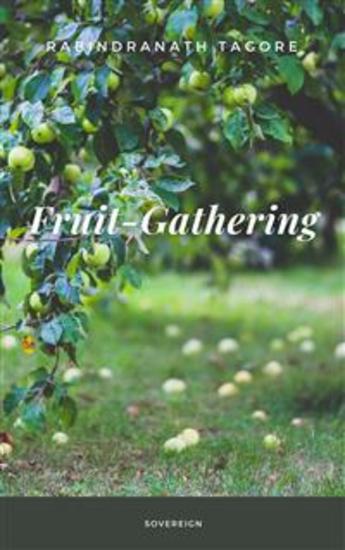
Fruit-Gathering - cover

Fruit-Gathering

Rabindranath Tagore

Casa editrice: Interactive Media

  • 0
  • 0
  • 0

Sinossi

Fruit-Gathering by Rabindranath Tagore is a poem about how people work hard so they can eat fruit. It's an ancient saying that "man cannot live on bread alone" and the old man in this poem symbolizes all of humanity, seeking nourishment from fruits. The old man spends his days climbing up the mountain to collect the delicious fruit.
Disponibile da: 17/01/2022.
Lunghezza di stampa: 52 pagine.

Altri libri che potrebbero interessarti

  • Tarzan the Terrible - cover

    Tarzan the Terrible

    edgar rice burroughs

    • 0
    • 0
    • 0
    The story follows Tarzan as he is forced to confront the evils of his past and protect his family from those who would do them harm. The novel is a testament to Tarzan's strength and resilience, as well as his capacity for love and compassion. Tarzan’s adventure weaves a thrilling tale of love and survival, driven by his unwavering determination to conquer this ancient world and reunite with his beloved.
    Mostra libro
  • HG Wells -More Selected Short Stories - cover

    HG Wells -More Selected Short...

    H. G. Wells

    • 0
    • 0
    • 0
    H.G. Wells is widely regarded as one of the most imaginative and visionary writers of the late 19th and early 20th centuries. Best known for his groundbreaking science fiction novels like The War of the Worlds and The Time Machine, Wells was also a prolific short story writer, producing a diverse body of work that explored many of the same themes as his longer novels: the wonders and perils of scientific progress, the mysteries of the human mind, and the complex relationship between society and the individual. 
    Wells’ short stories, though perhaps less celebrated than his novels, serve as a window into his vast intellectual curiosity and creative range. These stories often play with speculative ideas in compact, inventive ways, offering a glimpse of his talent for combining narrative flair with philosophical inquiry. In these pages, the reader will find tales of strange inventions, eerie encounters, and dystopian visions, all of which reflect Wells’ keen interest in the future of humanity and the ethical dilemmas that arise with technological advancement. 
    Head Stories Audio presents their second selection of Short Stories by H.G Wells, narrated by Simon Hester. With original music.
    Mostra libro
  • The Awakening - cover

    The Awakening

    Kate Chopin

    • 0
    • 0
    • 0
    Narrated by two-time Academy Award-winning actress Hilary Swank, The Awakening is set in New Orleans and the Southern Louisiana coast at the end of the nineteenth century. The plot centers on Edna Pontellier and her struggle to reconcile her increasingly unorthodox views on femininity and motherhood with the prevailing social attitudes of the turn-of-the-century American South. It is one of the earliest American novels that focuses on women's issues without condescension. It is also widely seen as a landmark work of early feminism, generating mixed reaction from contemporary readers and critics. The novel's blend of realistic narrative, incisive social commentary, and psychological complexity makes The Awakening a precursor of American modernist literature. 
     
    Cover illustrated by: Mar Bertran 
    Mar Bertran sees art as an intrinsic form of self-expression. She considers herself a sensitive person and believes that illustration has been pivotal in allowing her to let out her inner world full of insecurities. Visualizing her thoughts and emotions with the purpose of connecting with others has become Mar's way of living. Post-impressionism and pop art have been a massive influence on her work. Mar seeks an impact through bold colors and uncovers emotions in the character's eyes.
    Mostra libro
  • A Sense of the Future - From their pens to your ears genius in every story - cover

    A Sense of the Future - From...

    Martin Swayne

    • 0
    • 0
    • 0
    The bookshelves of British literature are incredible collections that have gathered together centuries of very talented authors.  From these Isles their fame spread and whilst among their number many are now forgotten or neglected their talents endure.  Among them is Martin Swayne.
    Mostra libro
  • The Devil Light - Former soldier and journalist that became a revered author and screenwriter - cover

    The Devil Light - Former soldier...

    Edgar Wallace

    • 0
    • 0
    • 0
    Richard Horatio Edgar Wallace was born on the 1st April 1875 in Greenwich, London.  Leaving school at 12 because of truancy, by the age of fifteen he had experience; selling newspapers, as a worker in a rubber factory, as a shoe shop assistant, as a milk delivery boy and as a ship’s cook.  
     
    By 1894 he was engaged but broke it off to join the Infantry being posted to South Africa. He also changed his name to Edgar Wallace which he took from Lew Wallace, the author of Ben-Hur.  
     
    In Cape Town in 1898 he met Rudyard Kipling and was inspired to begin writing. His first collection of ballads, The Mission that Failed! was enough of a success that in 1899 he paid his way out of the armed forces in order to turn to writing full time.  
     
    By 1904 he had completed his first thriller, The Four Just Men. Since nobody would publish it he resorted to setting up his own publishing company which he called Tallis Press. 
      
    In 1911 his Congolese stories were published in a collection called Sanders of the River, which became a bestseller. He also started his own racing papers, Bibury’s and R. E. Walton’s Weekly, eventually buying his own racehorses and losing thousands gambling.  A life of exceptionally high income was also mirrored with exceptionally large spending and debts.  
     
    Wallace now began to take his career as a fiction writer more seriously, signing with Hodder and Stoughton in 1921. He was marketed as the ‘King of Thrillers’ and they gave him the trademark image of a trilby, a cigarette holder and a yellow Rolls Royce. He was truly prolific, capable not only of producing a 70,000 word novel in three days but of doing three novels in a row in such a manner. It was estimated that by 1928 one in four books being read was written by Wallace, for alongside his famous thrillers he wrote variously in other genres, including science fiction, non-fiction accounts of WWI which amounted to ten volumes and screen plays. Eventually he would reach the remarkable total of 170 novels, 18 stage plays and 957 short stories. 
     
    Wallace became chairman of the Press Club which to this day holds an annual Edgar Wallace Award, rewarding ‘excellence in writing’.  
     
    Diagnosed with diabetes his health deteriorated and he soon entered a coma and died of his condition and double pneumonia on the 7th of February 1932 in North Maple Drive, Beverly Hills. He was buried near his home in England at Chalklands, Bourne End, in Buckinghamshire.
    Mostra libro
  • A Middle-Sized Artist - From their pens to your ears genius in every story - cover

    A Middle-Sized Artist - From...

    Charlotte Perkins Gilman

    • 0
    • 0
    • 0
    Charlotte Perkins Gilman was born on 3rd July 1860 in Hartford, Connecticut, to an unaffectionate mother and a father who abandoned her and her older brother to a life of poverty. 
    Inevitably her schooling was limited and by 15 she had attended seven different schools but received only four years education.  However Charlotte was resourceful and did spend time with her father’s aunts – the suffragist Isabella Beecher Hooker and the ‘Uncle Tom Cabin’s’ author, Harriet Beecher Stowe as well as many hours at the public library studying ancient civilisations. 
    In 1878, she enrolled in classes at the Rhode Island School of Design where she met Martha Luther and they developed a close relationship until Luther married in 1881. Charlotte was devastated and detested romance and love until she met and married the artist Charles Walter Stetson.  
    Their only child, Katharine Beecher Stetson, was born in 1885 but left Charlotte with post-natal depression, then often dismissed as a case of hysteria or nerves.  Unsuited to domestic life she ruptured her life and moved to California with Katherine.  She divorced in 1894 and then sent Katharine east to live with her father and his second wife confirming that his paternal rights be acknowledged and that Katherine establish a relationship with her father. 
    After her mother died in 1893, Charlotte moved back east and became involved with her first cousin, Wall Street attorney, Houghton Gilman who she married in 1900. After his death she moved back to California, where Katherine now lived.   
    Her most popular story is ‘The Yellow Wallpaper’ which touched on her own post-partum depression and underlined the need for women to be responsible for their mental and physical well-being, as the narrator is ordered by her husband/doctor to take compete rest in her room where she is isolated and becomes obsessed with the revolting yellow wallpaper.   
    She wrote other notable short stories the best of which we also include.   
    Charlotte lectured widely for social reform, wrote important non-fiction works that questioned our patriarchal system and left a legacy as a leading and positive spokesperson for feminism.  
    She was diagnosed with incurable breast cancer in 1932 and, as she wrote in her suicide note and autobiography, she ‘chose chloroform over cancer’    
    Charlotte Perkins Gilman took her own life on 17th August 1935, aged 75, in Pasadena, California.
    Mostra libro