Join us on a literary world trip!
Add this book to bookshelf
Grey
Write a new comment Default profile 50px
Grey
Subscribe to read the full book or read the first pages for free!
All characters reduced
Together we win - cover

Together we win

Rabbi Uri Pilichowski

Publisher: Spines

  • 0
  • 0
  • 0

Summary

As the news of the attacks began to circulate in communities around Israel, the first reactions were shock and disbelief. Surely, the numbers were exaggerated, people thought. An attack of this magnitude couldn’t happen in Israel. Memories of the Yom Kippur War flooded in, and the thought that history thought to never be repeated was occurring all over again. Israel’s intelligence services can hear conversations in Jericho and Ramallah, find hidden tunnels from Lebanon, and even steal tons of material from a warehouse in Tehran. Is it possible that intelligence services could miss an attack that required months of planning?! The news of killed, kidnapped, and raped Israels was too much to contemplate. This was the Yom Kippur War all over again, and the invincibility Israelis felt for the past few decades had been shattered.
We don’t know how the attacks of the Simchas Torah massacre on October 7th will transform Israel years from now. At the moment, when the Israeli people are at war, it is too early to fully understand the effects that the attacks have had on Israel and her people. Since the attack, Israeli society has pulled itself together into a united block, fighting its enemies, supporting its refugees, and praying together for the return of the hostages. Israelis on the right and the left, religious and secular, and from all regions, have pulled together to defeat Israel’s enemies and strengthen Israeli society. One thing is certain, with unity, together we win! This book aims to teach that lesson and many more from Israel’s war in Gaza.
Available since: 10/02/2024.

Other books that might interest you

  • Lose weight fast with psychotherapy - Deep Hypnosis developed with a psychiatrist and psychotherapist for lasting change - cover

    Lose weight fast with...

    Marcus Alvet

    • 0
    • 0
    • 0
    This audiobook has been made with an expert in the field, a therapist and psychotherapist. 
    Are you struggling to get more fit or keeping up the inspiration when you cut down on calories? We are presenting this psychotherapy program that will help you lose weight.  
    This one of a kind weight loss plan can help you: 
    - Find down better ways of moving past your cravings of food 
    - Dispose of obstacles in your subliminal to lose weight  
    - Make progress toward a superior acceptance of yourself 
    - Reinvent your dietary patterns and your approach to everyday life 
    - Reinforce your conviction 
    - Get a stronger motivation and view towards working out 
    Self-Hypnosis has been proven to give astounding outcomes provided you are ready and prepared to change your dietary patterns you will get in shape effectively and easily. 
    The self-hypnosis changes how you look at eating by giving you certain ideas (suggestions) to your subconscious. You will learn how to look at food in another way.  
    In the event that you can't quit eating pointless food and have a hard time embracing smart eating habits, this should imply that your perspectives are put away in your subconscious. What's more, this implies that this is where the change should occur - in your subconscious.  
    You will learn how to only eat when you are hungry, to simply eat quality food, and enjoy the food more, to eat more modest meals, to eat gradually , and consistently leave food on the plate to show that you have insight into your eating habits.  
    To lose weight with self-hypnosis you must learn restraint. You will also learn how to be totally legitimate with yourself when you view the amount you eat and the amount you exercise. You should change your reasoning in your subconcious mind first, to get the possibility to change your body. 
    © 2023 Marcus Alvet
    Show book
  • Scent - A Natural History of Fragrance - cover

    Scent - A Natural History of...

    Elise Vernon Pearlstine

    • 0
    • 0
    • 0
    A fascinating exploration of the natural history of scent and human perceptions of fragrance from the viewpoint of plant and pollinator 


    Plants have long harnessed the chemical characteristics of aromatic compounds to shape the world around them. Frankincense resin from the genus Boswellia seals injured tissues and protects trees from invading pathogens. Jasmine produces a molecule called linalool that attracts pollinating moths with its flowery scent. Tobacco uses a similarly sweet-smelling compound called benzyl acetone to attract pollinators. Only recently in the evolutionary history of plants, however, have humans learned to co-opt their fragrances to seduce, heal, protect, and alter moods themselves. 


    In this wide-ranging and accessible new book, biologist-turned-perfumer Elise Vernon Pearlstine turns our human-centered perception of fragrance on its head and investigates plants' evolutionary reasons for creating aromatic molecules. Delving into themes of spirituality, wealth, power, addiction, royalty, fantasy, and more, Pearlstine uncovers the natural history of aromatic substances and their intersection with human culture and civilization.
    Show book
  • Cleopatra’s Needles - The Lost Obelisks of Egypt - cover

    Cleopatra’s Needles - The Lost...

    PhD Bob Brier

    • 0
    • 0
    • 0
    In the half-century between 1831 and 1881 three massive obelisks left Egypt for new lands. Prior to these journeys, the last large obelisk moved was the Vatican obelisk in 1586—one of the great engineering achievements of the Renaissance. Roman emperors moved more than a dozen, but left no records of how they did it. The nineteenth-century engineers entrusted with transporting the obelisks across oceans had to invent new methods, far from certain that they would work. As the three obelisks, bound for Paris, London, and New York, sailed towards their new homes, the world held its breath. Newspapers reported the obelisks' daily progress, complete with illustrations of the heroic deeds of the engineers and crews struggling under nearly impossible conditions. When the obelisks arrived safely in their new homes, bands played Cleopatra's Needle Waltz and silver obelisk pencils dangled from fashionable ladies' necks. 


    This turbulent era, caught up in obelisk mania, is recreated by Bob Brier in all its glory. Amid tales of engineering dexterity and naval endurance, the individuals involved in transporting the obelisks and receiving them in their future homes are brought to life through their letters, diaries, and newspaper articles. This book will fascinate all those interested in Egypt, its iconic monuments, and the history of great endeavor.
    Show book
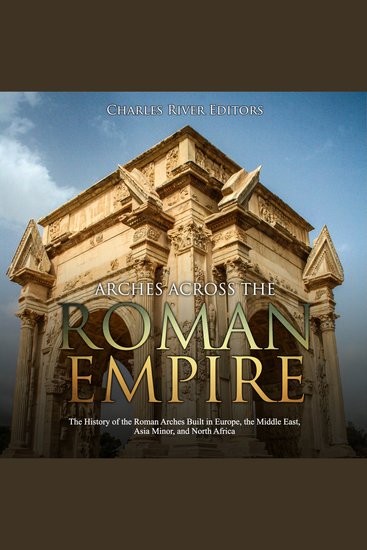
  • Arches across the Roman Empire: The History of the Roman Arches Built in Europe the Middle East Asia Minor and North Africa - cover

    Arches across the Roman Empire:...

    Charles River Editors

    • 0
    • 0
    • 0
    Some of the most iconic symbols of the Roman Empire that have survived into the modern world today are the arches that Romans erected to commemorate military victories and glorify individual emperors. The story of how arches came to be used throughout the Roman world in such a way is one that involves the evolution of the military and its leaders into the political forces that came to dominate the state, and those arches, along with the triumphs that came to be associated with many of them, were key parts in the process of exhibiting the might of both Rome. At the same time, they were meant to mark the individual achievements of Rome’s rulers, making them an enormous and expensive PR exercise that steadily grew over the years. 
    Of course, Roman arches have intrigued historians for years. Franz Botho Graef, a German classical archaeologist and art historian, a prominent expert in the area, devoted his life to the identification and cataloguing of Roman arches. He documented 125 extant arches, and 30 further examples discerned from the literature or other sources, scattered throughout Rome and its provinces. Graef’s listing is usually taken as the starting point for subsequent researchers, but another eminent historian in the field, A. Frothingham, has disputed Graef´s listings, arguing that only 115 of the 125 identified arches actually existed. He also claimed to have identified 280 further “monuments and arches,” the majority of which were located within Asia Minor, North Africa, and Syria. However, this methodological approach introduced a new category – monuments - into the cataloguing process, which has only served to complicate the debate.
    Show book
  • In the Name of Emmett Till - How the Children of the Mississippi Freedom Struggle Showed Us Tomorrow - cover

    In the Name of Emmett Till - How...

    Robert H. Mayer, Leslie-Burl...

    • 0
    • 0
    • 0
    The killing of Emmett Till is widely remembered today as one of the most famous examples of lynchings in America. African American children in 1955 personally felt the terror of his murder. From the violent Woolworth's lunch-counter sit-ins in Jackson to the school walkouts of McComb, the young people of Mississippi picketed, boycotted, organized, spoke out, and marched, working to reveal the vulnerability of black bodies and the ugly nature of the world they lived in. These children changed that world. 


    In the Name of Emmett Till: How the Children of the Mississippi Freedom Struggle Tore Down Yesterday and Showed Us Tomorrow weaves together the riveting tales of those young women and men of Mississippi, figures like Brenda Travis, the Ladner sisters, and Sam Block who risked their lives to face down vicious Jim Crow segregation. Listeners also discover the adults who guided the young people, elders including Medgar Evers, Robert Moses, and Fannie Lou Hamer. 


    This inspiring new book of history for young adults from award-winning author Robert H. Mayer is an unflinching portrayal of life in the segregated South and the bravery of young people who fought that system. As the United States still reckons with racism and inequality, the activists working In the Name of Emmett Till can serve as models of activism for young people today.
    Show book
  • A Rare Recording of Christabel Pankhurst British Suffragette - cover

    A Rare Recording of Christabel...

    Christabel Pankhurst

    • 0
    • 0
    • 0
    Christabel Harriette Pankhurst (September 22, 1880 - February 13, 1958) was a British suffragette born in Manchester, England. A co-founder of the Women's Social and Political Union (WSPU)--and daughter of women's suffrage movement leader Emmeline Pankhurst and radical socialist Richard Pankhurst--she directed its militant actions from exile in France from 1912 to 1913. In 1914, Pankhurst supported the war against Germany. After the war, she moved to the United States, where she worked as an evangelist for the Second Adventist movement. This is a recording from 1908.
    Show book