Join us on a literary world trip!
Add this book to bookshelf
Grey
Write a new comment Default profile 50px
Grey
Subscribe to read the full book or read the first pages for free!
All characters reduced
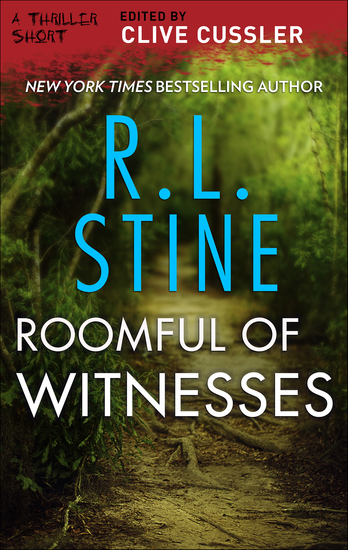
Roomful of Witnesses - cover

Roomful of Witnesses

R. L. Stine

Publisher: MIRA

  • 0
  • 0
  • 0

Summary

Prepare for edge-of-your-seat suspense in this Thriller Short.Originally published in THRILLER 2 (2009),edited by #1 New York Times bestselling author Clive Cussler.In this compelling Thriller Short from bestselling author R.L. Stine, a man discovers what can happen when hostility gets the best of him. For former convicts Wayne Mullet and Leon Maloney, working at a retirement home for chimpanzees located in the Louisiana woods is a step up from prison life. Their jobs at The Haven aren’t the greatest. Still, Wayne wants to keep his. But when Leon takes his resentment out on two old dudes, Leon gets what’s coming to him. Unfortunately, though, it’s Wayne who’s left holding the bag in a room full of witnesses.Don’t miss any of these exciting stories from Thriller 2: The Weapon by Jeffery DeaverRemaking by Blake CrouchIced by Harry HunsickerJustice Served by Mariah StewartThe Circle by David HewsonRoomful of Witnesses by R.L. StineThe House on Pine Terrace by Phillip MargolinThe Desert Here and the Desert Far Away by Marcus SakeyOn the Run by Carla NeggersCan You Help Me Out Here? by Robert FerrignoCrossed Double by Joe HartlaubThe Lamented by Lawrence LightVintage Death by Lisa JacksonSuspension of Disbelief by Tim MaleenyA Calculated Risk by Sean ChercoverThe Fifth World by Javier SierraGhost Writer by Gary BraverThrough a Veil Darkly by Kathleen AntrimBedtime for Mr. Li by David J. MontgomeryProtecting the Innocent by Simon WoodWatch Out for My Girl by Joan JohnstonKilling Time by Jon LandBoldt’s Broken Angel by Ridley Pearson
Available since: 01/08/2018.
Print length: 22 pages.

Other books that might interest you

  • Honest Work - A Good Women Story - cover

    Honest Work - A Good Women Story

    Halle Hill

    • 0
    • 0
    • 0
    Maudette works at the state fair. She hates her job, she hates what her mother does for a living, she hates the people in her town, especially one of her mother’s clients, a local deacon. Working the tilt-a-whirl one day, she begins to consider revengeHonest Work is a short story from Halle Hill’s Good Women, which delves into the lives of twelve Black women across the Appalachian South. Darkly funny and deeply human, Good Women observes how place, blood ties, generational trauma, obsession, and boundaries―or lack thereof―influence how we navigate our small worlds, and how those worlds so often collide in ways we don’t expect.
    Show book
  • Dream Life and Real Life - cover

    Dream Life and Real Life

    Olive Schreiner

    • 0
    • 0
    • 0
    "Dream Life and Real Life" is a haunting short story about a little orphan girl in servitude to a cruel Boer family. One night, following a beating, she runs away and hides in a cave. But there she overhears three men plotting to rob and burn down the Boer's farm and kill the family. What should she do? Warn them, or let them burn to death?  
     
    Olive Schreiner (March 24, 1855 - December 11, 1920) was a South African author, anti-war campaigner and intellectual. She is remembered today for her 1883 novel, The Story of an African Farm, which has been highly acclaimed. It deals boldly with such contemporary issues as agnosticism, existential independence, individualism, the professional aspirations of women, and the elemental nature of life on the colonial frontier.
    Show book
  • Avalanche - Stories - cover

    Avalanche - Stories

    Jessica Westhead

    • 0
    • 0
    • 0
    "Things used to be easier, but even in those carefree days, the rules were in place for a reason. And that reason is: so we can all agree. So we can all have the same standard applied across the board. So there is no special treatment, which no one should receive. This is why we need the rules." 


    The stories in Avalanche combine humor with an earnest examination and indictment of white entitlement, guilt, shame, and disorientation in the wake of waking up to the reality of racism. Focusing on the perspective of white, cis, straight, and mostly middle-aged and middle-class characters, this collection shines a light on the obliviousness of white privilege, the violence of polite, quiet racism hiding just under the surface of mundane, everyday situations, and the anguished flailing of "well-intentioned white ladies" desperate to confirm their essential goodness at all costs. Westhead writes with compassion and empathy for both her frustrating and frustrated white protagonists and the racialized characters who encounter them, and uses humor not to comfortably distance white readers from the harmful behavior of her self-absorbed protagonists, but to pull them in close to recognize—and reckon with—those familiar parts of themselves, and to become more aware of the insidious systems of white supremacy at work behind the scenes. 


    Bonus material: This audiobook includes the Acknowledgments as supplemental material in printable PDF format.
    Show book
  • The Devil in the Belfry - From their pens to your ears genius in every story - cover

    The Devil in the Belfry - From...

    Edgar Allan Poe

    • 0
    • 0
    • 0
    Edgar Poe was born in Boston Massachusetts on 19th January 1809. His father abandoned his family the following year and within a year his mother had died leaving him an orphan.   
    He was taken in by the Allan family but never formally adopted although he now referred to himself as Edgar Allan Poe.  His father alternatively spoiled or chastised him and tension was frequent over gambling debts and monies for his education.  His university years to study ancient and modern languages was cut short by lack of money and he enlisted as a private in the army claiming he was 22, it is more probable he was 18. After 2 years he obtained a discharge in order to take up an appointment at the military academy, West Point, where he failed to become an officer. 
    Poe had released his 1st poetry volume in 1827 and after his 3rd turned to prose and placing short stories in several magazines and journals.  At age 26 he obtained a licence to marry his cousin.  She was a mere 13 but they stayed together until her death from tuberculosis 11 years after. 
    In January 1845 ‘The Raven’ was published and became an instant classic.  Thereafter followed the prose works for which he is now so rightly famed as a master of the mysterious and the macabre. 
    Edgar Allan Poe died at the tragically early age of 40 on 7th October 1849 in Baltimore, Maryland. Newspapers at the time reported Poe's death as ‘congestion of the brain’ or ‘cerebral inflammation’, common euphemisms for death from disreputable causes such as alcoholism but the actual cause of death remains a mystery. 
    Poe is also one of a number of authors credited with inventing the detective genre with his Parisian sleuth C. Auguste Dupin.  He featured in three stories including the legendary ‘Murders in the Rue Morgue’ and by sheer deduction, logic and a touch of Gallic arrogance revealed what was hidden to the rest of us.
    Show book
  • Top 10 Short Stories The - English Authors of the West Midlands - The top ten Short Stories of all time written by English authors born in the West Midlands - cover

    Top 10 Short Stories The -...

    George Eliot, Jerome K, Arnold...

    • 0
    • 0
    • 0
    Short stories have always been a sort of instant access into an author’s brain, their soul and heart.  A few pages can lift our lives into locations, people and experiences with a sweep of landscape, narration, feelings and emotions that is difficult to achieve elsewhere. 
     
    In this series we try to offer up tried and trusted ‘Top Tens’ across many different themes and authors. But any anthology will immediately throw up the questions – Why that story? Why that author?  
     
    The theme itself will form the boundaries for our stories which range from well-known classics, newly told, to stories that modern times have overlooked but perfectly exemplify the theme.  Throughout the volume our authors whether of instant recognition or new to you are all leviathans of literature. 
     
    Some you may disagree with but they will get you thinking; about our choices and about those you would have made.  If this volume takes you on a path to discover more of these miniature masterpieces then we have all gained something. 
     
    In the heartlands of England, in its gritty and grimy industrial landscape, literary talent abounds.  Experiences learnt and observed here have found their way into many of the finest literary works this country has produced.  Genius has many names. 
     
    1 - The Top 10 - English Authors of the West Midlands - An Introduction 
    2 - The Lifted Veil - Part 1 by George Eliot 
    3 - The Lifted Veil - Part 2 by George Eliot 
    4 - The Absent Minded Man by Jerome K Jerome 
    5 - The Matador of the Five Towns by Arnold Bennett 
    6 - The Last House in C Street by Mrs Craik 
    7 - Reality or Delusion by Mrs Ellen Wood 
    8 - The Ghost in the Clock Room by Hesba Stretton 
    9 - Blessed Are the Meek by Mary Webb 
    10 - The Dust of Death by Fred M White 
    11 - Alexander the Ratcatcher by Richard Garnett 
    12 - Her Murderer by Mary Cholmondeley
    Show book
  • The Blind Accordionist - cover

    The Blind Accordionist

    C.D. Rose

    • 0
    • 0
    • 0
    In the novel Who's Who When Everyone Is Someone Else, the character "C. D. Rose" (not to be confused with the author C. D. Rose) searches an unnamed middle-European city for the long-lost manuscript of a little-known writer named Maxim Guyavitch. That search was fruitless, but in The Blind Accordionist, "C. D. Rose" has found the manuscript—nine sparkling, fable-like short stories—and he presents them here with an (hilarious) introduction explaining the discovery, and an afterword providing (hilarious) critical commentary on the stories, and what they might reveal about the mysterious Guyavitch. 


    The Blind Accordionist is another masterful book of world-making by the real C. D. Rose, absorbing in its mix of intelligence and light-heartedness, and its ultimate celebration of literature itself. It is the third novel in the series about "C. D. Rose," although the reader does not need to have read the previous two books. (The first in the series was The Biographical Dictionary of Literary Failure; the second was Who's Who When Everyone Is Someone Else.) 


    Like those books, The Blind Accordionist can be read both as a simple but wonderful collection of quirky stories, and as comedy—or as a beautiful and moving elegy on the nobility of writers wanting to be read.
    Show book