Join us on a literary world trip!
Add this book to bookshelf
Grey
Write a new comment Default profile 50px
Grey
Subscribe to read the full book or read the first pages for free!
All characters reduced
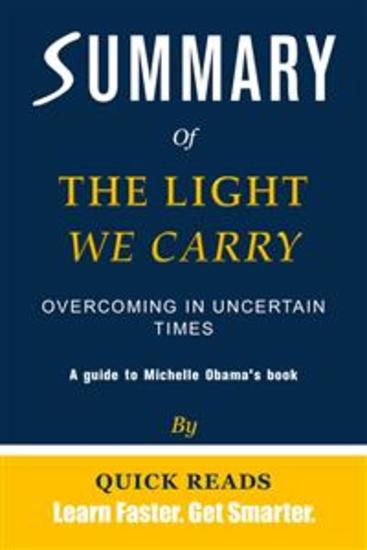
Summary of The Light We Carry - Overcoming in Uncertain Times by Michelle Obama | Get The Key Ideas Quickly - cover

Summary of The Light We Carry - Overcoming in Uncertain Times by Michelle Obama | Get The Key Ideas Quickly

Quick Reads

Publisher: Quick Reads

  • 0
  • 0
  • 0

Summary

The Light We Carry: Overcoming in Uncertain Times is an inspiring and empowering book that offers valuable insights and practical advice on how to navigate life's challenges. Written by Michelle Obama, the book covers a range of topics, including hope and resilience, community and support, self-care, education and empowerment, taking action, race, gender, privilege, family and motherhood, storytelling, self-discovery, self-reflection, and forgiveness. 

...Through her personal reflections and experiences, Michelle Obama provides readers with a powerful message of hope and resilience, encouraging them to find the light they need to carry on, even in the darkest of times. 

Whether you're looking for inspiration or practical advice, "The Light We Carry: Overcoming in Uncertain Times" is a must-read book that will leave you feeling motivated and empowered!

This is the SUMMARY of the book, which in no way intends to displace the original work but offers the following:

* An in-depth analysis of the book

* An efficiently written work that conveys the authors' message in a user friendly manner.

* A sufficient synopsis of the authors' main ideas.

These and many more can be found in this little book of immeasurable value!

If you want to discover a revolutionary guide that will give inspiration, guidance, and practical advice on how to navigate difficult times, then click on the Buy Now button to order your copy now!.
---------
DISCLAIMER

This book is an unofficial summary and analysis of Michelle Obama's book, The Light We Carry: Overcoming in Uncertain Times, which should be read in conjunction with the original work, not as a substitute. This content is solely the responsibility of Quick Reads, which is not affiliated with the original author in any way.
Available since: 01/26/2023.

Other books that might interest you

  • What Sheep Think About the Weather - How to Listen to What Animals Are Trying to Say - cover

    What Sheep Think About the...

    Amelia Thomas

    • 0
    • 0
    • 0
    It started with a hummingbird dive-bombing Amelia Thomas over her morning coffee, and a pair of piglets who just wouldn't stay put. Soon Amelia, journalist and new farmer, begins to question the communications of the creatures all around her. Are they all just animals reacting instinctually to the world around them—or are they trying to communicate something deeper? 
     
    Driven by lifelong curiosity, Amelia embarks on a journey to uncover what animals truly seek to say to humans. On the way, along with groundbreaking chimps and circumspect octopuses, she'll meet an extraordinary cast of experts, from animal behaviorists and anthrozoologists to trackers and psychologists, and even explore the surprising insights of pet psychics, A.I. researchers, and animal mindfulness practitioners. Each perspective offers a new layer of understanding about the subtle, complex ways animals connect with us—and will deepen our appreciation for every creature with whom we share our planet. 
     
    In What Sheep Think About the Weather, Amelia chronicles her sometimes difficult discoveries with humor, heart, and awe. More than just a memoir, this book is a call to listen—not only to the animals we love but to the untamed world around us. What if the answers to some of humanity's greatest questions have been whispered to us all along?
    Show book
  • Ulysses - A Reader's Odyssey - cover

    Ulysses - A Reader's Odyssey

    Daniel Mulhall

    • 0
    • 0
    • 0
    Marking the centenary of Ireland's – and possibly the world's – most famous novel, this joyful introductory guide opens up Ulysses to a whole new readership, offering insight into the literary, historical and cultural elements at play in James Joyce's masterwork.
    Both eloquent and erudite, this book is an initiation into the wonders of Joyce's writing and of the world that inspired it, written by Daniel Mulhall, Ireland's ambassador to the United States and an advocate for Irish literature around the world.
    One hundred years on from that novel's first publication, Ulysses: A Reader's Odyssey takes us on a journey through one of the twentieth century's greatest works of fiction. Exploring the eighteen chapters of the novel and using the famous structuring principle of Homer's Odyssey as our guide, Daniel Mulhall releases Ulysses from its reputation of impenetrability, and shows us the pleasure it can offer us as readers.
    Show book
  • Jewish Legends of the Patriarchs & Prophets: Midrashic and Apocryphal Tales Beyond Scripture - Rediscover Adam Noah Abraham Moses and More Through Ancient Hebrew Lore - cover

    Jewish Legends of the Patriarchs...

    Various Ancient Jewish Writers,...

    • 0
    • 0
    • 0
    What if ancient storytellers whispered fuller portraits of Adam, Noah, and Moses—waiting for you to listen? 
    The Jewish Legends of the Patriarchs & Prophets audiobook lifts timeless midrashic adventures off the page with engaging narration and rhythmic prose. Journey through: 
    •	The Book of Jasher – Expansive episodes that flesh out Genesis and Exodus. 
    •	Ladder of Jacob – A celestial ascent through seven shimmering heavens. 
    •	Joseph and Asenath – A dramatic love story of faith and transformation. 
    •	Lives of the Prophets – Brief yet powerful sketches of Israel’s greatest voices. 
    Hear the patriarchs wrestle angels, prophets behold fiery visions, and sages unveil cosmic mysteries—stories that once echoed in synagogue courts and candle-lit homes.  
    Immerse yourself in a sonic pilgrimage through the legends that kept Jewish hope alive across centuries.
    Show book
  • The Real Queen Charlotte - Inside the Real Bridgerton Court - cover

    The Real Queen Charlotte -...

    Catherine Curzon

    • 0
    • 0
    • 0
    Known to millions as the imperious matriarch of Bridgerton's court, Charlotte of Mecklenburg-Strelitz was still a teenager when she was chosen to be the bride of King George III. Shy, innocent, and sheltered, the orphaned princess and her groom carried the hopes of a nation on their shoulders. 


    The unassuming young couple symbolized a new beginning, but soon those hopes began to sour. Charlotte and George's marriage lasted for nearly sixty years and produced more than a dozen children, but it was beset by unrest at home, war in the colonies, and the king's encroaching madness. 


    As the royal couple battled against their critics, their political opponents, and sometimes their own family, Charlotte learned what it really meant to be queen. Locked in a bitter struggle with her eldest son for the king's future and with her daughters for their freedom, the timid young girl grew into an insular and domineering woman that few dared to cross. 


    Shouldering the burden of family disputes, ambitious courtiers, and the care of the man she adored, Charlotte of Mecklenburg-Strelitz presided over one of the most tumultuous eras that the monarchy has ever seen. This is the story of her extraordinary life.
    Show book
  • The Age of Enlightened Despots - Reform and Reaction - cover

    The Age of Enlightened Despots -...

    Nova Ashford

    • 0
    • 0
    • 0
    The Age of Enlightened Despotism was a period in European history during the 18th century when absolute monarchs, inspired by the ideas of the Enlightenment, sought to combine their centralized power with reforms aimed at improving the welfare of their subjects. These rulers, often referred to as "enlightened despots," were influenced by the rationalist philosophy that emphasized reason, science, and progress. However, they did not embrace the democratic principles of the Enlightenment, opting instead to preserve their absolute authority while implementing select reforms to improve governance, society, and the economy. 
    At the heart of enlightened despotism was the belief that monarchs could act as benevolent rulers who used their absolute power to guide their countries towards prosperity and progress. These monarchs saw themselves as enlightened figures, tasked with leading their nations in line with the principles of the Enlightenment but without relinquishing control over the state. In contrast to traditional autocratic rulers, enlightened despots were often receptive to new ideas about governance, education, legal systems, and the treatment of their subjects. They embraced reforms that were designed to modernize their societies, often implementing policies that reflected Enlightenment thinkers such as Voltaire, Montesquieu, and Rousseau. 
    Frederick the Great of Prussia, Catherine the Great of Russia, and Joseph II of Austria were the most prominent examples of enlightened despots. Each of these rulers used their power to implement a range of reforms. Frederick, for instance, was known for his military prowess and his efforts to modernize the Prussian state, introducing reforms that improved the legal system, promoted education, and supported religious tolerance.
    Show book
  • Lost Fatherland - Europeans between Empire and Nation-States 1867-1939 - cover

    Lost Fatherland - Europeans...

    Iryna Vushko

    • 0
    • 0
    • 0
    How the demise of the Habsburg Empire, postwar sovereignty, and new diplomatic frontiers shaped the nature of citizenship, identity, and belonging across Europe 


    This book is a collective portrait of twenty-one key statesmen who came of age during the Habsburg Empire. They include the cofounder of Austro-Marxism and the Austrian republic's first foreign minister, the cofounder of the European Union after the Second World War, the founder of the Communist Party of Czechoslovakia, and Mussolini's ambassador to Vienna. Some survived the First World War and the resulting geographical divisions in their homelands, and some went on to serve in politics and governments throughout Europe. 


    Taken together, the stories of these men offer listeners a window on broad issues of European history in the late nineteenth and early twentieth centuries—chiefly, how an imperial heritage, a shared vision of statehood and nationalism, and a commitment to peaceful conflict resolution helped establish enduring loyalty and unity despite the geographical fault lines resulting from the war. As Iryna Vushko explains, their stories also offer an increasingly nuanced understanding of the achievements and failures of the Habsburg Empire.
    Show book