Join us on a literary world trip!
Add this book to bookshelf
Grey
Write a new comment Default profile 50px
Grey
Subscribe to read the full book or read the first pages for free!
All characters reduced
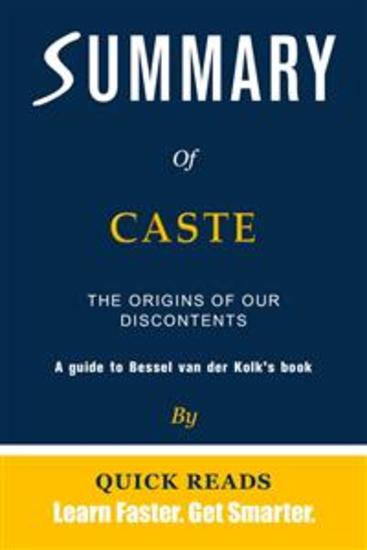
Summary of Caste - The Origins of Our Discontents by Isabel Wilkerson | Get The Key Ideas Quickly - cover

Summary of Caste - The Origins of Our Discontents by Isabel Wilkerson | Get The Key Ideas Quickly

Quick Reads

Publisher: Quick Reads

  • 0
  • 0
  • 0

Summary

"Summary of Caste: The Origins of Our Discontents" is a powerful and thought-provoking examination of the ways in which the caste system continues to shape American society today. Written by Pulitzer Prize-winning author Isabel Wilkerson, the book traces the history of the caste system in America and its impact on issues such as race, class, and inequality. 

Drawing on extensive research and personal interviews, Wilkerson argues that the caste system is not just a relic of the past, but an insidious force that continues to shape our society in ways we may not even be aware of. 
This book is a must-read for anyone interested in understanding the root causes of America's ongoing struggles with racism and inequality and the ways in which they are deeply entwined with our nation's history.

Click the Buy Now button for instant access!

---------
DISCLAIMER

This book is an unofficial summary and analysis of Isabel Wilkerson's book, Caste: The Origins of Our Discontents, which should be read in conjunction with the original work, not as a substitute. This content is solely the responsibility of Quick Reads, which is not affiliated with the original author in any way.
Available since: 01/27/2023.

Other books that might interest you

  • The Time Beneath the Concrete - Palestine Between Camp and Colony - cover

    The Time Beneath the Concrete -...

    Nasser Abourahme

    • 0
    • 0
    • 0
    In The Time beneath the Concrete, Nasser Abourahme argues that settler colonialism is always as much an attempt to conquer time as it is to conquer land. Taking as his primary object  Palestinian refugee camps, created in the fallout of the eliminatory violence of Israel's founding, Abourahme shows how these camps become the primary place where settler colonial attempts to dominate space and time encounter Indigenous refusal. Seen from the camps, Israel becomes a settler colonial project defined by its inability to move past the past—a project stuck at its foundational moment of conquest. At the same time, the Palestinian insistence on return is a refusal to abide by the closure of the past into settler futurity. Palestinian struggle does not just happen in the open time of dispossession; it happens over this time. That struggle, Abourahme demonstrates, is a form of anticolonial refusal that draws its power not from any decisive finality, but precisely from irresolution and keeping time open. 


    Duke University Press Scholars of Color First Book Award
    Show book
  • The Indonesian Famine of 1945-1946 - A Study in Post-War Disruption - cover

    The Indonesian Famine of...

    Sarah Willards

    • 0
    • 0
    • 0
    The conclusion of World War II marked a pivotal turning point in Indonesia’s history. As the Japanese forces surrendered in August 1945, the vacuum left behind in their wake exposed the fragility of colonial and wartime institutions. Indonesia, long under Dutch colonial rule and occupied by Japan since 1942, was suddenly thrust into a state of political and administrative chaos. The power void that followed the Japanese capitulation was quickly filled by nationalist fervor, culminating in the proclamation of Indonesian independence on August 17, 1945. However, the declaration did not result in immediate recognition or control. Instead, the country found itself caught between competing powers and clashing agendas. 
    The collapse of Japanese administrative structures left the newly proclaimed Republic of Indonesia struggling to assert its legitimacy. Republican leaders, including Sukarno and Mohammad Hatta, faced the monumental task of organizing a new government while also managing the fallout of war. Meanwhile, Dutch authorities, with Allied support, sought to re-establish their colonial presence. This led to violent confrontations and widespread instability, as various factions—including local militias, former Japanese-trained troops, and returning colonial forces—vied for control over towns, supply routes, and administrative posts. 
    The disintegration of centralized governance had far-reaching consequences. Essential services, including food distribution and public health, were severely disrupted. The chaos was further compounded by a breakdown in communication lines and transportation infrastructure, much of which had been damaged during the war or repurposed by occupying forces. With no clear authority in many regions, local leaders and grassroots organizations were left to manage crises as best they could, often with limited resources and no coordination.
    Show book
  • The American Operations in WW2: Ryukyus - cover

    The American Operations in WW2:...

    History U.S. Army Center of...

    • 0
    • 0
    • 0
    World War II was the largest and most violent armed conflict in the history of mankind. Highly relevant today, World War II has much to teach us, not only about the profession of arms, but also about military preparedness, global strategy, and combined operations in the coalition war against fascism. This book follows military operations of the US Army in the Ryukyus, Japan from 26 March to 2 July 1945. 
    In late September 1944 the Joint Chiefs of Staff (JCS) in Washington decided to invade Okinawa, the largest island in the Ryukyu Islands, as part of a strategy to defeat Japan. The effort was code-named Operation ICEBERG. Okinawa had initially emerged as an objective in the spring of 1943, when the Allies believed that an invasion of the home islands might be necessary to force Tokyo's surrender. Possession of Okinawa would give the American forces additional, better-positioned air bases for intensifying the air campaign against the home islands and also provide important anchorages and staging areas for the huge, ambitious effort needed to invade Japan.
    Beginning in late September 1944 American aircraft and submarines began to tighten a noose around the Ryukyus, making surface shipping extremely hazardous for the Japanese. Heavy bombers of the Fourteenth and Twentieth Air Forces and carrier planes from Admiral William F. Halsey's Third Fleet struck repeatedly at Japanese positions in the Philippines, Taiwan, and the Ryukyu Islands. On 29 September B-29 bombers conducted the initial reconnaissance mission over Okinawa and its outlying islands. On 10 October nearly two hundred of Admiral Halsey's planes struck Naha, Okinawa's capital and principal city, in five separate waves. The city was almost totally devastated. The American war against Japan was coming inexorably closer to the Japanese homeland...
    Show book
  • Churn - The Tension That Divides Us and How to Overcome It - cover

    Churn - The Tension That Divides...

    Claude M. Steele

    • 0
    • 0
    • 0
    With Malcolm Gladwell–like clarity, Churn captures the most commonplace tensions of life in a multifaceted democracy and how to minimize their corrosive effects in everyday life. 
    A pioneer of social psychology, Claude M. Steele is renowned for Whistling Vivaldi, a runaway bestseller that analyzed societal stereotypes—from beliefs about racial and gender test score gaps to the athletic prowess of Black men—and how to mitigate these “stereotype threats.” In Churn, he coins a new term to identify “the agitation we can feel in diverse settings,” such as everyday exchanges between teachers and students; police and the public; managers and employees; parents and children; and strangers, or even friends, of different sexes and races. Steele braids together psychological research with his own biracial life story, demonstrating how initial wariness between people of different identities is as much a product of our history as of our biases. Through brilliant analysis Churn reveals how trust building can be a fresh and surprisingly powerful strategy for mitigating these tensions in the real–life settings of our lives and for realizing the full potential of our multiracial, multiethnic, multiclassed democracy.
    Show book
  • How Polarization Begets Polarization - Ideological Extremism in the US Congress - cover

    How Polarization Begets...

    Thomas L. Brunell, Bernard...

    • 0
    • 0
    • 0
    Extreme polarization in American politics is perhaps the most confounding political phenomenon of our time. This book binds together polarization in Congress and polarization in the electorate within an ever-expanding feedback loop. This loop is powered by the discipline exerted by the respective political parties on their Congressional members and district candidates and endorsed by the voters in each Congressional district who must choose between the alternatives offered. Tight national party discipline produces party delegations in Congress that are widely separated from one another but each ideologically narrowly distributed. 


    As district constituencies become more polarized and are egged on by activists, parties are further motivated to appeal to their respective bases rather than to voters in the ideological center. America has indeed acquired parties with clear platforms—once thought to be a desirable goal—but these parties are now feuding camps. What resolution might there be? Just as the progressive movement slowly replaced the Gilded Age, might a new reform effort replace the current squabble? Or could an asymmetry develop in the partisan constraints that would lead to ascendancy of the center, or might a new and over-riding issue generate a cross-cutting dimension, opening the door to a new politics? Only the future will tell.
    Show book
  • The Expanding Circle - Ethics Evolution and Moral Progress - cover

    The Expanding Circle - Ethics...

    Peter Singer

    • 0
    • 0
    • 0
    What is ethics? Where do moral standards come from? Are they based on emotions, reason, or some innate sense of right and wrong? For many scientists, the key lies entirely in biology—especially in Darwinian theories of evolution and self-preservation. But if evolution is a struggle for survival, why are we still capable of altruism? 


    In his classic study The Expanding Circle, Peter Singer argues that altruism began as a genetically based drive to protect one's kin and community members but has developed into a consciously chosen ethic with an expanding circle of moral concern. Drawing on philosophy and evolutionary psychology, he demonstrates that human ethics cannot be explained by biology alone. Rather, it is our capacity for reasoning that makes moral progress possible. In a new afterword, Singer takes stock of his argument in light of recent research on the evolution of morality.
    Show book