Join us on a literary world trip!
Add this book to bookshelf
Grey
Write a new comment Default profile 50px
Grey
Subscribe to read the full book or read the first pages for free!
All characters reduced
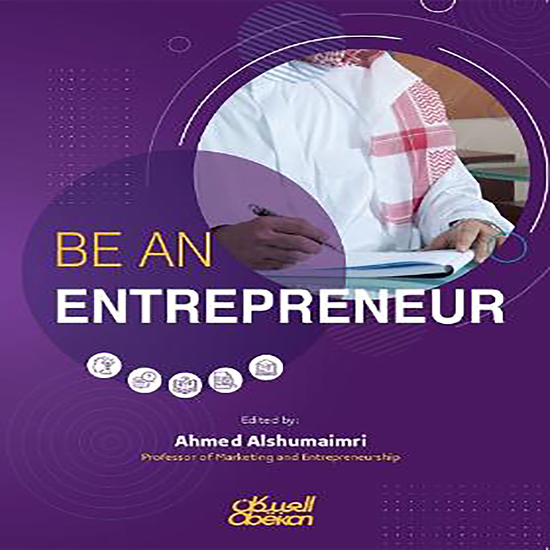
Be An Entrepreneur - cover

Be An Entrepreneur

PROFESSOR AHMED ALSHUMAIMRI

Publisher: Obeikan

  • 0
  • 0
  • 0

Summary

About this Book

We believe that we are in the era when the college student should learn how to create jobs for himself and for others rather than just be a job seeker upon graduation. This book is meant to explain the steps to take in starting a venture and running a business. It is about the adventure of starting a small business step by step. It is designed for both undergraduate and graduate courses that focus on entrepreneurship theory and practice.


About the Editor

Professor Ahmed Alshumaimri is a practitioner and mentor for entrepreneurial innovation. He is one of the founders of Entrepreneurship in the Kingdom of Saudi Arabia. He has got consulting, direct marketing, strategic planning, and SME and entrepreneurship background spanning over twenty-five years, including international business projects across North America, United Kingdom, and the Kingdom of Saudi Arabia. He is a venture capitalist and a member of Angel investor group who establishes tens of SMEs. Dr. Ahmed's interests include entrepreneurship, networking, business collaborations, business incubation, and technology.
Available since: 07/05/2025.
Print length: 359 pages.

Other books that might interest you

  • Bohemians - A Very Short Introduction - cover

    Bohemians - A Very Short...

    David Weir

    • 0
    • 0
    • 0
    The Romantic myth of Bohemia originated in the early nineteenth century as a way of describing the new conditions faced by artists and writers when the previous system of aristocratic patronage collapsed in the wake of the Age of Revolution. Without the patron system, the artist was free to move around, to seek an audience wherever fortune beckoned. This marketing model likening the artist's vagabond career to the "gypsy" life helps to explain part of the bohemian myth, but not all of it. Most bohemians have scant interest in commercial gain and are not so itinerant after all, confining their movements to down-market urban neighborhoods where the rent is cheap and the morals are loose. 


    This Very Short Introduction traces the myth of Bohemia through its various fictional manifestations, from Henry Murger's novel Scenes of Bohemian Life and Giacomo Puccini's opera La Bohème to Aki Kaurismäki's film La vie de Bohème and Jonathan Larson's musical Rent. It goes on to examine the history of different bohemian communities, including those in the Latin Quarter of Paris and the Greenwich Village neighborhood of New York. David Weir also considers the politics of Bohemia and traces the careers of the artists Gustave Courbet and Pablo Picasso and the great chanteuses Yvette Guilbert, Fréhel, and Edith Piaf in the Montmartre neighborhood of Paris.
    Show book
  • The Fenway Effect - A Cultural History of the Boston Red Sox - cover

    The Fenway Effect - A Cultural...

    David Krell

    • 0
    • 0
    • 0
    To be a part of Red Sox Nation is to be a hopeful romantic who neither betrays loyalty nor surrenders hope in the direst of circumstances. From Bangor to Back Bay, New Englanders endure in baseball matters. And life. The team's history has intersected with the history of Boston and well beyond it, through the Curse of the Bambino, the military service of Ted Williams during World War II, and the Boston Marathon bombing. The Fenway Effect chronicles these stories and others that have built the incredible saga of the Boston Red Sox. 


    How did Cheers depict the passion of Boston's sports fans? Why is Narragansett beer so important to New England? What's the architectural impact of The Teammates—the statue of Bobby Doerr, Johnny Pesky, Ted Williams, and Dom DiMaggio outside Fenway Park? What did the Boston press really think about Red Sox owner Harry Frazee selling Babe Ruth to the Yankees? What was the origin of Fenway Park's predecessor—Huntington Avenue Grounds? 


    Even Yankees fans will tip their caps to the rich impact of the Red Sox on music, movies, branding, broadcasting, and more. Plus, there's a chapter focusing on the oral history of Red Sox fans, some of whom share here anecdotes that are funny, insightful, and heartwarming.
    Show book
  • Grant at 200 - Reconsidering the Life and Legacy of Ulysses S Grant - cover

    Grant at 200 - Reconsidering the...

    Frank J. Scaturro, Chris Mackowski

    • 0
    • 0
    • 0
    Ulysses S. Grant stood at the center of the American Civil War maelstrom. The Ohio native answered his nation's call to service and finished the war as a lieutenant general in command of the United States Army. Four years later, he ascended to the presidency to better secure the peace he had helped win on the battlefield. Despite his major achievements in war and peace, political and sectional enemies battered his reputation. For nearly a century, his military and political career remained deeply misunderstood. 


    Since the Civil War centennial, however, Grant's reputation has blossomed into a full renaissance. His military record garners new respect and, more recently, an appreciation for his political career—particularly his strong advocacy for equal rights—is quickly catching up. 


    Throughout these decades, his personal memoirs marking him as a significant American "Man of Letters" have never gone out of print. Grant at 200: Reconsidering the Life and Legacy of Ulysses S. Grant celebrates the bicentennial of the birth of a man whose towering impact on American history has often been overshadowed and, in many cases, ignored. This collection of essays by some of today's leading Grant scholars offers fresh perspectives on Grant's military career and presidency, as well as underexplored personal topics such as his faith and family life.
    Show book
  • The Lyceum Address - The Perpetuation of Our Political Processes - cover

    The Lyceum Address - The...

    Abraham Lincoln

    • 0
    • 0
    • 0
    Abraham Lincoln's Lyceum Address, delivered in 1838, reflects on the fragility of American democracy and the potential dangers of lawlessness and mob rule. Lincoln begins by honoring the Founding Fathers and their sacrifices, emphasizing the importance of preserving their legacy. He warns against the threat posed by individuals who seek to undermine the rule of law and exploit public discontent for personal gain. Lincoln argues that the true danger to the nation comes not from external enemies but from internal strife and moral decay. 
    Central to Lincoln's message is the idea that respect for laws and institutions is essential for maintaining a stable and just society. He calls for citizens to uphold the principles of justice and equality, stressing the need for education and moral guidance to foster responsible citizenship. Lincoln uses historical examples, including the rise and fall of ancient republics, to illustrate the consequences of unchecked lawlessness and civic indifference. 
    Throughout the address, Lincoln's eloquence and deep concern for the future of democracy in America are evident. He urges his audience to cherish and protect the nation's democratic ideals, emphasizing that the strength of the United States lies in the unity and moral character of its people. Lincoln's Lyceum Address remains a timeless reminder of the enduring values that underpin a free and democratic society.
    Show book
  • The End of the Roman Republic - cover

    The End of the Roman Republic

    Editors Charles River

    • 0
    • 0
    • 0
    Possibly the most important man of antiquity, and even all of history, was Julius Caesar. Alexander Hamilton, the famous American patriot, once remarked that “the greatest man who ever lived was Julius Caesar”. Such a tribute, coming from one of the Founding Fathers of the quintessential modern democracy in reference to a man who destroyed the Roman Republic, is testament to the enduring mark that Caesar left upon the world. The ultimate conqueror, statesman, dictator, visionary, and opportunist, during his time in power Caesar expanded the borders of Rome to almost twice their previous size, revolutionized the infrastructure of the Roman state, and destroyed the Roman Republic for good, leaving a line of emperors in its place. His legacy is so strong that his name has become, in many languages, synonymous with power. 
    	During one of the most turbulent periods in the history of Rome, men like Julius Caesar, Mark Antony, and Octavian participated in two civil wars that would spell the end of the Roman Republic and determine who would become the Roman emperor. In the middle of it all was history’s most famous woman, the Egyptian pharaoh Cleopatra, who famously seduced both Caesar and Antony and thereby positioned herself as one of the most influential people in a world of powerful men. Cleopatra was a legendary figure even to contemporary Romans and the ancient world, and she was a controversial figure who was equally reviled and praised through the years, depicted as a benevolent ruler and an evil seductress.  
    Octavian was the first true Roman Emperor, and the first man since the Tarquinus, five centuries earlier, to establish a successful hereditary ruling dynasty in what had been a proud Republic for over half a millennium. He was a canny strategist, an excellent orator, a fine writer, a generous patron of the arts and enthusiastic promoter of public works, but above all he was a master politician.
    Show book
  • Meditations - cover

    Meditations

    Marcus Aurelius

    • 0
    • 0
    • 0
    The Meditations of Marcus Aurelius are a series of personal writings that were created as a form of self-improvement. The purpose was to help Marcus reflect on his own thoughts and actions, in order to grow and become a better person. The writings are a collection of aphorisms, which are brief and insightful statements about life. They offer advice on how to deal with difficult situations, as well as guidance on how to be a good person. Read in English, unabridged.
    Show book