Join us on a literary world trip!
Add this book to bookshelf
Grey
Write a new comment Default profile 50px
Grey
Subscribe to read the full book or read the first pages for free!
All characters reduced
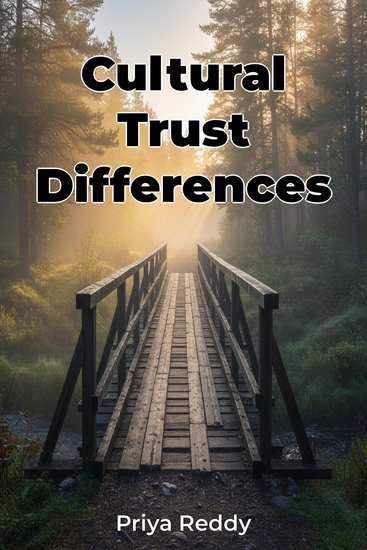
Cultural Trust Differences - cover

Cultural Trust Differences

Priya Reddy

Translator A AI

Publisher: Publifye

  • 0
  • 0
  • 0

Summary

Cultural Trust Differences explores how trust, a cornerstone of society, varies significantly across cultures. It delves into the psychological and social mechanisms that shape trust perceptions and behaviors, illustrating how these differences impact intercultural interactions. The book emphasizes that trust isn't universal but rather a culturally constructed phenomenon deeply rooted in shared experiences and values. Understanding these nuances is vital in our interconnected world, influencing areas from international business to diplomacy. The book examines cultural dimensions like individualism and collectivism, showing how they correlate with trust behaviors. For instance, societies with strong collectivist values may prioritize trust within their in-group, while individualistic cultures might emphasize broader, more generalized trust. By integrating insights from anthropology, social psychology, and international relations, Cultural Trust Differences provides a comprehensive view. Beginning with core trust concepts, the book progresses to examine specific cultural dimensions using case studies from East Asia, Europe, and the Americas. It culminates by exploring practical implications in international business and diplomacy, offering strategies for building cross-cultural trust. This approach makes it a valuable resource for students, researchers, and professionals navigating diverse cultural landscapes.
Available since: 02/21/2025.
Print length: 78 pages.

Other books that might interest you

  • Work (Annotated) - A Story of Experience - cover

    Work (Annotated) - A Story of...

    Louisa May Alcott, June Ann Bristol

    • 0
    • 0
    • 0
    If Little Women is the story of Louisa May Alcott’s childhood, Work is a story of her adulthood. This semi-autobiographical novel takes the listener through a journey of life as a working woman before and after the Civil War. This annotated edition of Work: A Story of Experience includes the unabridged novel by Louisa May Alcott, as well as a biography of the author, written by June Ann Bristol, exploring her life experiences in relation to those of the story’s protagonist.
    Show book
  • Enquiry Concerning the Principles of Morals and Other Works An - cover

    Enquiry Concerning the...

    David Hume

    • 0
    • 0
    • 0
    In his authobiography, David Hume declared unequivocally that this work, An Enquiry Concerning the Principles of Morals (1751) is ‘of all my writings, historical, philosophical, or literary, incomparably the best.’ In it, Hume takes the discussion away from traditional attitudes where either rational or metaphysical issues govern moral principles. Instead, he introduces the human factor, introducing the sentiments and passions inherent in human psychology.  
    In the opening paragraph of his Enquiry he states the ground clearly: ‘There has been a controversy started of late, much better worth examination, concerning the general foundation of Morals; whether they be derived from Reason, or from Sentiment; whether we attain the knowledge of them by a chain of argument and induction, or by an immediate feeling and finer internal sense; whether, like all sound judgement of truth and falsehood, they should be the same to every rational intelligent being; or whether, like the perception of beauty and deformity, they be founded entirely on the particular fabric and constitution of the human species.’ 
    He challenges the notion that reason can dictate moral principles independently of our desires and sentiments, arguing instead that reason serves as a tool to navigate and articulate our moral sentiments. 
    Central to Hume's thesis is the concept of moral approbation and disapprobation, which he contends stem from our natural inclination to feel pleasure or aversion in response to certain actions or traits. 
    He pursues his theme with characteristic clarity, concentrating on topics including benevolence, justice, utility, qualities useful to ourselves and others. He rejects moral absolutism which presumes the existence of immutable moral laws. Throughout, he emphasizes the importance of empathy and compassion as essential components of ethical behaviour.  
    Hume's "An Enquiry Concerning the Principles of Morals" stands as a testament to his profound insight into the complexities of human nature and morality. 
    This recording also contains two essays which also reflect the independence of his views for his time, On Suicide and On the Immortality of the Soul.
    Show book
  • Four Dissertations - A Natural History of Religion Of the Passions Of Tragedy Of the Standard of Taste - cover

    Four Dissertations - A Natural...

    David Hume

    • 0
    • 0
    • 0
    David Hume (1711-1776) remains one of the most stimulating and entertaining writers in the English essay tradition. Though primarily known for long-form writings, he was adept at taking one subject and looking at it in a more concise but accessible manner. 
    Hume devoted his life to study – across a wide range of his personal interests, reflecting his background in philosophy, history, economics, and many other subjects. This can be clearly seen in Four Dissertations (1757) and the topics he chose to consider. 
     
    Of these, The Natural History of Religion is the most well-known and widely quoted. Hume’s views, shaped by empiricism and scepticism, enables him to offer a perspective unusual for his age, though naturally it is embedded in the prevailing view ‘The whole frame of nature bespeaks an intelligent author’. Nevertheless, this does not restrict his thinking as he examines the psychological and sociological factors that shape religious sentiment. 
     
    The other three Dissertations are no less fascinating. Fittingly, in Of The Passions, Hume delves into the complex realm of human emotions. Investigating the nature of desire, love, fear, and more, he presents a wide-ranging study of how passions influence our actions and shape our experiences. 
     
    Of Tragedy, explores the aesthetics of dramatic art. Hume looks into the power of tragedy to elicit a passionate response and provoke contemplation. He examines the mechanisms by which tragedies captivate audiences and evoke a range of sentiments, shedding light on the profound impact of art on human consciousness. 
     
    In Of the Standard of Taste, Hume takes the viewpoint of the beholder, rather than the object. Declaring ‘We are apt to call barbarous whatever departs widely from our own taste and apprehension,’ he proposes that two elements, sentiment and critical faculty form a major part in decisions on taste. For “Beauty is no quality in things themselves: It exists merely in the mind which contemplates them; and each mind perceives a different beauty.” But such a subjective view cannot deny a certain consensus on beauty, which leads Hume to examine the matter of aesthetics in the light of judgements of established critics. 
     
    This recording concludes with Hume’s two short autobiographies, written at different times in his life and with differing characteristics. The first, A Kind of Life (1734) is a letter written to a doctor and the second, My Own Life (1776) was written shortly before his death.
    Show book
  • Nazca Civilization - The Enigmatic Lines and the Desert Kingdom of Peru - cover

    Nazca Civilization - The...

    Rolf Hedger

    • 0
    • 0
    • 0
    The Nazca civilization emerged along the southern coast of present-day Peru, a harsh and arid region that required ingenuity and adaptation for survival. Flourishing between approximately 100 BCE and 800 CE, the Nazca people built upon the cultural and technological advancements of their predecessors, most notably the Paracas culture. The transition from the Paracas to the Nazca was marked by shifts in artistic expression, religious practices, and innovations in agriculture that allowed the new civilization to thrive in the desert landscape. 
    One of the defining characteristics of the Nazca civilization was its ability to adapt to the unforgiving environment. The region’s climate was dry, with little rainfall, yet the Nazca found ways to harness the limited water supply to sustain their agricultural economy. They engineered underground aqueducts known as puquios, a sophisticated irrigation system that transported water from underground sources to the surface, ensuring a steady supply for crops. This ingenuity allowed them to cultivate maize, beans, squash, and cotton, which became essential to their diet and economy. 
    The Nazca culture was also shaped by its geography. The valleys of the Rio Grande de Nazca provided fertile land where the civilization’s settlements and ceremonial centers flourished. Unlike the grand urban centers of the Andean highlands, the Nazca people lived in smaller, dispersed communities that relied on a combination of agriculture and trade. These communities were connected by a shared cultural and religious framework that revolved around the worship of powerful deities linked to nature, fertility, and water.
    Show book
  • Summary: Sapiens - A Brief History of Humankind by Yuval Noah Harari - cover

    Summary: Sapiens - A Brief...

    ExecutiveGrowth Summaries

    • 0
    • 0
    • 0
    Sapiens became a #1 international bestseller and a New York Times bestseller for simple reasons… 
    (Notice: This is a SUMMARY of Yuval Noah Harari’s bestseller, Sapiens: A Brief History of Humankind.) 
    Unlike other macroscopic reviews of human history, Sapiens: A Brief History of Humankind combines the best research into history with recent discoveries in biology and archaeology and complementary disciplines of science. It provides a unique point of view on how we got to where we are today – and what that means for us as a species. 
    Dr. Yuval Noah Harari traces the development of consciousness, above all else. 100,000 years ago Homo Sapiens were insignificant animals – but today they dominate the planet. At some point, the evolution of thinking superseded biological evolution. Much of our 'success' hinges on the importance of the myths and legends – the fictions of our imagination that have played such a vital role in the development of culture, ideology, religion, economics, science – instead of our pure biological traits. 
    Reading our summary is the perfect way to cover the full material and grasp the essential insights of Dr. Harari’s research in a fraction of the time. If you find Dr. Harari’s concepts enticing, we highly advise you to buy the full audiobook! 
    DISCLAIMER: Testimonies show that our professional summaries introduce more readers to the full book who otherwise would have been overwhelmed by the initial commitment. Listeners can use this summary as an introduction or a companion to the original, NOT AS A SUBSTITUTE.
    Show book
  • A Nation Again - The inside story of Scotland's journey to the European Championship - cover

    A Nation Again - The inside...

    Andy Bargh

    • 0
    • 0
    • 0
    A Nation Again is the chaotic tale of the Scotland men's team's return to a major tournament after more than 20 years in the wilderness. 
    Ten had come and gone for Scotland since they reached France '98, but the birth of UEFA's Nations League offered a new route to glory. In early 2018, after a long search for Gordon Strachan's replacement, Alex McLeish became manager for a second time. Despite successfully navigating the Nations League group stage, it wasn't plain sailing, and his tenure ended after a shocking defeat at the start of Euro 2020 qualifying. 
    With a play-off semi-final on the horizon, the Scottish FA turned to Steve Clarke, who took on the challenge of inspiring a team rooted in failure, creating a band-of-brothers mentality and figuring out how to organise this incredibly talented group of players. From a couple of the lowest lows, came the highest high. 
    With exclusive memories and audio from those who were part of the journey, such as John McGinn, Stephen O'Donnell, Lyndon Dykes, Ryan Christie and David Marshall, this is the story of how Scotland finally became a nation again.
    Show book