Join us on a literary world trip!
Add this book to bookshelf
Grey
Write a new comment Default profile 50px
Grey
Subscribe to read the full book or read the first pages for free!
All characters reduced
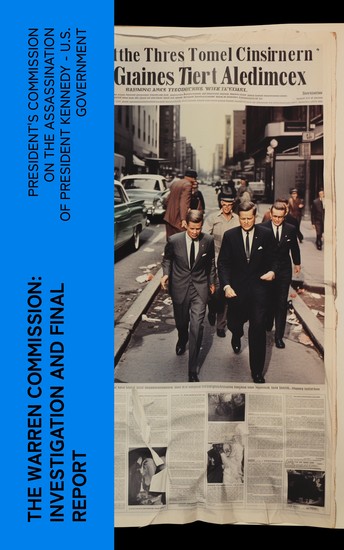
The Warren Commission: Investigation and Final Report - cover

The Warren Commission: Investigation and Final Report

President's Commission on the Assassination of President Kennedy U.S. Government

Publisher: e-artnow

  • 0
  • 0
  • 0

Summary

The President's Commission on the Assassination of President Kennedy, known unofficially as the Warren Commission, was established by President Lyndon B. Johnson through Executive Order 11130 on November 29, 1963 to investigate the assassination of United States President John F. Kennedy that had taken place on November 22, 1963.  This book includes the Commission's report, which was based on the investigation, as well as all the supporting documents collected during the investigation, and the testimony or depositions of 552 witnesses.
Available since: 12/13/2023.
Print length: 10367 pages.

Other books that might interest you

  • Schooling Secrets: The Hidden Truth Behind Our Education System - "Elevate your learning journey with insightful audio lessons exposing the hidden truths of education!" - cover

    Schooling Secrets: The Hidden...

    Lysander Mortimer

    • 0
    • 0
    • 0
    Schooling Secrets: The Hidden Truth Behind Our Education System   
    ⭐⭐ Simplified Guide & Explanations Included⭐⭐ 
    Are you eager to advance in your career and deepen your understanding of the education system? 
    Looking for a comprehensive resource that unveils the hidden truths about our educational landscape? 
    Your quest ends here! 
    This guide is your ultimate tool for enhancing your knowledge, applying your skills, and engaging in practical exercises. With this resource, you're well-equipped for success. 
    Updated for the latest education insights. 
    Key features of this insightful guide include: 
    - In-depth analysis of the current education system 
    - Clear explanations of the transformative truths that can reshape education 
    - Effective strategies for understanding and implementing changes in education 
    What sets our guide apart is its thoroughness, which is essential for your mastery of this critical subject. Concepts are explored in detail, not just superficially addressed. 
    Please be aware that this guide is an independent resource and is not associated with any official educational institutions. 
    Crafted with a straightforward structure and accessible language, our guide ensures smooth navigation between topics. Say goodbye to complicated jargon and hello to clear, concise, and accurate content. 
    So, why delay? Click the BUY NOW button, secure your copy, and embark on your journey to mastering the truths that can transform education today!
    Show book
  • The Shocking Truth about Online Privacy - cover

    The Shocking Truth about Online...

    Zoey Fraisers

    • 0
    • 0
    • 0
    In today’s digital world, privacy is no longer a given—it’s something we must actively fight to protect. Every time we browse the web, use social media, or make online purchases, we leave behind a trail of personal data. This data is collected, analyzed, and often sold without our knowledge. Many people believe that if they have “nothing to hide,” they have nothing to worry about. However, this misconception ignores the real risks of online privacy erosion.  
      
    Companies, governments, and cybercriminals are constantly gathering information about individuals, using it for targeted advertising, surveillance, and even fraud. The websites you visit, the products you search for, and even the time you spend on a page are all tracked to create a detailed profile of who you are. This data is used to manipulate consumer behavior, influence political opinions, and, in some cases, restrict freedoms. Governments argue that surveillance is necessary for national security, but history has shown that mass data collection can lead to severe privacy violations and even oppression.  
      
    Beyond corporations and governments, cybercriminals exploit the vast amount of personal information available online. Data breaches have become more frequent, exposing millions of users to identity theft, fraud, and financial losses. Social engineering scams take advantage of publicly available data, making it easier for criminals to deceive and manipulate individuals. The more our private information is exposed, the more vulnerable we become to digital threats. 
    Show book
  • The Representativeness Heuristic - Judging Likelihood on Similarity - cover

    The Representativeness Heuristic...

    William Rands

    • 0
    • 0
    • 0
    The representativeness heuristic is one of the most influential concepts in cognitive psychology, profoundly shaping the way individuals make judgments and decisions. First introduced by psychologists Amos Tversky and Daniel Kahneman, this heuristic explains how people often assess probabilities and likelihoods based on how closely an event or object resembles a prototype or existing mental model. While this cognitive shortcut can be useful in navigating a complex world, it also introduces biases that distort reasoning and lead to systematic errors. 
    At its core, the representativeness heuristic simplifies decision-making by allowing individuals to rely on surface-level similarities rather than delving into deeper, more complex analyses. For example, if someone observes a well-dressed, articulate individual discussing financial markets, they might assume the person is a financial expert, even without any concrete evidence. This judgment stems from the resemblance of the observed traits to the prototype of a financial expert. However, such assumptions often overlook critical information, such as actual expertise or experience. 
    The origins of the heuristic lie in the evolutionary need for humans to make rapid decisions in uncertain environments. In situations where time and resources are limited, relying on similarity and pattern recognition can provide a survival advantage. While these mechanisms were effective in ancestral contexts, their application to modern, complex scenarios often leads to cognitive pitfalls. In many cases, the representativeness heuristic prompts individuals to ignore statistical data, base rates, and other relevant information in favor of intuitive judgments.
    Show book
  • The Forgotten Slave Trade - The White European Slaves of Islam - cover

    The Forgotten Slave Trade - The...

    Simon Webb

    • 0
    • 0
    • 0
    Everybody knows about the transatlantic slave trade. A century before Britain became involved in this terrible business, whole villages and towns in England, Ireland, Italy, Spain, and other European countries were being depopulated by slavers, who transported the men, women, and children to Africa where they were sold. This is the forgotten slave trade; one which saw over a million Christians forced into captivity in the Muslim world. 


    Starting with the practice of slavery in the ancient world, Simon Webb traces the history of slavery in Europe, showing that the numbers involved were vast and that the victims were often treated far more cruelly than black slaves in America and the Caribbean. Castration, used very occasionally against black slaves taken across the Atlantic, was routinely carried out on an industrial scale on European boys who were exported to Africa and the Middle East. Most people are aware that the English city of Bristol was a major center for the transatlantic slave trade in the eighteenth century, but hardly anyone knows that 1,000 years earlier it had been an important staging-post for the transfer of English slaves to Africa. 


    This book will forever change how you view the slave trade and show that many commonly held beliefs about this controversial subject are almost wholly inaccurate and mistaken.
    Show book
  • Schizophrenia - Coping with Reality Distortions and Finding Support - cover

    Schizophrenia - Coping with...

    Coral Nunez

    • 0
    • 0
    • 0
    Schizophrenia is a complex and often misunderstood mental health disorder that affects a person’s thoughts, emotions, and behaviors. It is characterized by episodes of psychosis, which can include hallucinations, delusions, disorganized thinking, and impaired social functioning. While schizophrenia is a chronic condition, with proper treatment and support, many individuals can manage their symptoms and lead fulfilling lives. 
    Schizophrenia does not manifest in the same way for everyone. Some individuals may experience severe and persistent symptoms, while others may have periods of stability with occasional relapses. The disorder typically emerges in late adolescence or early adulthood, although it can develop later in life. Early detection and intervention are crucial in improving long-term outcomes. 
    There are several subtypes of schizophrenia, each presenting with different symptom patterns. Paranoid schizophrenia, once considered a distinct type, involves intense delusions and auditory hallucinations, often revolving around themes of persecution. Disorganized schizophrenia is marked by disorganized speech, erratic behavior, and difficulty with daily activities. Catatonic schizophrenia presents with extreme motor disturbances, including periods of excessive movement or complete immobility. While these classifications have evolved in recent psychiatric frameworks, they still help in understanding the diverse ways schizophrenia can manifest.
    Show book
  • The Era of Faith - 632-1667CE - cover

    The Era of Faith - 632-1667CE

    Pope Urban II, Pico della...

    • 0
    • 0
    • 0
    Five speeches from a millennium shaped by faith and empire.632CE. In Muhammed’s farewell address, he lauds his people for their achievements and virtues, and gives them his final instructions for living within the faith.In 1095, Pope Urban II’s Against The Infidels speech launches the Crusades, which lasted for another two hundred years. In it the Pope exhorts his clergy to make true the promise of Christianity and rise against their weaker natures and the enemy in the east.Pico della Mirandola’s Oration On The Dignity Of Man has been described as “the manifesto of the Renaissance”, and is an introduction to his 900 Theses, which was the first printed book ever banned by the Church. Written in 1486, it weaves together philosophy and theology from across history and the world. While Christian, it is a review of the philosophies and religions of the ages.The first section details man’s supremacy over all other beings but God, due to his inherent mutability. The second section dives into the value of philosophy and theology, preparing a discussion of Christian magic and mystery. The final section explores a positive conception of Christian magic, placing it in ancient traditions of magic.In 1588, Elizabeth I’s speech rouses her forces against the Spanish Armada. The Armada came to conquer England and re-establish Catholicism as the state religion. The ensuing conflict is one of England’s great military victories. It includes the famous line “I know I have but the body of a weak and feeble woman; but I have the heart of a king, and of a king of England, too”.John Milton, Satan’s First Speech, Paradise Lost, 1667. We end the volume with a speech against faith and monarchy, which gives us the phrase “Better to reign in Hell, then serve in Heav'n.” Paradise Lost explores the limits of both divinity and monarchy, and marks the end of an age where the two combined to rule the world.
    Show book