Join us on a literary world trip!
Add this book to bookshelf
Grey
Write a new comment Default profile 50px
Grey
Subscribe to read the full book or read the first pages for free!
All characters reduced
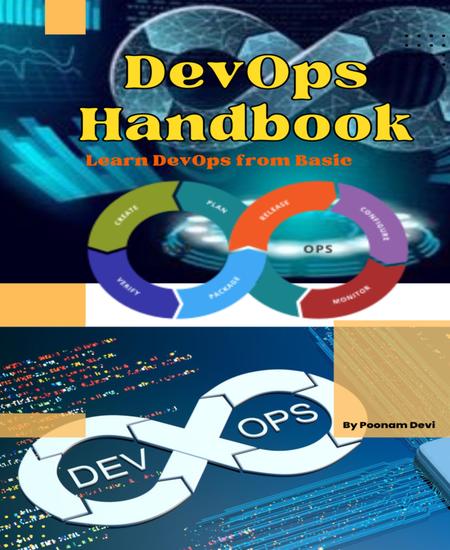
DevOps Handbook - DevOps eBook for IT Professionals - cover

DevOps Handbook - DevOps eBook for IT Professionals

POONAM DEVI

Publisher: BookRix

  • 0
  • 0
  • 0

Summary

"Unlock the Power of DevOps: Streamline Your Software Development and Operations for Unprecedented Efficiency and Innovation!
In today's fast-paced digital landscape, businesses must evolve or risk falling behind. DevOps, the transformative practice that fuses development and operations, is the key to staying competitive.
Our comprehensive guide, 'Unlocking DevOps Brilliance,' is your essential roadmap to mastering the DevOps methodology. Whether you're an IT professional, developer, manager, or executive, this book empowers you to break down the silos, automate processes, and accelerate software delivery.
Discover:

- Proven DevOps strategies and best practices
- Real-world success stories from leading organizations
- Expert insights on automation, CI/CD, and cloud technologies
- Strategies for fostering a culture of collaboration and innovationEmbrace DevOps, and revolutionize your software development lifecycle. Unleash the potential of your teams, drive faster releases, and achieve unparalleled agility in the ever-evolving tech landscape. 'Unlocking DevOps Brilliance' is your essential guide to building a brighter, more efficient future."
Feel free to tailor this blurb to the specific focus and goals of your DevOps book or resource.
Available since: 09/04/2023.
Print length: 47 pages.
Other books that might interest you

  • Human-Centered Design - Crafting Meaningful and User-Friendly Experiences - cover

    Human-Centered Design - Crafting...

    Jacob Richardson

    • 0
    • 0
    • 0
    In a world where technology evolves at breakneck speed, creating products and services that truly resonate with users is more important than ever. Human-Centered Design: Crafting Meaningful and User-Friendly Experiences offers a comprehensive guide to understanding and implementing the principles of Human-Centered Design (HCD) to deliver solutions that are not only functional but also deeply satisfying to the people who use them. 
    This book delves into the essence of HCD, emphasizing the importance of empathy, collaboration, and iteration in the design process. Through detailed explanations, real-world case studies, and practical exercises, readers will learn how to:Conduct thorough user research to uncover genuine needs and pain points.Develop insightful user personas and problem statements to guide the design process.Utilize brainstorming and ideation techniques to generate innovative concepts.Create effective prototypes and conduct meaningful usability tests to refine solutions.Leverage the latest tools and technologies in digital design, prototyping, and user feedback. 
    From technology and product design to healthcare and urban planning, this book explores how HCD can be applied across various fields to achieve impactful results. It also addresses the challenges of balancing user needs with business goals and overcoming resistance to change within organizations. 
    Human-Centered Design: Crafting Meaningful and User-Friendly Experiences is an essential resource that will inspire you to put people at the heart of your design process and deliver solutions that make a difference. 
     
    Show book
  • My Instruments Lied to Me Six Times - Building and Testing LLM Systems in Production and How to Find Out What Is Actually True - cover

    My Instruments Lied to Me Six...

    Nikolaos Broikos

    • 0
    • 0
    • 0
    This audiobook is narrated by an AI Voice. Six times during this programme, something the author had built reported a confident falsehood. Not one of the six was caught by a check he had written. 
     
    One of them was the strongest finding in the entire project: a perfect result, every trial, in the direction the whole field expects. It was completely false, and the only thing that caught it was opening a file and reading what the model had actually said. 
     
    This is the instrument book. How to build a comparison that means something. How to find out what a wrong answer scores on your own tests, before you report a score at all. How to prove a grader can fail before you let it grade anything. Why an evaluator's error rate tells you almost nothing and its error direction tells you everything. 
     
    Every method in it is a few hundred lines of ordinary code with no dependencies, and every one of them exists because something went wrong first. 
     
    It is also, unusually, a book that documents its own failures at full length: the detector that looked for one set form of words and reported ninety-six fabrications where there were none, the check that compared a string against a pair of values and therefore could never fail, the average built from six outliers of ninety-six. Not as a confession, but because the pattern in how they were found is the most transferable thing here. 
     
    For anybody who has to decide something about an AI system and would rather decide it on evidence than on somebody's confidence.
    Show book
  • Mushroom Gastronomy - The Art of Cooking with Mushrooms - cover

    Mushroom Gastronomy - The Art of...

    Krista Towns

    • 0
    • 0
    • 0
    Whether you forage for elusive mushrooms in the woods, at your local grocery, or farmers market, or are new to cooking with them, Mushroom Gastronomy is a long-awaited new cookbook that will prepare you for an exciting culinary journey into the world of edible mushrooms. The book explores 25 of the most popular edible and delicious mushrooms. Stunning photographs introduce each variety, including their unique nutritional values, ideal cooking methods, culinary tips, and flavor pairings, making this book a go-to resource for anyone interested in cooking with mushrooms.
    Show book
  • Addison’s Antidote - cover

    Addison’s Antidote

    Craig Beck

    • 0
    • 0
    • 0
    Millions of people around the world have been diagnosed with incurable autoimmune diseases like Addison’s. Debilitating conditions that make us tired, ill, and miserable. The only solution the medical industry offers are side-effect riddled maintenance drugs such as steroids and painkillers.Getting a formal diagnosis of Addison’s Disease is often a lengthy and challenging process. Many never get a medical confirmation of what is happening to their mind and body at all! Countless individuals live in constant pain and discomfort because they incorrectly assume all their health problems are the natural result of aging.Unfortunately, Craig Beck joined this ill-health demographic at the age of 48. After suffering months of severe symptoms, eventually, he too got handed the autoimmunity life sentence. However, rather than accept the hand as it was dealt. He remembered that the best medicine for a long and healthy life is found at the end of your fork, not the doctor's prescription pad. Craig decided to fall back on his research into natural medicine. He designed a diet and lifestyle that made inflammation the enemy and target. A process that would show amazing success at pushing Addison’s Disease firmly into near-permanent remission. In this special Addison’s addition of the Autoimmune Antidote, you will gain valuable insight into the new, natural approach that can help you prevent and maybe even reverse the life-limiting symptoms of Addison’s Disease and other inflammatory health problems. www.CraigBeck.com
    Show book
  • The Social Genome - The New Science of Nature and Nurture - cover

    The Social Genome - The New...

    Dalton Conley

    • 0
    • 0
    • 0
    A pioneering scientist presents a mind-expanding account of the sociogenomics revolution, which promises to upend everything we know about human development. 


    Sociogenomics brings together advances in molecular genetics and traditional social and behavioral science. The key tool is the polygenic index, which allows us to analyze DNA to measure a child's genetic potential. Today, we can estimate a child's adult height, how far they will go in school, and their weight as an adult—all from a cheek swab, finger prick, or vial of saliva. Dalton Conley and other researchers are using this new science to shed light on the ways in which genes shape our world, influencing how each person both creates and responds to the environment around them. Conley reveals a world where children's DNA influences the nurture they extract from their parents; the genes of our schoolmates affect our likelihood of smoking as much as our own DNA does; and spouses' genes influence each other's moods and behaviors. 


    The Social Genome presents a nuanced, powerful perspective on individual potential and social dynamics and raises critical ethical questions about how we will navigate a future where we have access to far more genetic information than ever before.
    Show book
  • The Environmental Unconscious - Ecological Poetics from Spenser to Milton - cover

    The Environmental Unconscious -...

    Steven Swarbrick

    • 0
    • 0
    • 0
    Why has psychoanalysis long been kept at the margins of environmental criticism despite the theories of eco-Marxism, queer ecology, and eco-deconstruction available today? What is unique, possibly even traumatic, about eco-psychoanalysis? The Environmental Unconscious addresses these questions as it provides an innovative and theoretical account of environmental loss focused on the counterintuitive forms of enjoyment that early modern poetry and psychoanalysis jointly theorize. 


    Steven Swarbrick urges literary critics and environmental scholars to rethink notions of entanglement, animacy, and consciousness raising. Through close readings of Edmund Spenser, Walter Ralegh, Andrew Marvell, and John Milton, he reveals a world of matter that is not merely hyperconnected, as in the new materialism, but porous and off-kilter. And yet the loss these poets reveal is central to the enjoyment their works offer—and that nature offers. 


    The Environmental Unconscious offers a provocative challenge to ecocriticism that a new theory of disconnection is desperately needed. Tracing the propulsive force of the environmental unconscious from the early modern period to Freudian and post-Freudian theories of desire, Swarbrick not only puts nature on the couch in this book but also renews the psychoanalytic toolkit in light of environmental collapse.
    Show book