Join us on a literary world trip!
Add this book to bookshelf
Grey
Write a new comment Default profile 50px
Grey
Subscribe to read the full book or read the first pages for free!
All characters reduced
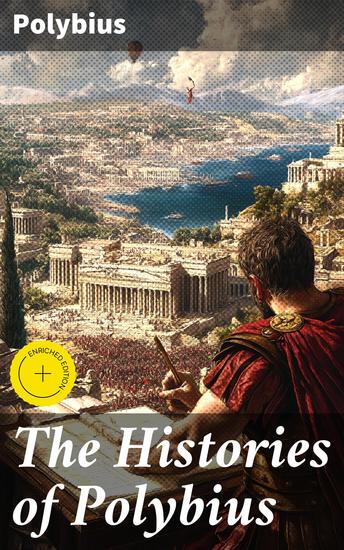
The Histories of Polybius - Unraveling the Roman Republic: A Comprehensive Account of Politics Warfare and Governance in Ancient Rome - cover

The Histories of Polybius - Unraveling the Roman Republic: A Comprehensive Account of Politics Warfare and Governance in Ancient Rome

Polybius

Translator Evelyn Shirley Shuckburgh, Friedrich Hultsch

Publisher: Good Press

  • 0
  • 0
  • 0

Summary

In "The Histories of Polybius," the ancient historian offers a meticulous account of the rise of the Roman Republic and its dominion over the Mediterranean world from 264 to 146 BCE. Written with striking clarity and employing a rigorous analytical style, Polybius' work is characterized by a systematic approach that emphasizes causation and the importance of firsthand evidence. He delves deeply into the interplay of military and political events, framing them within the context of broader philosophical themes, thus situating his text within the traditions of Hellenistic historiography. His innovative narrative techniques, combining anecdotal details with a comprehensive evaluation of power dynamics, have positioned this work as a cornerstone in historical writing, influencing future generations of historians. Polybius, born into a prominent Greek family of Megalopolis, was not only a witness to the tumultuous events of his time but also a participant in the political machinations that shaped them. His experience as a prisoner in Rome afforded him unique insights into Roman governance and society, leading him to explore themes of fate, fortune, and the cyclical nature of history. His intellectual lineage, steeped in Stoicism and the teachings of earlier historians, further informed his analytical lens, allowing him to craft a narrative that remains relevant. This seminal work is an essential read for anyone seeking to understand the complexities of ancient warfare, politics, and the evolution of one of history's greatest powers. Scholars, students, and enthusiasts of ancient history will find Polybius captivatingly informative, as he seamlessly intertwines critical events with the philosophical implications, inviting readers to contemplate the nature of power and progress in the ancient world.
Available since: 11/18/2023.
Print length: 1083 pages.

Other books that might interest you

  • Generational Wealth: Rich From The Inside Out - cover

    Generational Wealth: Rich From...

    Professor Gee

    • 0
    • 0
    • 0
    Generational Wealth: Rich From the Inside Out is not just about money. It's about building lasting success through character, discipline, and purpose. This book explores the core values that create true generational wealth, including integrity, humility, accountability, effective communication and comprehension skills, while being a boundless & perpetual learner. It's designed to empower individuals from all walks of life by combining timeless wisdom with practical insights for real-life application. Whether you're seeking personal growth or financial stability, this book offers a blueprint for becoming the kind of person success was meant to follow. 
    The book is designed to complement the teachings found on seeyourdollar.com—which is a platform dedicated to educating underserved communities about the core principles of financial literacy. While the website focuses on the numbers, such as compound interest, credit formulas, cash flow, and how money actually works, this book focuses on the values that numbers could never teach and the traits that money could never buy. 
    Because wealth doesn't follow the individual; it follows the principles applied by the individual!
    Show book
  • Bridging Spirit and Science - Integrating Spiritual Abilities with Technology for a New Human Future - cover

    Bridging Spirit and Science -...

    Martin K. Ettington

    • 0
    • 0
    • 0
    Spirit and Science are viewed as opposing views. I have lived my life in the middle of this divide. Trained as an engineer and scientist, I was taught to trust logic, mathematics, and experimental proof.  
    Yet my personal experiences — from moments of prophecy to direct awareness of subtle energies — convinced me that there is more to reality than conventional science admits.  
    For years I tried to keep the two worlds separate: the rational and the mystical. But over time, the boundary dissolved. I realized that both perspectives describe the same universe from different vantage points.  
    My work, and this book in particular, is about restoring the unity that once existed between them. 
    The purpose of this book is not to replace science with mysticism, nor to reduce spiritual experience to chemistry or neurology. Rather, it aims to show that consciousness, energy, and matter are aspects of a single integrated system.
    Show book
  • Tao te Ching - cover

    Tao te Ching

    Lao-Tzu

    • 0
    • 0
    • 0
    The Tao te Ching by the shadowy figure Lao-Tzu is the seminal text for the philosophical and religious tradition of Taoism. Scholars date the text to the 4th century BC and it has since become one of the most widely translated texts after the bible. The 'Book of the Way' is the philosopher's quintessential hand book for the art of living in accordance with Tao. At 5000 Chinese characters organized into 81 chapters the Tao te Ching is a short, yet poetic and esoteric experience.
    Show book
  • Steel Drivin' Man: John Henry the Untold Story of an American Legend - cover

    Steel Drivin' Man: John Henry...

    Scott Reynolds Nelson

    • 0
    • 0
    • 0
    The ballad "John Henry" is the most recorded folk song in American history and John Henry--the mighty railroad man who could blast through rock faster than a steam drill--is a towering figure in our culture. 
    In Steel Drivin' Man, Scott Reynolds Nelson recounts the true story of the man behind the iconic American hero, telling the poignant tale of a young Virginia convict who died working on one of the most dangerous enterprises of the time, the first rail route through the Appalachian Mountains. Using census data, penitentiary reports, and railroad company reports, Nelson reveals how John Henry, victimized by Virginia's notorious Black Codes, was shipped to the infamous Richmond Penitentiary to become prisoner number 497, and was forced to labor on the mile-long Lewis Tunnel for the C&O railroad. Equally important, Nelson masterfully captures the life of the ballad of John Henry, tracing the song's evolution from the first printed score by blues legend W. C. Handy, to Carl Sandburg's use of the ballad to become the first "folk singer," to the upbeat version by Tennessee Ernie Ford. 
    Attractively illustrated with numerous images, Steel Drivin' Man offers a marvelous portrait of a beloved folk song--and a true American legend.
    Show book
  • Complete Works of Marcus Aurelius - Meditations The Speeches of Marcus The Sayings of Marcus - cover

    Complete Works of Marcus...

    Marcus Aurelius

    • 0
    • 0
    • 0
    This comprehensive  presents the complete extant works of Marcus Aurelius relating to Marcus' life and works.Marcus Aurelius was a Roman Emperor from 161 to 180, known as one of the last of the Five Good Emperors, and is also considered one of the most important Stoic philosophers.Contents:MeditationsThe Speeches of MarcusThe Sayings of Marcus
    Show book
  • Sadists - World War II Torturers Generals and Cruel Nazi Scientists - cover

    Sadists - World War II Torturers...

    Kelly Mass

    • 0
    • 0
    • 0
    This is a combo of several books, which are: 
    1: Josef Mengele - Fiction books have been written about him. Documentaries have revealed the horrors he executed on innocent victims in concentration camps in Poland. Meet Dr. Josef Mengele, a man with a twisted mind who had no compassion for the subjects he experimented on. His methods were cruel. His conclusions were inconclusive, and his sadism hardly knew any boundaries. 
    2: Adolf Eichmann - You thought Adolf Hitler was bad. Well, someone who was less fortunate with power and control but equally sadistic was one of his slightly lower officers: Adolf Eichmann, the man who was in charge of many of the Holocaust deportations. In this book, you will learn more about the life of Eichmann, someone who had been slowly getting used to the idea that supposedly, the Jews were inferior and were allegedly a problem for the German civilization. 
    3: Paul Goebbels - There are doers and there are preachers. The people who were executing orders or abusing people in World War 2 wouldn’t have been able to commit any atrocities if the country hadn’t warmed up to an inhumane narrative. That’s where propaganda came in. Propaganda has long been part of various countries and societies to make the population believe something, and to find culprits, create feelings of animosity, and glorify local leaders or military campaigns. 
    4: Rudolf Hoess - We’ve all had our humble beginnings, and we seemed so innocent as children. However, for some people, given their childhood and circumstances, and then the political or war-driven environment they face, it goes completely wrong. Such was the case for Rudolf Hoess, a cruel, murderous Nazi commander who had been brainwashed by the system that justified his aid in exterminating millions of Jews.
    Show book