Join us on a literary world trip!
Add this book to bookshelf
Grey
Write a new comment Default profile 50px
Grey
Subscribe to read the full book or read the first pages for free!
All characters reduced
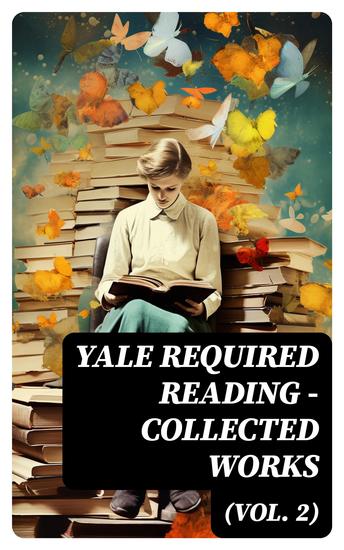
Yale Required Reading - Collected Works (Vol 2) - The Rise and Fall of Rome: The Greatest Works of the Roman Classical Literature - cover

Yale Required Reading - Collected Works (Vol 2) - The Rise and Fall of Rome: The Greatest Works of the Roman Classical Literature

Lucius Annaeus Seneca, Julius Caesar, Boethius, Horace, Plutarch Plutarch, Apuleius, Virgil Virgil, Persius, Terence, Ammianus Marcellinus, Sallust, Juvenal, Lucan, Suetonius, Tibullus Tibullus, Tacitus Tacitus, Petronius, Cornelius Nepos, Lucretius Lucretius, Martial, Catullus, Cicero Cicero, Claudian, Pliny the Younger, Saint Augustine of Hippo, Plautus, Ennius, Propertius, The Metamorphoses, Augustus, Quintilian

Translator Alfred John Church, Paul Nixon, J. S. J.S.Watson, Christopher Smart, William Rose, James Rhodes, Lewis Evans, John William Mackail, William Jackson Brodribb, W. A. McDevitte, W. S. Bohn, Henry Thomas Riley, William Ellery Leonard, Frederick Charles Tindal Bosanquet, E. Jones, Robinson Ellis, Harold Edgeworth Butler, Theodore Chickering Williams, John Selby Watson, Frederick W. Shipley, William Charles Firebaugh, Maurice Platnauer

Publisher: DigiCat

  • 0
  • 0
  • 0

Summary

Yale Required Reading - Collected Works (Vol. 2) presents a rich tapestry of classical literature that illuminates the diversity and depth within the Roman literary canon. This anthology encompasses a wide array of themes, from the political discourse of Julius Caesar and Suetonius to the philosophical musings of Seneca and Saint Augustine. Readers will find themselves immersed in the poetic eloquence of Virgil and Horace, as well as the satirical sharpness of Juvenal and Martial. Through its curated selection of historical, philosophical, and satirical works, this volume provides a comprehensive overview of Roman literary traditions and their lasting impact on Western thought. The anthology draws together voices from an impressive array of backgrounds, each contributing uniquely to the collection's thematic richness. Figures like Cicero and Tacitus reflect the influence of Roman rhetoric and historiography, while writers such as Pliny the Younger and Quintilian exemplify the philosophical and educational ideals of the time. These works collectively speak to cultural and historical movements that shaped their era, including Stoicism, the dynamics of the Roman Empire, and the Christianization of Late Antiquity. This diversity not only highlights individual authors' contributions but also sheds light on the evolution of Roman society. Yale Required Reading - Collected Works (Vol. 2) is an essential resource for anyone wishing to explore the multifaceted perspectives of Roman literature. It invites readers not only to engage with seminal texts that have shaped literary and philosophical traditions but also to appreciate the complexity and nuance within each work. Whether for educational purposes or personal enrichment, this anthology offers a gateway to the profound dialogue between these enduring classics, making it a truly enlightening addition to any reader's library.
Available since: 11/27/2023.
Print length: 7732 pages.
Other books that might interest you

  • Finding my rainbow - cover

    Finding my rainbow

    Yvonne Junor

    • 0
    • 0
    • 0
    Growing up in Melbourne during the sixties as a baby boomer, Yvonne's dreams were to find a life partner, build a home, raise a family, start a career and travel.The trajectory her life was changed forever when her husband took his life.Now she faces the challenges of raising their two children alone. This begins a transformative journey of self-empowerment and rediscovering what defines her identity.Yvonne shares her travails through career pathways, dealing with relationships, what travel has meant for her, the passion she has for food, exploring and defining spirituality, navigating physical, mental and emotional health and dealing with COVID lockdowns.In her quest for healing she learns some 'truths' about love, forgiveness, authenticity and turning a tragedy into a triumph.Finding My Rainbow is a memoir of loss, heartbreak and self-discovery, a story that'll move and inspire you to find your own inner strength.
    Show book
  • Ozzy Osbourne: The Prince of Darkness - Unauthorized Biography - cover

    Ozzy Osbourne: The Prince of...

    Silas Penwick

    • 0
    • 0
    • 0
    This audiobook is an independent journalistic and historical work based entirely on publicly available sources. It is not authorized, endorsed, or affiliated with Ozzy Osbourne, his family, or his official representatives. All facts presented are derived from credible, documented public records, interviews, and media reports. Any opinions expressed are solely those of the author. 
    Ozzy Osbourne: The Prince of Darkness is a journalistic and cultural chronicle spanning more than five decades in the life and career of one of the most influential figures in rock and heavy metal. From his childhood on the industrial streets of Birmingham to his rise as a global icon, this account delves into his years with Black Sabbath, his reinvention as a solo artist alongside Randy Rhoads, the most controversial moments of his career, and the tragedies that shaped his life. It also explores his adaptability in the MTV era, the creation of the Ozzfest festival, and the unexpected success of The Osbournes on television.
    Show book
  • Corrie Ten Boom - Evangelical Hero - cover

    Corrie Ten Boom - Evangelical Hero

    Joel R. Beeke, Douglas Bond

    • 0
    • 0
    • 0
    What do George Whitefield, Elisabeth Elliot, and J. Gresham Machen have in common? They were all Evangelical Heroes. In the Evangelical Heroes series, Joel Beeke and Douglas Bond present thirty biographical sketches of faithful evangelical leaders from the eighteenth, nineteenth, and twentieth centuries. From George Whitfield to Charles Spurgeon to R.C. Sproul, these men and women held firm to the authority of Scripture and the reality of Christ's death and resurrection in the face of rising liberalism in the Church. These inspiring volumes introduce us to faithful Christians from the past and encourage us to stand firm today!
    Show book
  • Aloysha the Pot - From their pens to your ears genius in every story - cover

    Aloysha the Pot - From their...

    Leo Tolstoy

    • 0
    • 0
    • 0
    Leo Tolstoy was born in 1828 in the Russian province of Tula to a wealthy noble family. As a child, he had private tutors but he showed little interest in any formal education. When he went to the University of Kazan in 1843 to study oriental languages and law, he left without completing his courses.  Life now was relaxed and idle but with some writing also taking place.  Gambling debts forced an abrupt change of path and he joined the army to fight in the Crimean War.  He was commended for his bravery and promoted but was appalled at the brutality and loss of life.  He recorded these and other earlier experiences in his diaries which formed the basis of several of his works. 
    In 1852 ‘Childhood’ was published to immediate success and was followed by ‘Boyhood’ and ‘Youth’. 
    His experience in the army and the horrors he witnessed resulted in ‘The Cossacks’ in 1862 and the trilogy ‘Sevastopol Tales’. After the war he travelled around Europe, visiting London and Paris and meeting such luminaries as Victor Hugo and Charles Darwin.  
    It was now that Tolstoy began his masterpiece, ‘War and Peace’. Published in 1869 it was an epic work that changed literature. He quickly followed this with ‘Anna Karenina’.  
    These successes made Tolstoy rich and helped him accomplish many of his dreams but also brought problems as he grappled with his faith and the lot of the oppressed poor. These revolutionary views became so popular that the authorities now kept him under surveillance.  
    He led a life of asceticism and vegetarianism and put his socialist ideals into practice by establishing numerous schools for the poor and food programmes. He also believed in giving away his wealth, which caused much discord with his wife.  
    His writing continued to bring forth classics such as ‘The Death of Ivan Ilyich’ and many brilliant and incisive short stories such as ‘How Much Land Does A Man Need’.  
    In 1901 Tolstoy was excommunicated from the Church and controversially deselected for the Nobel Prize for Literature. 
    Whilst undertaking a pilgrimage by train in October 1910 with his daughter Aleksandra he caught pneumonia in the nearby town of Astapovo.  Leo Tolstoy died on November 9th, 1910, he was 82.
    Show book
  • God of Sperm - Cappy Rothman's Life in Conception - cover

    God of Sperm - Cappy Rothman's...

    Joe Donnelly

    • 0
    • 0
    • 0
    God of Sperm tells the remarkable story of Dr. Cappy Miles Rothman, the son of notorious gangster Norman "Roughhouse" Rothman,  who went on to become a trailblazer in the field of reproductive medicine. 


    Rothman started the California Cryobank, one of the world's largest repositories of reproductive genetic material and cord-blood stem cells. Among other achievements, Rothman also pioneered the use of microsurgery in urological procedures, postmortem sperm retrieval techniques, and was one of the first practitioners of andrology, a specialty dealing with male reproductive biology and medicine. 


    How Cappy Rothman went from Mafia scion and man-about-town during the postwar Miami Beach–Havana era of gangster chic to one of the most consequential figures in modern medicine is an epic, only-in-America tale and also a fine reminder of the broad horizons and wild possibilities life in the US can offer.
    Show book
  • Hitler's Boy Soldiers - How My Father's Generation Was Trained to Kill and Sent to Die for Germany - cover

    Hitler's Boy Soldiers - How My...

    Helene Munson

    • 0
    • 0
    • 0
    Helene Munson resurrects her father’s WWII journals and embarks on a meticulous investigation, exposing how the Nazis trained 300,000 impressionable children as soldiers. In 1937, Munson’s father, Hans, was enrolled in an elite German school whose students were destined to take leadership roles in the Reich. At fifteen, he was drafted as an antiaircraft gunner—along with the rest of the Hitler Youth—and assigned to an SS unit. As the war was being lost, Hans and his schoolmates were ordered to the front lines. Few returned. A personal lens into a nation’s shameful past, Hitler’s Boy Soldiers documents the history of the largest army of child soldiers in recent memory. Munson explores the lifelong effects on brainwashed children coerced to join a party they didn’t understand. Both a modern narrative and an important historical contribution, Hitler’s Boy Soldiers grapples with inherited trauma, the nature of being victim or perpetrator, and the burden of guilt.
    Show book