Join us on a literary world trip!
Add this book to bookshelf
Grey
Write a new comment Default profile 50px
Grey
Subscribe to read the full book or read the first pages for free!
All characters reduced
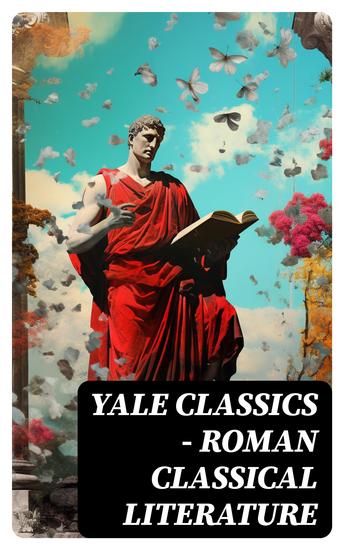
Yale Classics - Roman Classical Literature - Enriched edition - cover

Yale Classics - Roman Classical Literature - Enriched edition

Lucius Annaeus Seneca, Julius Caesar, Boethius, Horace, Plutarch Plutarch, Apuleius, Virgil Virgil, Persius, Terence, Ammianus Marcellinus, Sallust, Juvenal, Lucan, Suetonius, Tibullus Tibullus, Tacitus Tacitus, Petronius, Cornelius Nepos, Lucretius Lucretius, Martial, Catullus, Cicero Cicero, Claudian, Pliny the Younger, Saint Augustine of Hippo, Plautus, Ennius, The Metamorphoses, Augustus, Quintilian

Translator Alfred John Church, Paul Nixon, J. S. J.S.Watson, Christopher Smart, William Rose, James Rhodes, Lewis Evans, John William Mackail, William Jackson Brodribb, W. A. McDevitte, W. S. Bohn, Richard Mott Gummere, Henry Thomas Riley, William Ellery Leonard, Frederick Charles Tindal Bosanquet, E. Jones, Robinson Ellis, Harold Edgeworth Butler, Theodore Chickering Williams, John Selby Watson, Frederick W. Shipley, Edward Ridley, William Charles Firebaugh, Maurice Platnauer

Publisher: DigiCat

  • 0
  • 0
  • 0

Summary

Yale Classics - Roman Classical Literature invites readers on an intellectual journey through the epochs of ancient Rome, featuring works that span a vast array of themes from philosophy and politics to satire and epic poetry. This anthology is a vibrant tapestry of Roman literary tradition, showcasing the dynamism and complexity of the era. From philosophical meditations to incisive political commentaries, the collection reveals the multifaceted nature of Roman thought and its enduring impact on Western literature. The insightful interrogations of human nature and governance are powerfully echoed throughout, with standout pieces that elucidate the Roman world's intricate cultural and moral landscape. The anthology presents an impressive assembly of literary figures, from esteemed philosophers like Seneca and Saint Augustine to epic poets such as Virgil and Lucan. Each author provides a unique lens through which the reader can explore the vast field of Roman literary and cultural influence. The collection aligns with significant historical currents, offering insights into the philosophical, rhetorical, and societal transformations that defined Roman antiquity. As these diverse voices converge, they craft a dialogue enriched by their varied perspectives, underscoring the value of literary and historical diversity in understanding this seminal era. This anthology serves as a vital resource for readers seeking a comprehensive understanding of Roman thought and literature's historical continuity. It offers a remarkable opportunity to delve into a carefully curated selection of classical texts within a single volume, providing a rich educational experience. By engaging with these varied perspectives, styles, and themes, readers are invited to explore the dialogues that transcend time, making it an indispensable addition to the library of any enthusiast of classical literature.

In this enriched edition, we have carefully created added value for your reading experience:
- An Introduction draws the threads together, discussing why these diverse authors and texts belong in one collection.
- Historical Context explores the cultural and intellectual currents that shaped these works, offering insight into the shared (or contrasting) eras that influenced each writer.
- A combined Synopsis (Selection) briefly outlines the key plots or arguments of the included pieces, helping readers grasp the anthology's overall scope without giving away essential twists.
- A collective Analysis highlights common themes, stylistic variations, and significant crossovers in tone and technique, tying together writers from different backgrounds.
- Reflection questions encourage readers to compare the different voices and perspectives within the collection, fostering a richer understanding of the overarching conversation.
Available since: 11/27/2023.
Print length: 7732 pages.

Other books that might interest you

  • The Outward Path - The Wisdom of the Aztecs - cover

    The Outward Path - The Wisdom of...

    Sebastian Purcell

    • 0
    • 0
    • 0
    A practical and eye-opening guide to the Aztec philosophy on how to live. 


    The Outward Path refers to the central insight that our true desire as human beings is not really for "happiness," a fleeting mood. What we really want is a rich and worthwhile life, which we can only achieve by pursuing an outward path of engagement with other people. Wisdom is not a matter of "thinking for oneself," but comes through deliberating well in concert with others. Stoic and Buddhist philosophies will teach you to still your mind to address the outside world; but according to the Aztecs, we should cultivate healthy relationships first and then use those to forge a path forward. This "outward path" offers an alternative to the presumptions of our highly individualistic, competitive Western culture, with its epidemic of loneliness and other social ills. 


    Aztec self-help for the modern world, this is the first book in any modern language to present the core ethical principles of the Aztecs. It provides us with surprising insights about how to address concerns common to everyone, from how to make a good decision or strengthen your willpower, to how to sustain love and survive tragedy. Structured around twelve lessons and seven exercises, it's an ethical workout routine designed to help you become a better person—one more deeply rooted and fulfilled.
    Show book
  • Insurrection - Rebellion Civil Rights and the Paradoxical State of Black Citizenship - cover

    Insurrection - Rebellion Civil...

    Hawa Allan

    • 0
    • 0
    • 0
    The little-known and under-studied 1807 Insurrection Act was passed to give the president the ability to deploy federal military forces to fend off lawlessness and rebellion, but it soon became much more than the sum of its parts. Its power is integrally linked to the perceived threat of black American equity in what lawyer and critic Hawa Allan demonstrates is a dangerous paradox. While the Act was initially used to repress rebellion against slavery, during Reconstruction it was invoked by President Grant to quell white-supremacist uprisings in the South. During the civil rights movement, it enabled the protection of black students who attended previously segregated educational institutions. Most recently, the Insurrection Act has been the vehicle for presidents to call upon federal troops to suppress so-called "race riots" like those in Los Angeles in 1992, and for them to threaten to do so in other cases of racial justice activism. 


    Allan's distinctly literary voice underscores her paradigm-shifting reflections on the presence of fear and silence in history and their shadowy impact on the law. Throughout, she draws revealing insight from her own experiences as one of the only black girls in her leafy Long Island suburb, as a black lawyer at a predominantly white firm, and as a thinker about the use and misuse of appeals to law and order.
    Show book
  • Bagratids The: The History and Legacy of the Kings Who Ruled Medieval Armenia - cover

    Bagratids The: The History and...

    Editors Charles River

    • 0
    • 0
    • 0
    At the height of the Roman Empire, the Romans sought to preserve their influence in Greater Armenia by employing foreign kings as proxies. In contrast, the Armenian people and their rulers strived to emancipate themselves from Roman hegemony and the dominance of their allies, aspiring to reinstate the sovereignty of the Greater Armenian Kingdom while reestablishing a mutually beneficial military-political alliance with the neighboring Parthian Kingdom.  
    The early medieval history of Armenia is characterized by a complex interplay of external pressures and internal resilience as the region navigated the competing influences of the Byzantine and Sassanid Empires. By the sixth century, Armenia had become a contested frontier, its strategic location making it a focal point for both empires and an emerging target for Arab expansion in subsequent centuries. Amid this geopolitical turbulence, the Armenian nobility—particularly the Nakharar (Princes) class—played a pivotal role in maintaining a semblance of political and cultural autonomy. Among these noble families, the Bagratunis rose to prominence, adeptly maneuvering through periods of foreign domination to establish the Bagratuni (Bagratid) dynasty in 885. 
    Show book
  • World Brain - cover

    World Brain

    H. G. Wells

    • 0
    • 0
    • 0
    World Brain is a collection of essays and addresses by the English science fiction pioneer, social reformer, evolutionary biologist and historian H. G. Wells, dating from the period of 1936–1938. Throughout the book, Wells describes his vision of the World Brain: a new, free, synthetic, authoritative, permanent "World Encyclopaedia" that could help world citizens make the best use of universal information resources and make the best contribution to world peace.
    Show book
  • TASTE - An Assortment of Sensual Poetry - cover

    TASTE - An Assortment of Sensual...

    Breanna C. Johnson

    • 0
    • 0
    • 0
    TASTE is a sample of carefully crafted sensual poetry that transcends physical boundary. The author activates the imagination of readers and stimulates their senses through sultry, lip-biting, mouth-watering, verse composition.
    Show book
  • In the Shadow of the Rising Sun - Surviving a Prisoner of War Childhood - cover

    In the Shadow of the Rising Sun...

    Olga Henderson

    • 0
    • 0
    • 0
    In February 1942, nine-year-old Olga Morris and her family were in Singapore when the city fell to the Japanese Imperial Army in the biggest defeat in history of the British Forces. Turned back at an evacuation ship’s gangway as the bombs fell, Olga and her parents and siblings were forced to take their chances and hide out until, captured by Japanese soldiers, they were sent on a forced march to the notorious Changi Prison. 
     
    There’s a certain stereotype of the British in Singapore in the ‘30s and early ‘40s, which Olga Morris – Henderson as she is now – definitely did not fit. Her family was not part of the privileged Raffles Hotel set, with their big houses and servants. Her father worked in construction. Olga and her siblings grew up in Johor Bahru, a diverse part of Malaya just across the causeway from Singapore, amongst children of all faiths and cultures. It was a very happy upbringing. 
     
    All that changed in 1942. Olga was playing with her guinea pigs when a British Army officer arrived to tell her parents that the family had just 30 minutes to pack and be ready for evacuation to Singapore. The Japanese were ten miles away. Olga’s mother grabbed the family photograph album and they ran… 
     
    Days later, Singapore fell. Three years of captivity followed. Three years of disease, malnutrition, deprivation and oppression in Changi and Sime Road. 
     
    Desperate for food, Olga and her friends bravely raided the vegetable plot; “dodging the searchlights” and sometimes endured severe punishments. She stood alongside the other women and children through the ordeal of Tenko in the blazing sun. Halfway through their captivity, Olga’s ten-year-old brother was put into the men’s camp, where he suffered terrible cruelty that scarred him for life. 
     
    February 2022 marked 80 years since the Fall of Singapore and Olga is now ready to tell the story of her years as a child prisoner of war. It’s a story of great fear and deprivation; of a childhood utterly lost to conflict. It’s also a story of class prejudice and unkindness that didn’t end when Olga was freed from the camp and returned to England as a refugee. 
     
    Yet moments of humour and camaraderie also live on in Olga’s memory. There were plays and imaginary tea parties and even a secret girl guide group that held clandestine meetings, where they worked on sewing a quilt.
    Show book