Join us on a literary world trip!
Add this book to bookshelf
Grey
Write a new comment Default profile 50px
Grey
Subscribe to read the full book or read the first pages for free!
All characters reduced
Theaetetus - cover

Theaetetus

Plato

Publisher: Bu Classics Books

  • 0
  • 0
  • 0

Summary

Investigate the elusive nature of knowledge in a dialogue that rejects the definition of knowledge as mere perception or true belief. Socrates acts as a "midwife" to ideas, helping a brilliant young mathematician birth various theories only to test and discard them. The text is a masterpiece of epistemological inquiry, highlighting the distinction between the fluctuating world of the senses and the stability of truth. It remains a critical starting point for anyone asking what it means to truly know something.
Available since: 01/29/2026.
Print length: 124 pages.

Other books that might interest you

  • Phoney War The: The History of the Uneasy Calm along the Western Front at the Start of World War II - cover

    Phoney War The: The History of...

    Editors Charles River

    • 0
    • 0
    • 0
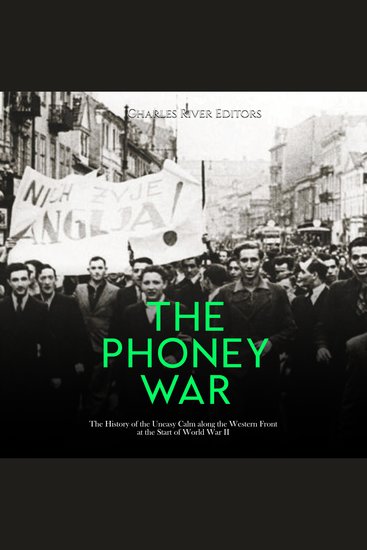
    Though the French would be decisively defeated soon after the Nazi invasion of Belgium and France in early 1940, they had not sat on their hands. As the power of Nazi Germany grew alarmingly during the 1930s, the French sought means to defend their territory against the rising menace of the Thousand Year Reich. As architects of the most punitive measures in the Treaty of Versailles following World War I, France was the most natural target for German retribution, so the Maginot Line, a series of interconnected strongpoints and fortifications running along much of France's eastern border, helped allay French fears of invasion.  
    	The popular legend of the Maginot Line portrays the frontier defenses as a useless “white elephant” project that was prompted by a gross misapprehension of warfare's new realities in the mid-20th century and quickly overwhelmed by the forceful advance of the German blitzkrieg. English idiom today invokes this vision of the Maginot Line as a metaphor for any defensive measure strongly believed in but actually useless. Indeed, usages such as “Maginot Line mentality,” describing an overly defensive, reactive mindset, perpetuate the legend. As a French author and military liaison with the British, Andre Maurois, wrote about his disillusionment with the defensive line he originally enthusiastically supported: “We know now that the Maginot line-complex was a dangerous disease of the mind; but I publish this as it was written in January, 1940.”  
    This was what brought about the stasis along the Western Front near the end of 1939, a short period of time now referred to as the Phoney War, during which the Western Allies awaited some sort of action by the Nazis. Ultimately, the Allies had not expected the Germans would be able to move armored units through the Ardennes Forests, a heavily wooded region spanning parts of Belgium, France and the Netherlands. 
    Show book
  • Lincoln & Churchill - Statesmen at War - cover

    Lincoln & Churchill - Statesmen...

    Lewis E Lehrman

    • 0
    • 0
    • 0
    “With penetrating insight, Lehrman unfolds the contrasts and similarities between these two leaders . . . I savored every page of this magnificent work.”—Doris Kearns Goodwin, #1 New York Times-bestselling author of Team of Rivals: The Political Genius of Abraham Lincoln  Winner of the Abraham Lincoln Institute of Washington’s 2019 book prize Lewis E. Lehrman, a renowned historian and National Humanities Medal winner, gives new perspective on two of the greatest English-speaking statesmen—and their remarkable leadership in wars of national survival. Abraham Lincoln and Winston Churchill, as commanders in chief, led their nations to victory—Lincoln in the Civil War, Churchill in World War II. They became revered leaders—statesmen for all time. Yet these two world-famous war leaders have never been seriously compared at book length. Acclaimed historian Lewis Lehrman, in his pathbreaking comparison of both statesmen, finds that Lincoln and Churchill—with very different upbringings and contrasting personalities—led their war efforts, to some extent, in similar ways. As supreme war lords, they were guided not only by principles of honor, duty, and freedom, but also by the practical wisdom to know when, where, and how to apply these principles. Even their writings and speeches were swords in battle. Gifted literary stylists, both men relied on the written and spoken word to steel their citizens throughout desperate and prolonged wars. And both statesmen unexpectedly left office near the end of their wars—Lincoln by the bullet, Churchill by the ballot. They made mistakes, which Lehrman considers carefully. But the author emphasizes that, despite setbacks, they never gave up. “Deeply researched and elegantly written. . . . a valuable contribution to our knowledge of the past. By expertly conjoining two great leaders in a single volume, he has enhanced our understanding of both.” ―The Wall Street Journal  Includes illustrations and photographs
    Show book

  • The Deepest Place - Suffering and the Formation of Hope - cover

    The Deepest Place - Suffering...

    MD Curt Thompson

    • 0
    • 0
    • 0
    In the face of personal and global suffering, is it possible to live with hope rather than despair? Join psychiatrist, speaker, and award-winning author Curt Thompson as he shows us how God transforms our grief into a lasting peace that surpasses all understanding. 
    Suffering is a defining reality of life. Yet so many of us are so focused on avoiding discomfort that we've never learned how to actually suffer. But what if we could move from anxiety to durable hope? 
    In The Deepest Place, Thompson invites us to explore how the Apostle Paul's experience of love, secure attachment, and the deeply felt sense of God's abiding presence carried him through the challenges he faced--and how it can help us not just survive, but flourish in the presence of suffering. 
    Combining scripture with his own professional insight, Thompson helps us discover that:Suffering can increase our sense of security rather than our fearsHope is something we form in communityFaith can grow out of anger, cynicism, and doubtPerseverance changes our brain and reshapes our imaginationListening to our bodies helps us find new hope in loss 
      
    As Thompson reminds us, those who have suffered greatly, including the Apostle Paul, are able to see their stories with a new understanding of God's presence and unfailing love. Let The Deepest Place show you how to do the same. 
    Graphics are included in the audiobook companion PDF download.
    Show book
  • The Psychology of Human Behavior - Analyze People Read Body Language Increase Your Emotional Intelligence and Improve Your Social Skills - cover

    The Psychology of Human Behavior...

    David Carnick

    • 0
    • 0
    • 0
    Do you struggle to understand what people are really thinking or feeling?
     
    - Do you replay conversations in your head, trying to decode what you missed?
     
    - Do your emotions take over at the worst possible moments?
     
    - Do you feel a step behind in social situations or unsure how to react?
     
    - Do you keep repeating habits you wish you could finally change?
     
    If this sounds familiar, I want you to know this: you are not alone. You want clarity, confidence, and a deeper understanding of human behavior, including your own. And you can get there.
     
    Now imagine for a moment what it would feel like to:
     
    - Understand the real meaning behind tone and expression
     
    - Stay calm and steady even when pressure rises
     
    - Sense hidden intentions through subtle behavior
     
    - Build habits that support who you want to become
     
    - Walk into any room feeling grounded and aware
     
    - Navigate conversations with ease instead of anxiety
     
    - Recognize your own patterns the moment they appear
     
    - Connect with people more naturally and deeply
     
    Inside this book you will discover:
     
    - How behavior, emotion, and environment shape every choice you make
     
    - How to read posture, gestures, and micro-expressions with clarity
     
    - What drives your emotional reactions and how to take control of them
     
    - The psychology of habits and how to rebuild them from within
     
    - The personality patterns that explain how people think and act
     
    - Ethical influence, persuasion cues, and how to spot manipulation
     
    - Practical ways to improve communication and connection
     
    - Identity-based strategies for real, sustainable transformation
     
    Your journey toward sharper perception, stronger emotional control, and deeper human understanding starts today.
    Show book
  • Breakthrough - A Story of Hope Resilience and Mental Health Recovery - cover

    Breakthrough - A Story of Hope...

    Ahmed Hankir

    • 0
    • 0
    • 0
    In Breakthrough, World Health Organization Award–winning psychiatrist and mental health advocate Dr. Ahmed Hankir delivers a unique and powerful insight into mental health and wellness, mental illness, mental health treatment, and the culture surrounding mental health by tracing his own personal recovery journey from impoverished and shunned psychiatric patient to becoming an NHS Consultant psychiatrist. In the book you'll explore many of the issues currently dominating the discussion of mental health and illness, including the impacts of poverty, unemployment, the cost of living crisis, homelessness, addictions, the use of medication to treat mental illness, the widespread prevalence of stigma, discrimination, and racism in mental health, and much more. 


    You'll also find: 


    ● Comprehensive discussions about how to overcome shame and stigma to seek help if you're suffering from a mental illness. 


    ● Explorations of how mental health practitioners and family members of people living with mental health conditions can themselves remain healthy as they care for others. 


    ● Examinations of why mental health–related stigma remains so stubbornly common in our societies and what we can do to combat it.
    Show book
  • World War II: Road to Mass Destruction - cover

    World War II: Road to Mass...

    Sachin Naha

    • 0
    • 0
    • 0
    Welcome to World War II: Road to Mass Destruction – an audiobook that takes you through the key moments before and during World War II. Starting with the Treaty of Versailles in 1919, which set the stage for anger and resentment, this story shows how dictators rose to power in Germany, Italy, and Japan, leading to the start of the war. From Hitler’s early aggressions to the invasion of Poland in 1939, the war spreads across Europe and the world. You’ll hear about important events like the fall of France, the Battle of Britain, and the attack on Pearl Harbor, along with the terrible events of the Holocaust. This audiobook gives you a clear, simple look at the major moments that shaped the conflict and the world’s fight for freedom. 
    Show book