Join us on a literary world trip!
Add this book to bookshelf
Grey
Write a new comment Default profile 50px
Grey
Subscribe to read the full book or read the first pages for free!
All characters reduced
The Republic - cover

The Republic

Plato

Translator Benjamin Jowett

Publisher: Zenith Whispering Pines Publishers

  • 0
  • 0
  • 0

Summary

What is justice—and who should rule?
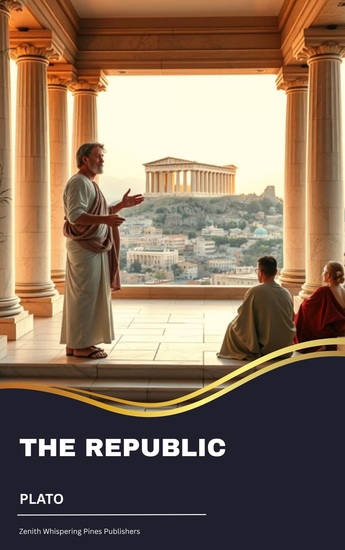
In this timeless philosophical dialogue, Plato explores the nature of justice, the structure of an ideal society, and the responsibilities of leadership. Through Socrates' probing conversations, readers confront enduring questions about morality, education, freedom, and truth—culminating in the famous Allegory of the Cave, one of the most powerful metaphors in all of philosophy.

Hailed as "the cornerstone of Western political thought," The Republic has shaped ideas about government, ethics, and human nature for over two thousand years. Its arguments remain provocative, challenging readers to rethink power, virtue, and the pursuit of the good life.

If you seek clarity on society's deepest questions and ideas that still define our world, this essential classic is indispensable.

Open the book—and enter the dialogue that still governs how we think about justice and truth.
Available since: 12/15/2025.
Print length: 388 pages.

Other books that might interest you

  • Battle of Dunkirk: Operation Dynamo - The Miracle of the Dunkirk Evacuation During World War 2 - cover

    Battle of Dunkirk: Operation...

    Liam Dale

    • 0
    • 0
    • 0
    Join The History Journals for an hourly history tour. In this edition, uncover the true tale of the Battle of Dunkirk and the heroism of civilians who rescued Allied troops from the Nazis. 
     
    The phrase "spirit of Dunkirk" embodies the indomitable British mentality, but many know little beyond its association with WWII and its location in France. However, Dunkirk's story, marked by incredible bravery of both military and civilians, is profoundly moving and inspirational. This journal transports you to 1940, a journey to discover true courage amid dire adversity. 
     
    Winston Churchill coined it the "miracle" of Dunkirk, a dramatic escape occurring in May and June 1940. To fully appreciate this event, it's essential to grasp its context - a Europe in turmoil under Adolf Hitler's relentless pursuit of global supremacy.
    Show book
  • Ignite Ideas: Make Your Message Unforgettable and Impactful - Transform your content into memorable strategies that inspire and move audiences forward - cover

    Ignite Ideas: Make Your Message...

    Ronan Thistlewood

    • 0
    • 0
    • 0
    Ignite Ideas: Transform Your Thoughts into Powerful Communication That Resonates 
    Are you eager to advance in your career and solidify your knowledge with impactful communication skills? Are you in search of a comprehensive guide that covers everything you need to effectively express your ideas? 
    Your search ends here! 
    This guide serves as your ultimate companion for enhancing your understanding, applying your skills, and engaging in practical exercises. With this resource, you are set to achieve your communication goals. 
    Updated to reflect the latest strategies for 2024-2025. Our guide stands out with its thorough coverage, which is vital for your success. Concepts are not just touched upon; they are explored in detail. 
    Key features of this enriched guide include in-depth insights related to effective communication, comprehensive explanation of how to articulate your thoughts effectively, and proven strategies for preparing and executing powerful messaging. 
    Designed with a clear structure and straightforward language, our Communication Guide ensures seamless transitions between topics. Say goodbye to confusing jargon and embrace content that is clear, precise, and technically sound. 
    So, why wait? Transform your communication and make your message unforgettable!
    Show book
  • Colony of Virginia The: The History of the British Empire’s Largest Colony Before the American Revolution - cover

    Colony of Virginia The: The...

    Editors Charles River

    • 0
    • 0
    • 0
    Nearly 20 years before Jamestown was settled, the English established one of the earliest colonies in North America around the Chesapeake Bay region, until the colony had over 100 inhabitants. Like other early settlements, Roanoke struggled to survive in its infancy, to the extent that the colony’s leader, John White, sailed back to England in 1587 in an effort to bring more supplies and help. However, the attempts to bring back supplies were thwarted by the Spanish in the midst of the Anglo-Spanish War going on at the time, and it was not until 1590 that White reached Roanoke again.  
    What White found when he came back to Roanoke led to one of the most enduring mysteries in American history. Despite the fact he had left over 100 people in Roanoke in 1587, White returned to literally nothing, with all traces of the settlement gone and no evidence of fighting or anything else that might have explained the disappearance of the inhabitants. The fate of Roanoke has fascinated people for over 400 years, and there is no shortage of theories regarding the disappearance of the colony. In addition to the possibility that the settlers moved to Croatoan Island, most theories speculate that they were either wiped out by nearby Native Americans or assimilated among a tribe. 
    Jamestown is remembered today because the settlement did survive through the hardships and go on to serve as the capital of the English colony for much of the 17th century. At the same time, one of the biggest reasons for its survival and fame today can be attributed to the local Native Americans, particularly Pocahontas, who has added both a human and romanticized, mythological element to Jamestown. She was the daughter of the paramount chief (mamanatowick) Powhatan, leader of an Algonquian-speaking native group in eastern Virginia.
    Show book
  • Suspended Education - School Punishment and the Legacy of Racial Injustice - cover

    Suspended Education - School...

    Aaron Kupchik

    • 0
    • 0
    • 0
    Every year, millions of public school students are suspended. This overused punishment removes students from the classroom, but it does not improve their behavior. Instead, suspension disrupts their education, harming the students, their families, and their schools. Black students suffer most within this broken system, experiencing a far greater risk of school punishment and the significant harms that accompany it. Many activists and scholars have considered how school punishment increases racial inequity, but few have thought to ask why. Why do we punish students the way we do, and why have we allowed this harmful practice to impact the lives of our nation's children? 


    In Supended Education, Aaron Kupchik shows that suspensions were not intended as a behavior management tool. Instead, they were designed to remove unwanted students from the classroom. Through statistical analysis and in-depth case studies of schools in Massachusetts and Delaware, Kupchik reveals how suspension rates skyrocketed after the 1954 Brown v. Board of Education decision, serving as an unofficial means of removing Black children from newly desegregated schools. His groundbreaking research traces the legacy of these segregationist movements, demonstrating that school districts with more desegregation-related legal battles from the 1950s onward suspend more Black students today.
    Show book
  • Lech Walesa: A short biography - 5 Minutes: Short on time – long on info! - cover

    Lech Walesa: A short biography -...

    5 Minutes, 5 Minute Biographies,...

    • 0
    • 0
    • 0
    Lech Walesa, unionist and Polish president: Life and work in a short biography! Everything you need to know, brief and concise. Infotainment, education and entertainment at its best!
    Show book
  • On Gaslighting - cover

    On Gaslighting

    Kate Abramson

    • 0
    • 0
    • 0
    "Gaslighting" is suddenly in everyone's vocabulary. It's written about, talked about, tweeted about, even sung about. It's become shorthand for being manipulated by someone who insists that up is down, hot is cold, dark is light—someone who isn't just lying about such things, but trying to drive you crazy. The term has its origins in a 1944 film in which a husband does exactly that to his wife, his crazy-making efforts symbolized by the rise and fall of the gaslights in their home. In this timely and provocative book, Kate Abramson examines gaslighting from a philosophical perspective, investigating it as a distinctive moral phenomenon. 


    Gaslighting, Abramson writes, is best understood as a form of interpersonal interaction, a particular way of fundamentally undermining someone. The gaslighter, Abramson argues, aims to make his target experience herself as incapable of reasoning, perceiving, or reacting in ways that would allow her to form appropriate beliefs, perceptions, or emotions in the first place. He seeks not only to induce in her this unmoored sense of herself but also to make it a reality. Using examples and analysis, Abramson gives an account of gaslighting and its immorality, and argues that such a discussion can help us understand other aspects of social life—from racism and sexism to the structure of interpersonal trust.
    Show book