Unisciti a noi in un viaggio nel mondo dei libri!
Aggiungi questo libro allo scaffale
Grey
Scrivi un nuovo commento Default profile 50px
Grey
Iscriviti per leggere l'intero libro o leggi le prime pagine gratuitamente!
All characters reduced
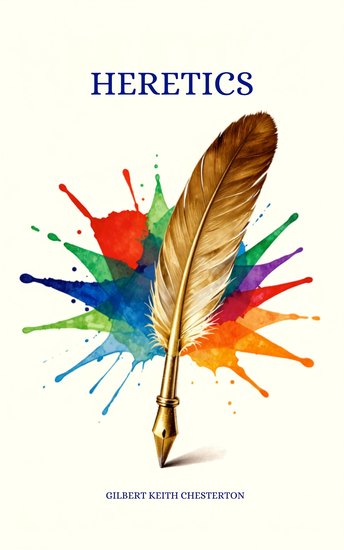
Heretics - cover

Heretics

Gilbert Keith Chesterton

Casa editrice: CLXBX

  • 0
  • 0
  • 0

Sinossi

Heretics by Gilbert Keith Chesterton is a bold and intellectually provocative collection of essays in which Chesterton examines and challenges the dominant thinkers, movements, and assumptions of his time.

With his signature wit, paradox, and clarity, Chesterton critiques modern ideologies and cultural trends, questioning the foundations of contemporary thought and exposing what he sees as inconsistencies in popular philosophy. Each essay engages directly with influential intellectual figures, offering sharp analysis paired with humor and moral reflection.

Rather than simply dismissing opposing viewpoints, Chesterton carefully dismantles them through reasoned argument, vivid imagery, and unexpected insight. His writing is both entertaining and deeply thought-provoking, encouraging readers to reconsider accepted beliefs and examine the assumptions behind modern life.

Heretics stands as one of Chesterton's most influential works of cultural and philosophical criticism. It remains essential reading for anyone interested in the intersection of literature, philosophy, and social commentary, and continues to spark discussion on truth, belief, and intellectual freedom.
Disponibile da: 19/06/2026.
Lunghezza di stampa: 225 pagine.

Altri libri che potrebbero interessarti

  • Prehistoric Warfare: The History of Early Human Conflicts - cover

    Prehistoric Warfare: The History...

    Editors Charles River

    • 0
    • 0
    • 0
    Raymond C. Kelly, an anthropologist and ethnologist who has written extensively on societal inequality and subsequent warfare suggests that among the hunter-gatherer groups of Homo erectus, the population density was low enough to avoid armed conflict in most cases. In the same vein, a perception has persisted that during this less populated time of Earth’s history, life among the Homo species was relatively peaceful. Archaeologists have supported this theory through early cave art, little of which ever depicts humans hunting or killing each other explicitly. Kelly theorized that the migration out of Africa by Homo erectus 1.8 million years ago was “a natural consequence of conflict avoidance.” He believes that this general period of “Paleolithic warlessness” was to persist until the appearance of Homo sapiens approximately 350,000 years ago, and that it began with the occurrence of “economic and social shifts associated with sedentism.” 
    However, depictions of humans pierced with arrows began to appear in the Aurignacian-Périgordian eras (30,000 years ago), and in the early Magdalenian era (17,000 years ago). A work of Mesolithic art (20,000 to 10,000 years ago) shows an explicit battle between groups of archers, and in Valencia, a group of three archers are seen surrounded by four of the similarly armed enemy in the Cova del Roure la Vella in Castellón. In the Ares del Maestrat in Alcañiz of Aragon, another work depicts warriors fleeing a group of eight archers, while a similar work at Val del Charco del Agua in Aragon shows seven archers with plumed headgear. Other examples show warriors in lines and columns with a “distinctly garbed leader at the front.”
    Mostra libro
  • Who killed Napoléon? 10 New scientific investigations to rescue history - cover

    Who killed Napoléon? 10 New...

    Gérard Lucotte, Philippe Bornet

    • 0
    • 0
    • 0
    “Let the muse of history be silent, and make way for genetics.” Jean Tulard. 
    “Fascinating.” Jean-Noël Fabiani, Professor Emeritus, Chair of the History of Medicine. 
    
    Until recent years, many mysteries and rumors have surrounded Napoleon. Was Napoleon's body taken by the British and placed in Westminster Abbey? Was he poisoned with arsenic? Did he die of hereditary stomach cancer, as the English claimed, or of hepatitis and dysentery rampant on that unhealthy island? Was Napoleon III descended from the Emperor? Did the Emperor's physician remove Napoleon's penis after his death on St. Helena in 1821?
    To answer these and many other questions, Professor Gérard Lucotte spent twelve years working on this subject. He was commissioned by Prince Charles Napoléon (a descendant of the Emperor, through the branch descended from Jérôme Bonaparte, the Emperor's youngest brother) and Count Walewski (a descendant of Napoleon the First’s natural son) to work on Napoléon's DNA. Thanks to his genetics laboratory and electron microscope, he has achieved a gigantic feat that will astound all Napoleon enthusiasts.
    Mostra libro
  • 10 Biggest Battles of the Civil War The: The History of the Largest Battles in America's Deadliest Conflict - cover

    10 Biggest Battles of the Civil...

    Editors Charles River

    • 0
    • 0
    • 0
    The names of history’s most famous battles still ring in our ears today, their influence immediately understood by all. Marathon lent its name to the world’s most famous race, but it also preserved Western civilization during the First Persian War. Saratoga, won by one of the colonists’ most renowned war heroes before he became his nation’s most vile traitor. Hastings ensured the Normans’ success in England and changed the course of British history. Waterloo, which marked the reshaping of the European continent and Napoleon’s doom, has now become part of the English lexicon.  
    Americans have long been fascinated by the Civil War and its biggest battles, and this audiobook explains the campaigns and events that brought about decisive battles like Gettysburg, Second Bull Run, Chancellorsville, Chickamauga, Antietam, Murfreesboro, and more, along with what went right and wrong on both sides and the aftermath of the battles. Accounts of the battles by important leaders like Sherman and Grant are cited, along with analysis of the generals and fighting. 
    Mostra libro
  • Dangerous Rise of Therapeutic Education The (Routledge Education Classic Edition) - cover

    Dangerous Rise of Therapeutic...

    Kathryn Ecclestone, Denis Hayes

    • 0
    • 0
    • 0
    The Dangerous Rise of Therapeutic Education confronts the silent ascendancy of a therapeutic ethos across the educational system and into the workplace. Controversial and compelling, Kathryn Ecclestone and Dennis Hayes’ classic text uses a wealth of examples across the education system, from primary schools to university and the workplace, to show how therapeutic education is turning children, young people and adults into anxious and self-preoccupied individuals rather than aspiring, optimistic and resilient learners who want to know everything about the world.Remaining extremely topical, the chapters illuminate the powerful effects of therapeutic education, including:How therapeutic learning is taking shape, now and in the futureHow therapeutic ideas from popular culture have come to govern social thought and policiesHow the fostering of dependence and compulsory participation in therapeutic activities that encourage the disclosing of emotions, can undermine parents’ and teachers’ confidence and authorityHow therapeutic forms of teacher training undermine faith in the pursuit of knowledgeHow political initiatives in emotional literacy, emotional wellbeing and ‘positive mental health’ propagate a diminished view of human potential throughout the education system and the workplace.The Dangerous Rise of Therapeutic Education is an eye-opening read for every teacher and leader across the field of education, and every parent and student, who is passionate about the power of knowledge to transform people’s lives. It is a call for a debate about the growing impact of therapeutic education and what it means for learning now and in the future.
    Mostra libro
  • Sunjata and Bakaridjan Koné: Two Captivating Legends from Mali - cover

    Sunjata and Bakaridjan Koné: Two...

    Matt Clayton

    • 0
    • 0
    • 0
    Do you like epic tales that sing the deeds of the world’s greatest heroes? 
    If so, you will love this volume of epics from the West African country of Mali. Each is full of battles and derring-do, magic, and prophecies based on historical events. The Epic of Sunjata tells the tale of the great thirteenth-century king of the Mali Empire, Sunjata Keita, who started life as a disabled boy but rose to become one of Mali’s greatest warriors and king of a vast empire. The Epic of Bakaridjan Koné, a proud epic in its own right, is but a part of the larger Epic of Bambara Segu, one of the longest African epics, detailing the history of the Segu Empire, which lasted from 1712 to 1861. Like Sunjata, Bakaridjan Koné is a formidable warrior; however, he has no designs on power, preferring only to serve his king with valorous deeds.  
    Here are just a few of the amazing episodes you’ll read in these epics:How a hunter prophesied that Sunjata would become the king of a great empire.How Sunjata was disabled at birth but learned to walk and gained superhuman strength.Sunjata’s exile from Mali and his growth into manhood.How Sunjata fought and defeated the evil sorcerer-king, Sumanguru Kanté.How a Muslim soothsayer prophesied that Bakaridjan Koné would outshine all of the king’s sons and become the greatest warrior of Segu.How Bakaridjan Koné performed the deeds of a hero while he was yet a boy.How Bakaridjan Koné defeated an evil water jinni that even King Da Monzon was afraid to challenge.How Bakaridjan Koné lost his honor and then regained it. How King Da Monzon tried to assassinate Bakaridjan but was foiled by Bakaridjan’s son.  
    Scroll up and click the “add to cart” button to enjoy each of these fascinating West African epics!
    Mostra libro
  • Fair or Foul - The Lady Macbeth Guide to Ambition (Unabridged) - cover

    Fair or Foul - The Lady Macbeth...

    Stefan Stern

    • 0
    • 0
    • 0
    What does success mean? When is enough enough? Is Lady Macbeth right to suggest that only those with the 'illness' of ambition achieve the highest goals? Fair or Foul considers this powerful human phenomenon and its place in our lives.
    
    'A welcome blast of clear thinking about ambition and how we choose to lead our lives' Alastair Campbell
    
    
    From the success of the first US woman Vice President, Kamala Harris, the obstacles she faced and the possibilities that still lie ahead, to Boris Johnson's young aspirations to be 'world king' and the pathological intensity of his ambition, Stern considers the careers and personal lives of politicians, sports stars and business people, to name a few, to illuminate this strange and powerful driver. Discover how ambition and success work together, how attitudes have shifted over time, and how gender roles have an impact on our goals.
    
    Incisive, contemporary and accessible, this book is for anyone who is looking for a change of direction or emphasis on how to move forward. It will also provide consolation, amusement and plenty of insightful meditations on the complex nature of ambition.
    
    
    'Is this a bestseller which I see before me? It deserves to be. Fascinating exploration of the beast of ambition and whether we can tame it or be devoured by it' Richard Herring
    
    'A brilliantly readable and inspiring study of our love-hate relationship with ambition' Viv Groskop
    
    'Wise, compelling . . . and dare I say it, ambitious in its ultimate aim, it encourages readers to ask profound questions about meaning and purpose' Sathnam Sanghera
    
    'This is a book which is rich, witty and deeply thoughtful (not unlike a Shakespeare play). Stefan Stern has created a timely book about the meaning of life and work out of a timeless work of art. It's brilliant' Julia Hobsbawm
    
    'A fascinating, witty and clear-headed investigation of the importance and the dangers of striving for more' Oliver Burkeman
    Mostra libro