Join us on a literary world trip!
Add this book to bookshelf
Grey
Write a new comment Default profile 50px
Grey
Subscribe to read the full book or read the first pages for free!
All characters reduced
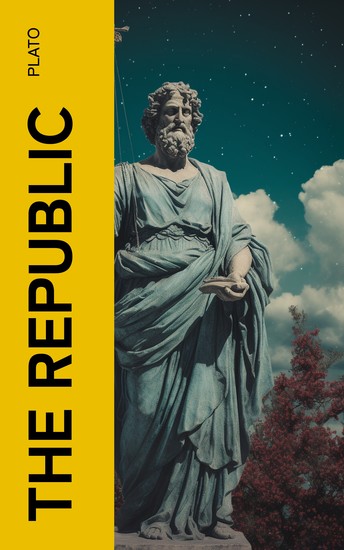
The Republic (Annotated) - Enriched Edition A Socratic Dialogue on Justice the Just City the Theory of Forms and the Philosopher King - cover

The Republic (Annotated) - Enriched Edition A Socratic Dialogue on Justice the Just City the Theory of Forms and the Philosopher King

Plato

Translator Benjamin Jowett

Publisher: e-artnow

  • 0
  • 0
  • 0

Summary

In The Republic, Plato constructs one of the foundational works of Western philosophy: a dramatic dialogue that moves from the question of justice in the soul to the design of a just city. Through Socrates' searching dialectic, the work examines education, political authority, poetry, metaphysics, and the famous theory of Forms, culminating in the allegory of the cave. Its literary style fuses philosophical argument with dramatic characterization, myth, irony, and speculative political theory, situating it within classical Athenian debates about democracy, sophistry, and civic virtue. Plato, an Athenian aristocrat and student of Socrates, wrote in the aftermath of political instability, the Peloponnesian War, and Socrates' execution in 399 BCE. These experiences deeply shaped his suspicion of unexamined public opinion and his concern with the moral formation of rulers and citizens. His Academy and dialogues reflect a lifelong attempt to preserve Socratic inquiry while transforming it into a systematic philosophical vision. The Republic is indispensable for readers interested in philosophy, politics, literature, or education. Challenging yet profoundly rewarding, it invites reflection on justice, truth, power, and the responsibilities of intellectual life.

This enriched edition has been carefully crafted to add value to your reading experience.
- A succinct Introduction situates the work's timeless appeal and themes.
- The Synopsis outlines the central plot, highlighting key developments without spoiling critical twists.
- A detailed Historical Context immerses you in the era's events and influences that shaped the writing.
- An Author Biography reveals milestones in the author's life, illuminating the personal insights behind the text.
- A thorough Analysis dissects symbols, motifs, and character arcs to unearth underlying meanings.
- Reflection questions prompt you to engage personally with the work's messages, connecting them to modern life.
- Hand‐picked Memorable Quotes shine a spotlight on moments of literary brilliance.
- Interactive footnotes clarify unusual references, historical allusions, and archaic phrases for an effortless, more informed read.
Available since: 11/21/2023.
Print length: 487 pages.


Other books that might interest you

  • Escape from the Deep - A True Story of Courage and Survival During World War II - cover

    Escape from the Deep - A True...

    Alex Kershaw

    • 0
    • 0
    • 0
    "Their submarine was dead, one hundred and eighty feet below the surface of the Pacific Ocean. Somehow they survived. They were tortured and beaten. Somehow they survived. Alex Kershaw has done it again as he brings to life World War II's greatest submarine survival adventure." --James Bradley, author of Flags of Our Fathers and Flyboys In the early morning hours of October 24, 1944, the legendary U.S. Navy submarine Tang was hit by one of its own faulty torpedoes. The survivors of the explosion struggled to stay alive one hundred-eighty feet beneath the surface, while the Japanese dropped deadly depth charges. As the air ran out, some of the crew made a daring ascent through the escape hatch. In the end, just nine of the original eighty-man crew survived.  But the survivors were beginning a far greater ordeal. After being picked up by the Japanese, they were sent to an interrogation camp known as the “Torture Farm.” When they were liberated in 1945, they were close to death, but they had revealed nothing to the Japanese, including the greatest secret of World War II.  With the same heart-pounding narrative drive that made The Bedford Boys and The Longest Winter national bestsellers, Alex Kershaw brings to life this incredible story of survival and endurance.
    Show book
  • New York's Secret Subway - The Underground Genius of Alfred Beach and the Origins of Mass Transit - cover

    New York's Secret Subway - The...

    Matthew Algeo

    • 0
    • 0
    • 0
    In the nineteenth century, Manhattan's streets were so choked with pedestrians, horses, vehicles, and vendors that a trip from City Hall to Central Park could take hours. Alfred Beach had the perfect solution: build a giant pneumatic tube underneath Broadway from the Battery to Harlem. Air pressure would shoot passengers up and down the island in clean, quiet carriages. But Beach was up against the operators of the horse-drawn streetcars and the politicians in their pay, most conspicuously William M. Tweed, the notorious "Boss" of Tammany Hall.New York's Secret Subway: The Underground Genius of Alfred Beach and the Origins of Mass Transit tells a classic story of good versus evil, pitting the mild-mannered Beach, a visionary inventor and entrepreneur, against the oafish tyrant Tweed, the exemplar of corruption in the Gilded Age. It also tells the story of one of the most astonishing feats of engineering in American history, the surreptitious creation of the nation's first operational subway. Unfortunately, political lethargy and greed would conspire to deny the city a subway for another thirty years. Yet Alfred Beach still proved conclusively the feasibility of underground railways in Manhattan, and paved the way for modern mass transportation systems. Although this true story took place more than a century ago, it will at times sound surprisingly familiar.
    Show book
  • Grading for Growth - A Guide to Alternative Grading Practices that Promote Authentic Learning and Student Engagement in Higher Education - cover

    Grading for Growth - A Guide to...

    David Clark, Robert Talbert

    • 0
    • 0
    • 0
    Are you satisfied with your current and traditional grading system? Does it accurately reflect your students’ learning and progress? Can it be gamed? Does it lead to grade-grubbing and friction with your students? The authors of this book, David Clark and Robert Talbert – two professors of mathematics with input from colleagues across disciplines and institutions – offer readers a fundamentally more effective and authentic approach to grading that they have implemented for over a decade. Grading for Growth helps educators navigate the complicated landscape of grading and assessment and includes grading systems such as Standards-Based Grading, Specifications Grading, and Ungrading. 
     
    Recognizing that traditional grading penalizes students in the learning process by depriving them of the formative feedback that is fundamental to improvement, the authors offer alternative strategies that encourage revision and growth. Alternative grading is concerned with students’ eventual level of understanding. This leads to big changes: Students take time to review past failures and learn from them. Conversations shift from “why did I lose a point for this” to productive discussions of content and process.Alternative grading can be used successfully at any level, in any situation, and any discipline, in classes that range from seminars to large multi-section lectures. This book offers a comprehensive introduction to alternative grading, beginning with a framework and rationale for implementation and evidence of its effectiveness. The heart of the book includes detailed examples – including variations on Standards-Based Grading, Specifications Grading, and ungrading -- of how alternative grading practices are used in all kinds of classroom environments, disciplines and institutions with a focus on first-hand accounts by faculty who share their practices and experience. The book includes a workbook chapter that takes readers through a step-by-step process for building a prototype of their own alternatively graded class and ends with concrete, practical, time-tested advice for new practitioners. 
     
    The underlying principles of alternative grading involve:Evaluating student work using clearly defined and context-appropriate content standards.Giving students helpful, actionable feedback.Summarizing the feedback with marks that indicate progress rather than arbitrary numbers.Allowing students to revise without penalty, using the feedback they receive, until the standards are met or exceeded. 
     
    This book is intended for faculty interested in exploring alternative forms of learning assessment as well as those currently using alternative grading systems who are looking for ideas and options to refine practice. 
     
    This audiobook is skillfully read by Michael Hacker, and was produced and published by Echo Point Books & Media, an independent bookseller in Brattleboro, Vermont. Audio engineering by Jonah Rosenberg.
    Show book
  • The Fall Of Homo Digitalis - Impersonal Intimacy And New Relationships in The Digital Era - cover

    The Fall Of Homo Digitalis -...

    Brian Gibson

    • 0
    • 0
    • 0
    This audiobook is narrated by an AI Voice.  
    With unparalleled insight and a keen understanding of the digital revolution's impact on our lives, this book explores the rise of Homo Digitalis, a new era of human existence where screens, algorithms, and data have reshaped how we interact. 
    From the exhilarating thrill of swiping right to the troubling reality of social media-driven envy, this book delves into the paradox of our time: the paradox of impersonal intimacy. We've become experts at connecting with others across the globe, yet sometimes struggle to communicate with those closest to us. "The Fall of Homo Digitalis" explores how these unprecedented technological advancements have reshaped our understanding of love, friendship, and human connection. 
    Whether you're a digital native, a concerned parent, or anyone curious about the transformative power of technology on our relationships, this book is a must-read for all those seeking to comprehend the ever-shifting dynamics of love, intimacy, and human connection in the digital age. "The Fall of Homo Digitalis" mirrors our digital selves and guides us toward a more connected and authentic future.
    Show book
  • China Japan and the USA - cover

    China Japan and the USA

    John Dewey

    • 0
    • 0
    • 0
    "China, Japan, and the U.S.A." by John Dewey is a compelling exploration of the complex interplay between these three influential nations in the early 20th century. With keen insight and intellectual rigor, Dewey delves into the political, cultural, and philosophical dynamics that shaped their interactions and the global landscape. Drawing upon his extensive knowledge of history, Dewey meticulously examines the evolving relationships between China, Japan, and the United States during a pivotal era of transformation. He skillfully navigates the intricate threads of diplomacy, economic development, and cultural exchange, offering a nuanced understanding of the forces at play. Read in English, unabridged.
    Show book
  • Dutch Golden Age The: The Rise of the Netherlands as a Global Power in the 17th Century - cover

    Dutch Golden Age The: The Rise...

    Charles River Editors

    • 0
    • 0
    • 0
    During the 17th century, the Netherlands, despite having only 1.5 million people in 1600, became a global maritime and trading power. By contrast, France at the time had 20 million people, Spain had 8 million, and England had 5 million. Nevertheless, Amsterdam became one of the most important urban centers in the world and the location of the world’s first stock market, and Dutch merchant ships and pirates plied the Atlantic Ocean, the Indian Ocean, and the Pacific Ocean. The Dutch acquired colonies in the East Indies, where they seized control of the spice trade from the Portuguese, and in the West Indies, they acquired a number of islands from the Spanish (several of which are still Dutch today). They became the only Westerners who were allowed to trade with Shogunate Japan from a small island next to Nagasaki, and they settled the town that ultimately became New York City. Naturally, all of this imperialism generated enormous amounts of wealth that flowed into the Netherlands. 
    What made the Netherlands’ global influence in the 17th century all the more remarkable is that the Dutch had only recently achieved political independence through the process of fighting a long and brutal war of resistance against rule by the Spanish Hapsburgs, starting in 1568. In 1581, the seven northern provinces – Holland, Zeeland, Utrecht, Gelderland, Overijssel, Friesland, and Groningen – declared their independence, and fighting took place back and forth on land and sea for decades, with the Dutch receiving some much-needed assistance from England’s Queen Elizabeth I. Thousands of civilians were massacred by the rampaging Spanish armies, and on the water, Dutch “sea beggars” attacked and harassed the Spanish fleet. Pro-Spanish privateers operating out of Dunkirk did the same against Dutch shipping. 
    Show book