Join us on a literary world trip!
Add this book to bookshelf
Grey
Write a new comment Default profile 50px
Grey
Subscribe to read the full book or read the first pages for free!
All characters reduced
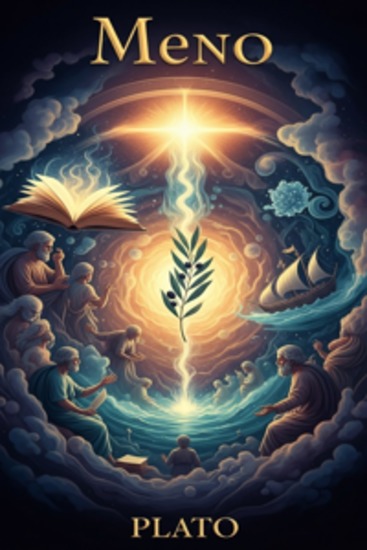
Meno - cover

Meno

Plato

Publisher: Bu Classics Books

  • 0
  • 0
  • 0

Summary

Follow the famous geometrical demonstration with an enslaved boy as Socrates attempts to prove that learning is actually a form of recollection from a previous existence. This dialogue addresses the paradox of inquiry, asking how one can search for something they do not already know, while simultaneously exploring whether virtue can be taught. It bridges the gap between metaphysics and ethics, offering a glimpse into the theory of forms through practical application. The work remains essential for those interested in epistemology and the Socratic approach to education.
Available since: 01/29/2026.
Print length: 50 pages.

Other books that might interest you

  • Story Like You Mean It - How to Build and Use Your Personal Narrative to Illustrate Who You Really Are - cover

    Story Like You Mean It - How to...

    Dr. Dennis Rebelo

    • 0
    • 0
    • 0
    Each of us has a story to share, a mixture of lived experiences—planned and unplanned—that come together and give our existence shape and identity. But in a world where we rely on screens and images for communication and self-expression, do we truly know how to tell our story? 


    Do you know how to tell yours? 


    In Story Like You Mean It, Dr. Dennis Rebelo helps you communicate with ease and connect with others by constructing a self-narrative with intention and purpose. At the intersection of academic theory and practical experience, Dr. Rebelo shares insights he has gained coaching clients on how to build and then share their life-work narratives. Students from the US Navy and CVS Health's Executive Learning Series for Diverse Suppliers, and even NFL alumni, have used Dr. Rebelo's Peak Storytelling model to navigate personal history, reflect on influential moments, and compellingly communicate their true value. What raw experiences made you who you are today? How do you express them meaningfully to showcase your worth? Dive into the intricacies of StoryPathing, become the master of your own narrative, and reap the benefits of sharing who you truly are.
    Show book
  • The New World Order - cover

    The New World Order

    H. G. Wells

    • 0
    • 0
    • 0
    The New World Order is a non-fiction book written by H.G. Wells and was published by Secker & Warburg in January 1940. In The New World Order, Wells proposed a framework of international functionalism that could guide the world towards achieving world peace. To achieve these ends, Wells asserted that a socialist and scientifically planned world government would need to be formed to defend human rights.Wells's motivation for writing The New World Order was based upon the outbreak of World War II. Wells was concerned that the Allies had no clear statement of aims for fighting in the war and that this would lead to the continuation of the pre-existing balance of power. In The New World Order, Wells writes that without a revolution in international affairs and the establishment of human rights, then further destructive wars were inevitable.
    Show book
  • Human Nature - cover

    Human Nature

    Julie S. Paschold

    • 0
    • 0
    • 0
    The poems in Human Nature offer a stunning and tender ecology. It’s impossible to turn away from the awe and beauty, even as the poems also engage in playfulness and grief and resistance. In these deeply spiritual poems, the body is intricately bound to the natural world. As readers of this work, we can feel both the immense power and smallness of our human hands trembling in each shimmering line. 
    —Stacey Waite, author of Butch Geography 
    Embodying a rainbow of emotions, the poetry of Paschold grounds the reader to the world around them and those that inhabit it, big and small. 
    —Joel Sartore Photography - Office Staff 
    Julie Paschold takes a bold swing right in the title of her collection Human Nature, the delineation of which has been the prime ambition of literary folks since the first someone put pen to paper. Even, or especially, when “[w]e thin-skinned hairless beings” look outside ourselves at spiders and crocodile icefish, we also hold up a mirror in order to study our own reflection. Who can’t at times identify with “a prairie vole, / popcorn of the prairie, / . . . everything is out to eat me”? And it’s not just our fellow critters we see ourselves in: Even “[t]he sky has a sliver caught in her thumb.” It's this commonality which drives the poems and helps us understand where and how we fit in. 
    —JV Brummels, author of All the Live-Long Day
    Show book
  • Affirmations for Black Women - Reprogram Your Mind for Health Success Love Happiness Fitness Self-Esteem and Confidence Overcome Obstacles and Self-Sabotage with Subliminal Affirmations - cover

    Affirmations for Black Women -...

    Rose J. McBride

    • 0
    • 0
    • 0
    Are you a Black woman wanting to attract more success, love and happiness? 
    Then you are in the right place! 
    Imagine where you would go and what you could do if only you had the right advice and the right strategies to increase self-esteem, motivation, and start living a life full of love, happiness, and success. 
    As black women, we share a collective history of strength and courage. While we may have varying degrees of success and self-esteem, we are all united as a sisterhood and we all have the potential to do great things. 
    The reason this book was made is to help you unlock that potential. 
    With 500 life-changing affirmations, written specifically for BIPOC women, this book will help you manifest the changes you want to see in your life. 
    So if you’re battling with a lack of self-confidence, or you’re striving to become financially free, these daily affirmations will help get you there. 
    Consistently using these affirmations will help you to:Love and accept the amazing person you areIncrease your motivation and self-confidenceEliminate / Decrease negative thinkingLearn to express gratitude for your life each single dayManifest and attract happiness, success and abundanceAnd much, much more! 
      
    Buy this book now to start your journey to happiness and success!
    Show book
  • Battle of Ia Drang The: The History and Legacy of the Vietnam War’s First Major Battle - cover

    Battle of Ia Drang The: The...

    Editors Charles River

    • 0
    • 0
    • 0
    Before the Vietnam War, most Americans would have been hard pressed to locate Vietnam on a map. South Vietnamese President Diệm’s regime was extremely unpopular, and war broke out between Communist North Vietnam and South Vietnam around the end of the 1950s. Kennedy’s administration tried to prop up the South Vietnamese with training and assistance, but the South Vietnamese military was feeble. A month before his death, Kennedy signed a presidential directive withdrawing 1,000 American personnel, but shortly after Kennedy’s assassination, new President Lyndon B. Johnson reversed course, instead opting to expand American assistance to South Vietnam. 
    In 1965, the government decided to divert many air assets to supporting a bigger American ground presence in South Vietnam. Admiral U.S.G. Sharp noted, “Our Rolling Thunder bombing program against North Vietnam got off to a painfully slow start and inched along in the most gradual increase in intensity." 
    The fighting in the la Drang Valley represented the first significant encounters between American soldiers and the North Vietnamese. Fought in November 1965 as a part of the Pleiku campaign in Vietnam’s Central Highlands, these battles were most notable at the time for involving large-scale helicopter assaults supported by B-52 strategic bombers playing tactical support roles. They also established a model for the war in Vietnam in which the Americans made use of rapid air mobility, reliance on artillery, and close air support, while the North Vietnamese attempted to engage their enemy at close range with the objective of neutralizing their firepower. But it would also serve as a harbinger of what was to come, as tactical successes would not bring about strategic advantages for the Americans. In fact, both sides would claim victory by the time fighting was done around Ia Drang. 
    Show book
  • Yul The Younger - cover

    Yul The Younger

    Jules Wright

    • 0
    • 0
    • 0
    The Roman Empire is coming apart at the seams, relying on German recruits and foederati to hold the empire together. The eastern and western empires are ruled by incompetent young men who allow their German warlords to rule for them, but imperial elites conspire against the generals. Yul the Younger is a Saxon boy negotiating life in the empire with strong ties to his family in Germania. His father, Yul the Elder, sends Yul to a monastery school to learn the ways of the empire, with the father serving the empire as a quaestor (treasurer) in the east of Britannia. Yul the elder’s job is to make certain that the mostly German troopers of the Saxon Shore are fed, equipped, and paid, but Romano-British landlords are withholding taxes while enslaving Germans and building lavish country houses. Life in the monastic school at Verulamium (Saint Albans) proves difficult for Yul the Younger with monks insisting he give up his Germanic gods for Christ. He is also harassed by the entitled sons of British elites. Yul dares to make his escape with his best friend, a Pict, named Keaffer. Both enlist in the Brave Companions stationed at Othona as self-declared Emperor Flavius Claudius Constantine opts to invade Gaul to capture the purple and stop the Germanic tribes from crossing the Rhine Frontier to settle in the dying empire. Tall, blond, and broad, Yul joins the invasion of Europa. He also finds love and seeks revenge for the wrongs committed by Britons against his family and companions.
    Show book