Join us on a literary world trip!
Add this book to bookshelf
Grey
Write a new comment Default profile 50px
Grey
Subscribe to read the full book or read the first pages for free!
All characters reduced
Laws - Enriched edition - cover

Laws - Enriched edition

Plato

Translator Benjamin Jowett

Publisher: DigiCat

  • 0
  • 0
  • 0

Summary

In 'Laws,' Plato embarks on a profound exploration of political philosophy and ethics, delving into the very foundations of lawful governance and social order. Written in a dialogue format characteristic of Plato's style, this late dialogue shifts from the idealism outlined in 'The Republic' to pragmatic considerations of how laws can be effectively implemented in a real society. The work juxtaposes various forms of governance, addresses the moral responsibilities of citizens and legislators, and articulates a vision for a just city-state that emphasizes the importance of education and communal well-being.

In this enriched edition, we have carefully created added value for your reading experience:
- A succinct Introduction situates the work's timeless appeal and themes.
- The Synopsis outlines the central plot, highlighting key developments without spoiling critical twists.
- A detailed Historical Context immerses you in the era's events and influences that shaped the writing.
- An Author Biography reveals milestones in the author's life, illuminating the personal insights behind the text.
- A thorough Analysis dissects symbols, motifs, and character arcs to unearth underlying meanings.
- Reflection questions prompt you to engage personally with the work's messages, connecting them to modern life.
- Hand‐picked Memorable Quotes shine a spotlight on moments of literary brilliance.
- Interactive footnotes clarify unusual references, historical allusions, and archaic phrases for an effortless, more informed read.
Available since: 05/28/2022.
Print length: 577 pages.

Other books that might interest you

  • Veto Message Regarding the Bank of the United States - cover

    Veto Message Regarding the Bank...

    Andrew Jackson

    • 0
    • 0
    • 0
    In 1832, President Jackson vetoed a bill that aimed to renew a charter for the US Bank. He issued this message to accompany the rejection in which he explained his controversial decision. He believed the bank held too much power, and that “It is easy to conceive that great evils to our country and its institutions might flow from such a concentration of power in the hands of a few men irresponsible to the people.” While some saw this decision a dictator-like act, others saw it as a spark of hope for the poor.  
    Show book
  • The Duties of American Citizenship - cover

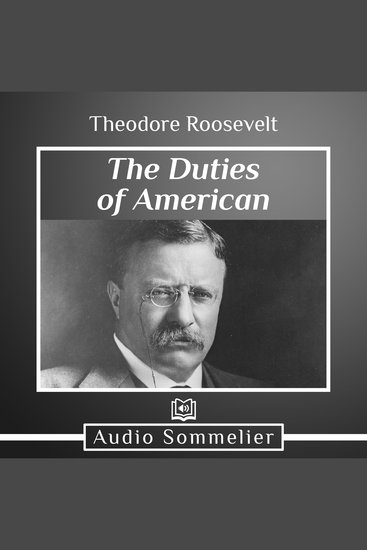
    The Duties of American Citizenship

    Theodore Roosevelt

    • 0
    • 0
    • 0
    In this speech, a young Theodore Roosevelt describes what he believes are the key principles to good citizenship. In addition to emphasizing ethical behavior, Roosevelt takes a firm stance on the necessity of engaging in politics and voting. He states unflinchingly, “The people who say that they have not time to attend to politics are simply saying that they are unfit to live in a free community.” To be “a good American citizen,” Roosevelt says one must boldly engage with the issues our nation faces today, and in doing so, shape its future.  
    Show book
  • If It Takes a Thousand Years - From Al-Qaeda to Hamas How the Jihadists Think & How to Defeat Them - cover

    If It Takes a Thousand Years -...

    Jesse Petrilla

    • 0
    • 0
    • 0
    An inside look into the mindset of jihad, including firsthand interviews with some of the world's most sinister terrorists. 


    During an interrogation in Afghanistan, when asked how long the jihadists intended to fight, a Taliban commander uttered the words, "If it takes a thousand years." This chilling statement illustrates both how terrorists of this level operate and the generational approach they take when it comes to bringing destruction to the world. 


    The West is facing a determined enemy with a fundamentally different world view. Author and former Army Captain Jesse Petrilla provides unique insight into the jihadist mind, featuring interviews with Taliban and Al-Qaeda members just after their capture, interviews with international journalists and professors, warnings from European politicians, as well as experiences from travels throughout the Islamic world. 


    If It Takes a Thousand Years delves into the policies which have enabled our enemies both at home and abroad, providing positive solutions as to how America and the West can confront this threat and protect their way of life.
    Show book
  • Anne Frank - cover

    Anne Frank

    History Nerds

    • 0
    • 0
    • 0
    In a world marked by profound turmoil and unspeakable horror, one young girl’s voice continues to resonate through the ages, offering a beacon of hope, resilience, and the enduring power of the human spirit. "Anne Frank" delves deep into the life and legacy of Anne Frank, exploring the nuances of her extraordinary story beyond the pages of her famous diary. 
    From her early years, to her family's flight to Amsterdam, this book paints a vivid picture of Anne’s life before and during the dark days of World War II. But who was Anne Frank beyond the confines of her diary? Discover the curious and spirited young girl who dreamed of being a writer, and maintained an indomitable will to live even in the face of unimaginable adversity. Learn about the historical context that shaped her experiences and the pivotal events that led to her family's tragic fate. 
    Whether you are a student, a history enthusiast, or someone seeking to understand the profound legacy of Anne Frank, this book provides a comprehensive and heartfelt exploration of one of the most iconic figures of the 20th century. Join us on this poignant journey to uncover the story of Anne Frank, the girl whose voice will never be forgotten.
    Show book
  • A Rare Recording of John E Brown - cover

    A Rare Recording of John E Brown

    John E. Brown

    • 0
    • 0
    • 0
    John E. Brown (April 2, 1879 – February 12, 1957) was a prominent Methodist evangelist, publisher, radio pioneer, and educator in the first half of the twentieth century. In 1919, he established John Brown University, one of Arkansas’ leading private universities to provide an interdenominational, Christian education for needy students. He was also the leading figure in securing passage of a law prohibiting the sale of alcohol in Benton County, a ban that continued into the twenty-first century.
    Show book
  • Louvre and the Hermitage The: The History and Contents of Europe’s Biggest Art Museums - cover

    Louvre and the Hermitage The:...

    Editors Charles River

    • 0
    • 0
    • 0
    The very name of the Louvre conjures up scenes of art and elegance, and of long halls filled with beauty and people strolling through them whispering quietly among themselves about the glories they are witnessing. Even those who have never been to the Louvre know some of its most prized possessions, from ancient statues to Leonardo Da Vinci’s “Mona Lisa”. As the world’s largest museum, the Louvre is unquestionably the cultural highpoint of Paris, a city that has long been considered the cultural center of Europe. 
    However, life is rarely as simple as one imagines, and the life of the Louvre is no different. While just about everyone is familiar with its history as an art museum, the Louvre’s history goes back over 800 years, and it used to have far different purposes, both as a medieval fortress and a palatial residence for French kings. The Louvre bore witness to mass murder during the French Revolution, and there have been countless accusations of theft and other questionable actions since its opening. 
    Catherine the Great came to power in the midst of the Enlightenment, which was flourishing in France and Britain, and she would rule as an Enlightened ruler. A known correspondent of Voltaire’s, Catherine sought to modernize Russia and turn it into a force in its own right, creating a rich and cultured court at the same time. Over the course of nearly 35 years in power, Catherine ushered in the Russian Enlightenment and presided over a period of time known as the Golden Age of the Russian Empire. 
    Moreover, Catherine had an unmatched passion for the arts, and she began a private art collection that would eventually evolve into galleries upon galleries of historical treasures shipped in from all over the world. This fabled museum was none other than the Hermitage, located in the heart of Saint Petersburg, a city founded by the imperial empire's very own Peter the Great.
    Show book