Join us on a literary world trip!
Add this book to bookshelf
Grey
Write a new comment Default profile 50px
Grey
Subscribe to read the full book or read the first pages for free!
All characters reduced
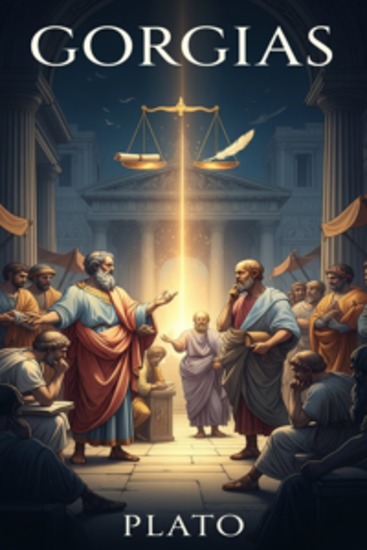
Gorgias - cover

Gorgias

Plato

Publisher: Bu Classics Books

  • 0
  • 0
  • 0

Summary

Dive into a rigorous debate concerning the true nature of rhetoric and its place in civil society, as Socrates confronts one of the most famous sophists of his time. The dialogue relentlessly questions whether the art of persuasion is a noble pursuit or merely a tool for manipulation and flattery without regard for justice. Plato argues passionately for the health of the soul over the power of speech, suggesting that it is better to suffer wrong than to commit it. This work stands as a powerful critique of political corruption and the moral responsibilities of those who wield influence.
Available since: 01/29/2026.
Print length: 142 pages.
Other books that might interest you

  • Egyptomania - Our Three Thousand Year Obsession with the Land of the Pharaohs - cover

    Egyptomania - Our Three Thousand...

    PhD Bob Brier

    • 0
    • 0
    • 0
    The world has always been fascinated with ancient Egypt. When the Romans conquered Egypt, it was really Egypt that conquered the Romans. Cleopatra captivated both Caesar and Marc Antony and soon Roman ladies were worshipping Isis and wearing vials of Nile water around their necks. What is it about ancient Egypt that breeds such obsession and imitation? Egyptomania explores the burning fascination with all things Egyptian and the events that fanned the flames—from ancient times, to Napoleon's Egyptian campaign, to the discovery of Tutankhamen's tomb by Howard Carter in the 1920s. For forty years, Bob Brier, one of the world's foremost Egyptologists, has been amassing one of the largest collections of Egyptian memorabilia and seeking to understand the pull of ancient Egypt on our world today. In this original and groundbreaking book, he explores our three-thousand-year-old fixation with recovering Egyptian culture and its meaning. He traces our enthrallment with the mummies that seem to have cheated death and the pyramids that as if they will last forever. Drawing on his personal collection—from Napoleon's twenty volume Egypt encyclopedia to Howard Carter's letters written from the Valley of the Kings as he was excavating—this is an inventive and mesmerizing tour of how an ancient civilization endures in ours today.
    Show book
  • A Blade of Grass - A Challenge to the Evolution Theory - cover

    A Blade of Grass - A Challenge...

    Mike Hodgson

    • 0
    • 0
    • 0
    This audiobook is narrated by an AI Voice.  
    Combining evidence and theory, this book questions whether plant life and creatures could all evolve from a few cells, all with their own individual DNA, each with the intelligence of a thousand computers built in. It discusses the Big Bang theory, where our world began, the beauty of creation and all the world's elements. What happened 6,000 years ago that dramatically changed our world? 
    In 1,500 years, humankind developed the ability not only to record history, but went from living in caves to building palaces. Something must have caused this change! Could it be that God created a new Adam and Eve? Are Judaism, Christianity and Islam based on myth or reality? Are we a unique combination of mind, body and spirit? 
    And finally, what is history, and how does it shape our interpretation of the world around us?
    Show book
  • The Wannabe Fascists - A Guide to Understanding the Greatest Threat to Democracy - cover

    The Wannabe Fascists - A Guide...

    Federico Finchelstein

    • 0
    • 0
    • 0
    Meet today's almost fascists and learn the warning signs to intercept them on the road from populism to dictatorship. 


    With The Wannabe Fascists, historian Federico Finchelstein offers a precise explanation of why Trumpism and similar movements across the world belong to a new political breed, the last outcome of the combined histories of fascism and populism: the wannabe fascists. This new type of populist politician is typically a legally elected leader who, unlike previous populists who were eager to distance themselves from fascism, turns to totalitarian lies, racism, and illegal means to destroy democracy from within. 


    Drawing on almost three decades of research on the histories of fascism and populism around the world, this book lays out in clear language what the author calls the "four pillars of fascism"—xenophobia, propaganda, political violence, and ultimately dictatorship. Finchelstein carefully explains how and why wannabe fascists like Trump, Bolsonaro, and Modi embrace the first three pillars but don't quite succeed in dictatorship and total suppression of the popular vote. The Wannabe Fascists stresses the importance of preventing despots from reaching this tipping point and offers a clear warning for what's at stake.
    Show book
  • How To Write Photoplays - cover

    How To Write Photoplays

    Embrie Zuver

    • 0
    • 0
    • 0
    Written during the formative years of motion pictures, How to Write Photoplays (Third Edition) by Embrie Zuver is a practical, no-nonsense guide to storytelling in the silent-film era—when images carried meaning, structure was everything, and writers learned to think in reels rather than words. 
    Designed for aspiring photoplaywrights, this instructional manual walks listeners step by step through the complete process of creating a market-ready scenario. Zuver defines the technical language of early studios and cameras, then explains how to generate ideas, shape plots, control pacing, and build emotion without dialogue. Topics include scenario formatting, titles and synopses, character lists, scene construction, continuity, entrances and exits, subtitles and inserts, crisis-to-climax structure, revision practices, manuscript preparation, sales etiquette, censorship considerations, and the realities of the production pipeline. 
    The book concludes with a full sample photoplay, Timid Teddy, illustrating every principle in action through a lighthearted romantic comedy of misunderstandings, social pressure, and earned affection—demonstrating how careful structure and visual storytelling could carry an audience to a satisfying conclusion. 
    Clear, encouraging, and firmly grounded in professional practice, How to Write Photoplays offers a rare inside look at how films were written before sound—and remains a valuable study in visual storytelling, narrative discipline, and the foundations of screenwriting itself.
    Show book
  • Lucky Lindy and Lady Lindy - cover

    Lucky Lindy and Lady Lindy

    Editors Charles River

    • 0
    • 0
    • 0
    In many ways, Charles Lindbergh represented the best and worst of America during the first half of the 20th century. Lindbergh became famous for being an aviation pioneer whose solo flight across the Atlantic captured the imagination of an entire world, yet he was an isolationist who wanted to keep American freedoms safe for Americans and no one else. Lindbergh was the quintessential family man, yet he fathered illegitimate children and suffered an unspeakable tragedy that became known as “The Crime of the Century.” Lindbergh embodied some of his era’s greatest virtues and harbored some of its worst prejudices.  
    Lindbergh was a 25 year old U.S. Air Mail pilot who was probably best known for two crashes before shooting to fame with his non-stop flight across the Atlantic from New York City to Paris on May 20-21, 1927. Lindbergh was Time Magazine’s first Man of the Year in 1927, and he used his newfound fame to promote the development of commercial flight and become a spokesman and symbol for advances in aviation.  
    In 1928, Amelia Earhart was the first woman to fly across the Atlantic Ocean, but she was disappointed that she had to do so as a passenger, complaining, “I was just baggage, like a sack of potatoes.” But by the mid-1930s, Earhart had set a multitude of altitude and distance records, but she wanted to attempt a circumnavigation of the world. After an ill-fated first attempt, Earhart and Fred Noonan set off on another attempt, creating one of the 20th century’s most enduring mysteries. Earhart and Noonan were to land on Howland Island, 1700 miles southwest of Hawaii, but radio transmissions ceased between the plane and authorities on the ground the morning of July 2, 1937. Earhart and Noonan had disappeared, never to be seen again, despite one of the nation’s largest and costliest manhunts to date.  
    The speculation over exactly what happened to Earhart and the mystery of her disappearance remain.
    Show book
  • Wage-Labour and Capital and Value Price and Profit - cover

    Wage-Labour and Capital and...

    Karl Marx

    • 0
    • 0
    • 0
    **Wage-Labour and Capital & Value, Price, and Profit** by Karl Marx is a compelling introduction to Marxist economic theory, combining two of his most influential works. In *Wage-Labour and Capital*, Marx explores the relationship between labor and capital, illuminating how the commodification of labor under capitalism generates profit for capitalists at the expense of workers. In *Value, Price, and Profit*, Marx delves deeper into the mechanisms of capitalist economies, discussing the labor theory of value, the creation of surplus value, and the inherent exploitation of wage labor. Together, these texts offer a powerful critique of capitalism's structure and dynamics, providing readers with foundational insights into Marxist economics and the social implications of labor exploitation. This edition is an essential resource for anyone seeking to understand the theories that have shaped modern political and economic thought.
    Show book