Join us on a literary world trip!
Add this book to bookshelf
Grey
Write a new comment Default profile 50px
Grey
Subscribe to read the full book or read the first pages for free!
All characters reduced
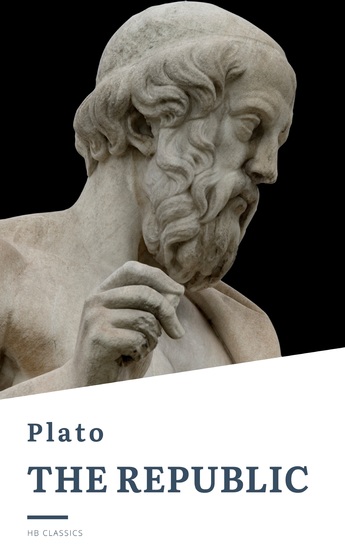
The Republic - cover

The Republic

Plato Plato, HB Classics

Translator Benjamin Jowett

Publisher: HB Classics

  • 0
  • 0
  • 0

Summary

Contains Active Table of Contents (HTML) and in the end of book include a bonus link to the free audiobook.

Often ranked as the greatest of Plato's many remarkable writings, this celebrated philosophical work of the fourth century B.C. contemplates the elements of an ideal state, serving as the forerunner for such other classics of political thought as Cicero's De Republica, St. Augustine's City of God, and Thomas More's Utopia.
Written in the form of a dialog in which Socrates questions his students and fellow citizens, The Republic concerns itself chiefly with the question, "What is justice?" as well as Plato's theory of ideas and his conception of the philosopher's role in society. To explore the latter, he invents the allegory of the cave to illustrate his notion that ordinary men are like prisoners in a cave, observing only the shadows of things, while philosophers are those who venture outside the cave and see things as they really are, and whose task it is to return to the cave and tell the truth about what they have seen. This dynamic metaphor expresses at once the eternal conflict between the world of the senses (the cave) and the world of ideas (the world outside the cave), and the philosopher's role as mediator between the two.
High school and college students, as well as lovers of classical literature and philosophy, will welcome this handsome and inexpensive edition of an immortal work. It appears here in the fine translation by the English classicist Benjamin Jowett.
Available since: 12/04/2022.
Print length: 289 pages.

Other books that might interest you

  • Confederacy on the Brink The: The History and Legacy of the Battles that Saved the Confederate Cause in 1862 - cover

    Confederacy on the Brink The:...

    Editors Charles River

    • 0
    • 0
    • 0
    As Union commander George McClellan moved the Army of the Potomac up the Peninsula in early 1862, the Union army had a nearly 2-1 advantage in manpower, so Army of Northern Virginia commander Joseph E. Johnston continued to gradually pull his troops back to a line of defense nearer Richmond as McClellan advanced. In conjunction, the Union Navy began moving its operations further up the James River, until it could get within 7 miles of the Confederate capital before being opposed by a Southern fort.  
    It was at this point that Johnston got uncharacteristically aggressive at the end of May, perhaps because he had run out of breathing space for his army. By the time the Battle of Seven Pines was over, nearly 40,000 had been engaged on both sides, making it the biggest battle in the Eastern theater to date, and Johnston was injured, bringing Robert E. Lee to command. 
    Despite not losing, the fighting rattled McClellan, but even after Lee pushed McClellan’s Army of the Potomac away from Richmond and back up the Peninsula in late June, he then had to swing his army north to face a second Union army: John Pope’s Army of Virginia. Correctly assuming that he needed to strike out before the Army of the Potomac successfully sailed back to Washington and linked up with Pope’s army, Lee daringly split his army to threaten Pope’s supply lines, forcing Pope to fall back to Manassas to protect his flank and maintain his lines of communication. At the same time, it left half of Lee’s army (under Stonewall Jackson) potentially exposed against the larger Union army until the other wing (under James Longstreet) linked back up. Thus, in late August 1862, the Army of Northern Virginia and the Army of Virginia found themselves fighting over nearly the exact same land the North and South fought over in the First Battle of Bull Run 13 months earlier. 
    Show book
  • Gichigami Hearts - Stories and Histories from Misaabekong - cover

    Gichigami Hearts - Stories and...

    Linda LeGarde Grover

    • 0
    • 0
    • 0
    Long before there was a Duluth, Minnesota, the massive outcropping that divides the city emerged from the ridge of gabbro rock running along the westward shore of Lake Superior. A great westward migration carried the Ojibwe people to the Point of Rocks. Against this backdrop—Misaabekong, the place of the giants—the lives chronicled in Linda LeGarde Grover's book unfold, some in myth, some in long-ago times, some in an imagined present, and some in the author's family history, all with a deep bond to the land, one another, and the Ojibwe culture. 


    Their fortunes and the family's future are inextricably entwined with tales of marriages to voyageurs, relocations to reservation lands, encounters with the spirits of the lake and wood creatures, the renewal of life—in myth and in art, the search for meaning in the transformations of our day is always vital. Finally, in one man's struggles, age-old tribulations, the intergenerational traumas of extended families and communities, and a uniquely Ojibwe appreciation for the natural and spiritual worlds converge, forging the Ojibwe worldview and will to survive as his legacy to his descendants. 


    Blending the seen and unseen, the old and the new, the amusing and the tragic and the hauntingly familiar, this lyrical work encapsulates a way of life forever vibrant at the Point of Rocks.
    Show book
  • Unequal - How extreme inequality is damaging democracy and what we can do about it - cover

    Unequal - How extreme inequality...

    David Buckham, Robyn Wilkinson,...

    • 0
    • 0
    • 0
    ‘Twenty-first-century capitalism and the democracies that enabled it are self-destructing... a sobering ― and impeccably researched ― warning of what is likely to come next’ Bruce Whitfield  
    The leading lights of the tech revolution – Gates, Bezos, Zuckerberg, Musk – have been hailed as savants and saviours of the modern age. And yet they are at the forefront of wealth inequality not seen since the heyday of the robber barons in the late 19th century, part of the slide to the First World War. Today, rampant inequality is inciting social unrest and undermining faith in the institutions of the democratic state. Citizens have been left at the mercy of unfettered capitalism – mere data subjects, endlessly surveilled, marshalled and increasingly angry and polarised. 
    The decoupling of capitalism from democracy has fostered an economic system seemingly powered by greed alone, with the marginalisation of democratic principles facilitating the rise of authoritarians and populists like Putin, Xi Jinping, Trump and Boris Johnson. 
    How has it come to this? And does the unanticipated fightback in Ukraine, with support from the West, show us the way to reclaiming the lost spirit of freedom inherent in liberal democracy?
    Show book
  • The Last Kings of Macedonia and the Triumph of Rome - cover

    The Last Kings of Macedonia and...

    Ian Worthington

    • 0
    • 0
    • 0
    In the history of ancient Macedonia, the last three Antigonid kings—Philip V, his son Perseus, and the pretender Andriscus or Philip VI—are commonly overlooked in favor of their predecessors Philip II and his son Alexander the Great, who established a Macedonian empire. By the time Philip V became king, Macedonia was no longer an imperial power and Rome was fast spreading its dominance over the Mediterranean. Viewed as postscripts to the kingdom's heyday, the last Macedonian kings are often denounced for self-serving ambitions, flawed policies, and questionable personal qualities by hostile ancient writers. They are condemned for defeats by Rome that saw both the end of the monarchy and the fall of the formidable Macedonian phalanx before the Roman legion. 


    Producing the first full-scale treatment of Philip V in eighty years and the first in English of Perseus and Andriscus in more than fifty, Ian Worthington argues that this period was far from a postscript to Macedonia's Classical greatness and disagrees that the last Antigonid kings were merely collateral damage in Rome's ascendancy in the east. Despite superior Roman manpower and resources, Philip and Perseus often had the upper hand in their wars against Rome. As Worthington asserts, these kings deserve to be remembered for striving to preserve their kingdom's independence against staggering odds.
    Show book
  • Ernest Shackleton’s Antarctic Survival Story - The True Story of Leadership Courage and Survival Against All Odds - cover

    Ernest Shackleton’s Antarctic...

    Jackson Lewis

    • 0
    • 0
    • 0
    Few survival stories are as legendary as Ernest Shackleton’s Antarctic expedition. Stranded for nearly two years in brutal conditions, his leadership turned what should have been a death sentence into one of the greatest rescues in history. 
    This audiobook takes you deep into the icy heart of Antarctica, following Shackleton and his crew as they battle the elements, make impossible decisions, and fight to stay alive. Discover: 
    ✅ The disastrous moment the Endurance was trapped in ice 
    ✅ How Shackleton’s unbreakable leadership kept his men alive 
    ✅ The incredible 800-mile open-sea voyage to seek help 
    ✅ The lasting legacy of one of history’s greatest survival stories 
    Ernest Shackleton’s Antarctic Survival Story is a must-listen for history lovers, adventure seekers, and anyone fascinated by true survival against impossible odds.
    Show book
  • When Movements Anchor Parties - Electoral Alignments in American History - cover

    When Movements Anchor Parties -...

    Daniel Schlozman

    • 0
    • 0
    • 0
    Throughout American history, some social movements, such as organized labor and the Christian Right, have forged influential alliances with political parties, while others, such as the antiwar movement, have not. When Movements Anchor Parties provides a bold new interpretation of American electoral history by examining five prominent movements and their relationships with political parties.Taking readers from the Civil War to today, Daniel Schlozman shows how two powerful alliances—those of organized labor and Democrats in the New Deal, and the Christian Right and Republicans since the 1970s—have defined the basic priorities of parties and shaped the available alternatives in national politics. He traces how they diverged sharply from three other major social movements that failed to establish a place inside political parties—the abolitionists following the Civil War, the Populists in the 1890s, and the antiwar movement in the 1960s and 1970s. Moving beyond a view of political parties simply as collections of groups vying for preeminence, Schlozman explores how would-be influencers gain influence—or do not. He reveals how movements join with parties only when the alliance is beneficial to parties, and how alliance exacts a high price from movements. Their sweeping visions give way to compromise and partial victories. Yet as Schlozman demonstrates, it is well worth paying the price as movements reorient parties' priorities.Timely and compelling, When Movements Anchor Parties demonstrates how alliances have transformed American political parties.
    Show book