Begleiten Sie uns auf eine literarische Weltreise!
Buch zum Bücherregal hinzufügen
Grey
Einen neuen Kommentar schreiben Default profile 50px
Grey
Jetzt das ganze Buch im Abo oder die ersten Seiten gratis lesen!
All characters reduced
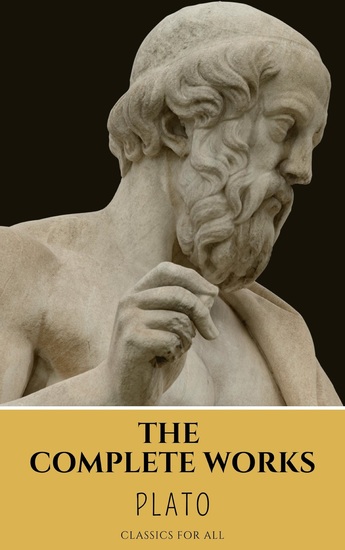
Plato: The Complete Works (31 Books) - cover

Plato: The Complete Works (31 Books)

Plato Plato, Classics for all

Übersetzer Benjamin Jowett

Verlag: Classics for all

  • 0
  • 0
  • 0

Beschreibung

Plato was a philosopher in Ancient Greece. He was an essential figure in the development of philosophy, especially the Western tradition, and he founded the Academy in Athens, the first institution of higher learning in the Western world.

Plato's dialogues have been used (and are still used) to teach a range of subjects, including philosophy, logic, ethics, rhetoric, religion and mathematics. His lasting themes include Platonic love, the theory of forms, the five regimes, innate knowledge, among others. His theory of forms launched a unique perspective on abstract objects, and led to a school of thought called Platonism.

This collection contains the following works by Plato:

Early Works
•Apology
•Charmides, or Temperance
•Crito
•Euthyphro
•Gorgias
•Hippias, Lesser
•Hippias, Greater
•Ion
•Laches
•Lysis
•Protagoras

Transitional Works
•Cratylus
•Euthydemus
•Meno
•Parmenides
•Phaedo
•Phaedrus
•Symposium
•The Republic

Middle Works
•Theaetetus

Late Works
•Critias
•Laws
•Philebus
•Sophist
•Statesman
•Timaeus

Works of Disputed Authorship
•Alcibiades I & II
•Eryxias
•Menexenus
•Theages
Verfügbar seit: 07.07.2022.
Drucklänge: 3000 Seiten.

Weitere Bücher, die Sie mögen werden

  • A Heart Finally Open - cover

    A Heart Finally Open

    Lamont Kellum Jr.

    • 0
    • 0
    • 0
    Lamont Kellum Jr. is a very profound and prolific writer. Taking his poetry and spoken word to new heights, he is now telling his story in his own cadence unapologetically. From having the artistical architecture in his writing of poetry, he decided to utilize his gifted craft with a story telling of his own after all these years of everyone else telling it. After being wrongfully convicted and sentenced to life in prison, Lamont, also known as King Ccholo, is now giving his true self in this audiobook. Speaking on his life experiences with his upbringing, friends, family, previous and current relationships; Lamont is now setting the tone with a new approach to poetry and spoken word and it starts NOW!
    Zum Buch
  • Sayajirao the maharaja who defied the King - cover

    Sayajirao the maharaja who...

    Amit Schandillia

    • 0
    • 0
    • 0
    The 1911 Delhi Durbar was the third and the last, and a very special one. It was an event of many historical firsts—the first time Delhi took over from Calcutta as India's capital, the first time a reigning British monarch visited India in person, and the first time an Indian king openly defied the British monarch outside of a war. The king in question was Sayajirao Gaekwad. From here onwards, his story was a story of defiance and insubordination with the most cautious mix of diplomacy. How did he manage that? Listen here!
    Zum Buch
  • Lucky Lindy and Lady Lindy - cover

    Lucky Lindy and Lady Lindy

    Editors Charles River

    • 0
    • 0
    • 0
    In many ways, Charles Lindbergh represented the best and worst of America during the first half of the 20th century. Lindbergh became famous for being an aviation pioneer whose solo flight across the Atlantic captured the imagination of an entire world, yet he was an isolationist who wanted to keep American freedoms safe for Americans and no one else. Lindbergh was the quintessential family man, yet he fathered illegitimate children and suffered an unspeakable tragedy that became known as “The Crime of the Century.” Lindbergh embodied some of his era’s greatest virtues and harbored some of its worst prejudices.  
    Lindbergh was a 25 year old U.S. Air Mail pilot who was probably best known for two crashes before shooting to fame with his non-stop flight across the Atlantic from New York City to Paris on May 20-21, 1927. Lindbergh was Time Magazine’s first Man of the Year in 1927, and he used his newfound fame to promote the development of commercial flight and become a spokesman and symbol for advances in aviation.  
    In 1928, Amelia Earhart was the first woman to fly across the Atlantic Ocean, but she was disappointed that she had to do so as a passenger, complaining, “I was just baggage, like a sack of potatoes.” But by the mid-1930s, Earhart had set a multitude of altitude and distance records, but she wanted to attempt a circumnavigation of the world. After an ill-fated first attempt, Earhart and Fred Noonan set off on another attempt, creating one of the 20th century’s most enduring mysteries. Earhart and Noonan were to land on Howland Island, 1700 miles southwest of Hawaii, but radio transmissions ceased between the plane and authorities on the ground the morning of July 2, 1937. Earhart and Noonan had disappeared, never to be seen again, despite one of the nation’s largest and costliest manhunts to date.  
    The speculation over exactly what happened to Earhart and the mystery of her disappearance remain.
    Zum Buch
  • Integrity in Actions - The Honest Practice - cover

    Integrity in Actions - The...

    Esther Jameson

    • 0
    • 0
    • 0
    Integrity is often regarded as one of the most essential virtues, yet its true meaning is far more complex than many assume. At its core, integrity is the alignment of one's actions with their values, beliefs, and principles. It is the foundation of trust, and without it, relationships—both personal and professional—are built on fragile ground. Integrity goes beyond just telling the truth; it involves living authentically and consistently, regardless of external pressures or consequences. It is about doing what is right, even when no one is watching, and staying true to one's principles, even when the path seems difficult. 
    To truly understand integrity, it’s important to distinguish it from honesty. While honesty is certainly a component of integrity, the latter involves a deeper commitment to ethical living. Honesty refers to the act of telling the truth, whereas integrity encompasses the broader commitment to act in a way that reflects personal moral values and societal expectations. Someone with integrity not only speaks the truth but also lives truthfully. This practice manifests in how a person carries themselves through their decisions, actions, and behaviors, and is a constant process of self-checking to ensure they remain in alignment with their ethical principles. 
    The importance of integrity in daily life cannot be overstated. In a world full of distractions and temptations, staying grounded in integrity can be a challenge. Yet, it is through consistent, small acts of integrity that we build our character. These small decisions may seem insignificant at the time but accumulate over a lifetime to define who we are and how others perceive us. Integrity impacts not just personal satisfaction but also how we are seen in the eyes of others. People are drawn to those who exhibit strong moral character, and trust grows in environments where integrity is consistently practiced.
    Zum Buch
  • The Late Medieval Scottish Parliament - Politics and the three Estates 1424–1488 - cover

    The Late Medieval Scottish...

    Roland Tanner

    • 0
    • 0
    • 0
    In this ground-breaking study of the medieval parliament, Roland Tanner gives the Scottish Parliament a human face by examining the actions and motives of those who attended. In the past, the Scottish Parliament was seen as a weak and ineffective institution – damned because of its failure to be more like its English counterpart. But Roland Tanner shows that the old picture of weakness is far from accurate. In its very different way, the Scottish Parliament was every bit as powerful as the English institution. The ‘Three Estates’ (the clergy, nobility and burgh representatives who attended Parliament) were able to wield a surprising degree of control over the Crown during the fifteenth century. For instance, they threatened to lock James I’s taxation in a box to which he, the king, would have no access, made James II swear not to alter acts of Parliament, and prevented him from using his own lands and wealth as patronage for his supporters, and forbade James III to leave the country.  Roland Tanner has avoided a dry constitutional approach. Instead he has sought to bring Parliament to life through the people who attended, the reasons why they attended, and the complex interactions which occurred when all the most wealthy, powerful and ambitious people in the kingdom gathered in one place.
    Zum Buch
  • How to Have a Life - An Ancient Guide to Using Our Time Wisely - cover

    How to Have a Life - An Ancient...

    Seneca

    • 0
    • 0
    • 0
    A vibrant new translation of Seneca's "On the Shortness of Life," a pointed reminder to make the most of our time 


    Who doesn't worry sometimes that smart phones, the Internet, and TV are robbing us of time and preventing us from having a life? How can we make the most of our time on earth? In the first century AD, the Stoic philosopher Seneca the Younger offered one of the most famous answers to that question in his essay "On the Shortness of Life"—a work that has more to teach us today than ever before. In How to Have a Life, James Romm presents a vibrant new translation of Seneca's brilliant essay, plus two Senecan letters on the same theme, complete with an inviting introduction. 


    With devastating satiric wit, skillfully captured in this translation, Seneca lampoons the ways we squander our time and fail to realize how precious it is. We don't allow people to steal our money, yet we allow them to plunder our time, or else we give it away ourselves in useless, idle pursuits. Seneca also describes how we can make better use of our brief days and years. In the process, he argues, we can make our lives longer, or even everlasting, because to live a real life is to attain a kind of immortality.
    Zum Buch