Join us on a literary world trip!
Add this book to bookshelf
Grey
Write a new comment Default profile 50px
Grey
Subscribe to read the full book or read the first pages for free!
All characters reduced
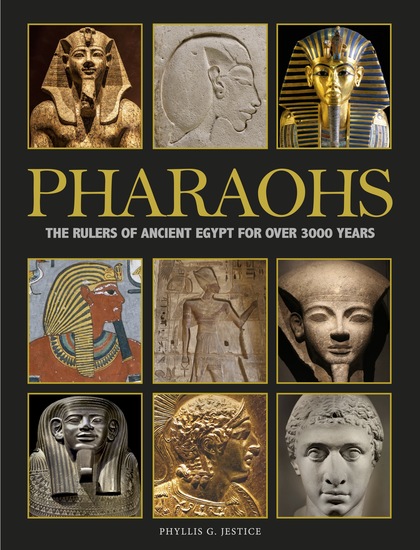
Pharaohs - cover

Pharaohs

Phyllis G. Jestice

Publisher: Amber Books Ltd

  • 0
  • 0
  • 0

Summary

Ancient Egypt is one of the great wellsprings of human civilization, first developing around the city of Memphis on the Nile River in the fourth millennium BCE. Egyptian life was centred on a complex system of religious rituals, with the pharaoh (king) seen as a living god among the people. Mighty pyramids, tombs and monuments were built to celebrate the pharaohs, many of which can still be seen in all their grandeur today. Arranged by dynastic period, Pharaohs offers a compact history of the reign of these god- kings, from Menes, who united the north and south kingdoms, to the Ptolemaic Queen Cleopatra, who was defeated along with her lover Mark Antony at the Battle of Actium (31 BCE) by imperial Rome. Along the way the reader will learn about the Great Pyramid constructed by Khufu, the last of the Seven Wonders of the ancient world; Queen Hatshepsut, a rare female pharaoh whose name means “foremost of noblewomen” and who launched a massive building programme at Luxor; the young pharaoh Tutankhamun, whose tomb was discovered intact in the Valley of the Kings, complete with the fabulous trappings of his divine status; and Ramesses II (“the Great”), who is thought to have enslaved the Israelites, built the magnificent temple of Abu Simbel, and defeated the Hittites at the Battle of Kadesh (1274 BCE) riding his trade-mark chariot. Carefully researched, superbly entertaining and illustrated throughout with more than 180 photographs and artworks, Pharaohs is an accessible history of the kings who ruled Ancient Egypt for more than 4,000 years.
Available since: 02/13/2024.
Print length: 224 pages.

Other books that might interest you

  • Doug Stanhope: No Place Like Home - cover

    Doug Stanhope: No Place Like Home

    Doug Stanhope

    • 0
    • 0
    • 0
    Doug Stanhope performs live in his hometown of Bisbee, Arizona, tackling an assortment of hard-hitting issues, from caring for the mentally-ill, to Vietnam vets, being locked up abroad and why everyone should kick like they kick. Watch him battle ISIS for the disenfranchised, angry youth.
    Show book
  • Cliché-Verre - Miniatures On Glass - cover

    Cliché-Verre - Miniatures On Glass

    Brian Allan Skinner

    • 0
    • 0
    • 0
    Cliché-verre is a technique of etching and painting directly on photographic negatives. The term means “glass negative” in French and is as old as photography itself, dating to the 1840s and earlier. The first successful photographic process involved coating glass plates with light-sensitive chemicals from which reversed (positive) prints could be made. Artists experimented with drawing, etching, and combining images directly on the glass, resulting in fanciful black-and-white prints. But few artists were inspired to develop the idea further until the advent of color photography in the early 20th Century. 
    The Magic Lantern, long predating photography, was invented by Christiaan Huygens, a Dutch astronomer and physicist, in the 1600s. It is a simple device for projecting images, based upon the centuries-old principles of the “camera obscura” or “darkened room.” When the photographic process evolved to  
    film rather than glass plates, the technology spread. Color film arrived in the 1930s. There were now both film negatives and positives (slides). 
    Brian Allan Skinner is the author of six volumes of illustrated fiction. His experiments with cliché-verre began in the 1960s. Here are 50 examples of his work from the past half-century, in brilliant color. In the epilogue, he explains his process in detail.
    Show book
  • Design Thinking - A comprehensive guide to design thinking and its applications - cover

    Design Thinking - A...

    Et Tu Code

    • 0
    • 0
    • 0
    Unlock the power of design thinking! This comprehensive guide takes you on a journey to understand the fundamentals and applications of design thinking, a revolutionary approach to innovation and problem-solving. 
    Learn how to think creatively, empathize with users, and develop innovative solutions that meet their needs. Dive into real-world examples and case studies from various industries, including technology, healthcare, education, and more. 
    Explore the five stages of design thinking: Empathize, Define, Ideate, Prototype, and Test. Discover how to: 
    * Develop a user-centered mindset 
    * Challenge assumptions and biases 
    * Foster collaboration and creativity 
    * Overcome obstacles and risks 
    * Measure success and iterate 
    Whether you're a designer, entrepreneur, or simply looking to innovate in your work or personal life, this book will provide you with the tools and knowledge to apply design thinking principles and bring your ideas to life.
    Show book
  • Life Is So Strange: Missing Persons & Beyond - cover

    Life Is So Strange: Missing...

    Dale Bozzio

    • 0
    • 0
    • 0
    This audiobook is narrated by an AI Voice.  
    • One of music's most recognizable and influential artists, Missing Person's Dale Bozzio, shares her most intimate and inspirational moments in this superb autobiography! 
    • Bozzio kisses and tells ALL, weaving stories from throughout her entire life including her childhood, her time as a Playboy bunny, her fateful introduction to Frank Zappa, her meteoric rise with Missing Persons, her love affair and collaborations with Prince, and so much more!
    Show book
  • Annie Korzen: Funny Jewish & Live! - cover

    Annie Korzen: Funny Jewish & Live!

    Annie Korzen

    • 0
    • 0
    • 0
    Humorist and comic actress Annie Korzen -- as seen on Seinfeld, Oliver Beene, New Girl, I'm Sorry -- has spent her career making people laugh. Hear the best of live comedy performances from this master storyteller!
    Show book
  • Duet - An Artful History of Music - cover

    Duet - An Artful History of Music

    Eleanor Chan

    • 0
    • 0
    • 0
    When, how, where, does a mark become a musical note? What alchemy occurs to transform a symbol into sound: a song; a symphony; a chorus? 
     
    Music is interwoven into the fabric of our lives. We listen to it, some of us play it, but throughout history, humans have also attempted to capture it visually, from the musical images of Ancient Sumer, to Frozen's Elsa standing on the side of a mountain, her voice making crystals in the air. In this startlingly original history of music, Eleanor Chan takes us on a journey through sound that encompasses the 35,000-year-old flute found in a German cave, Kandinsky's kaleidoscopic paintings, illuminated manuscripts, and haute couture. 
     
    Classically trained musician and art historian Dr. Eleanor Chan opens up a world of sound and vision, exploring different ways to think about listening and seeing. Ultimately, this book asks the listener what it is, and what it might mean, to truly see music.
    Show book