Join us on a literary world trip!
Add this book to bookshelf
Grey
Write a new comment Default profile 50px
Grey
Subscribe to read the full book or read the first pages for free!
All characters reduced
The Victim and The Worm - cover

The Victim and The Worm

Phyllis Bottome

Publisher: Good Press

  • 0
  • 0
  • 0

Summary

In Phyllis Bottome's compelling novel, "The Victim and The Worm," readers are invited into a richly layered narrative that examines the complex interplay between victimhood and resilience. Bottome employs a keen psychological insight coupled with a vivid, nuanced prose style that reveals the inner lives of her characters with poignant clarity. The setting, steeped in the societal mores of early twentieth-century England, serves as a backdrop for exploring themes of power, betrayal, and the struggle for self-identity, echoed in the lives of her flawed yet relatable protagonists. The plot deftly navigates through moments of tension and revelation, making the work both a thriller and a profound emotional study. Phyllis Bottome, a British author known for her sharp observations of human nature, drew from her extensive experiences in social circles and her keen interest in psychology to craft this novel. Her background as both a novelist and a biographer led her to explore the darker facets of human existence, which are distinctly reflected in "The Victim and The Worm." Bottome's literary career was marked by her dedication to revealing the intricacies of personal relationships and the societal pressures that shape individual destinies. This novel is a must-read for anyone interested in psychological fiction that tackles the profound questions of morality and personal agency. Bottome's skillful storytelling and rich character development offer a rewarding experience for both casual readers and literary scholars alike, making "The Victim and The Worm" a timeless exploration of the human condition.
Available since: 04/24/2025.
Print length: 200 pages.

Other books that might interest you

  • The Human Comedy - cover

    The Human Comedy

    Honoré de Balzac

    • 0
    • 0
    • 0
    Own the Entire Spectacle of the Human Condition.
    
    Honoré de Balzac did not just write fiction; he built a civilization. "The Human Comedy" is arguably the most ambitious project in literary history—a vast, interconnected universe designed to capture every facet of 19th-century life. This collection serves as a grand social map, spanning from the opulence of Parisian high society to the rugged reality of the French provinces.
    
    Inside this monumental body of work, you will discover:
    
    A Living Social History: A staggering web of characters who reappear across different stories, creating a sense of a persistent, evolving world that influenced authors from Flaubert to Kerouac.
    
    The Architecture of Ambition: Unflinching observations of the power of wealth, the weight of social status, and the relentless drive for success in a rapidly changing world.
    
    Masterful Realism: Balzac's signature style of meticulous detail, bringing to life the fashion, architecture, and secret motivations of an entire era.
    
    The Philosophical Core: Deep inquiries into the forces that govern human behavior—obsessions, passions, and the inevitable clash between the individual and society.
    
    Reading this collection is an immersive experience. To enter Balzac's world is to witness the birth of modern society through the eyes of its most astute observer. This volume is an essential cornerstone for any library of world literature and a must-read for anyone seeking to understand the true complexity of human nature.
    
    Step into the grand design of a literary titan. Buy "The Human Comedy" today and explore the depths of Balzac's genius.
    Show book
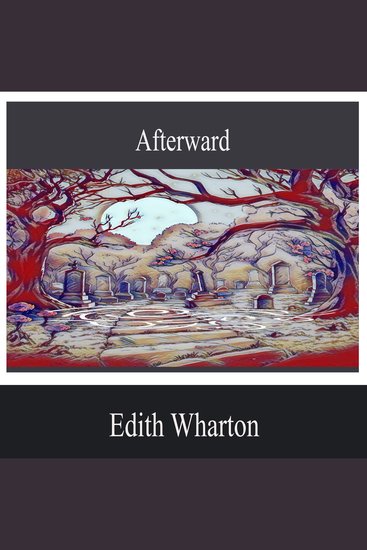
  • Afterward - cover

    Afterward

    Edith Wharton

    • 0
    • 0
    • 0
    "Afterward" is a short story by American writer Edith Wharton. It was first published in the 1910 edition of The Century Magazine and later reprinted in her books The Collected Short Stories of Edith Wharton and Tales of Men and Ghosts. This intriguing tale weaves an ironic ghost story around themes of greed and retribution.
    Show book
  • Canon Alberic's Scrap Book - From their pens to your ears genius in every story - cover

    Canon Alberic's Scrap Book -...

    M R James

    • 0
    • 0
    • 0
    Montague Rhodes James is cited as perhaps the greatest English writer of ghost stories, an opinion few would disagree with. 
    James was born on 1st August 1862 at Goodnestone Parsonage in Kent, where his father was Curate but at age 3 the family went to live at Livermere, near Bury St Edmunds in East Anglia.  
    From early childhood he had a passion for mediaeval books and antiques. He was educated initially as a boarder at Temple Grove School in East Sheen, west London, before gaining a scholarship to Eton and thence Cambridge where he gained a double first, becoming a distinguished linguist and mediaevalist.  
    Before the Great War vacations were usually spent touring Europe absorbing cultures and references for his later writing. 
    A man of enormous knowledge it was said he timed his breakfast egg whilst he completed the Times crossword.  
    Many of his elegant yet terrifying tales were created by discarding the prevailing gothic cliches and placing his characters and narrative in a realistic setting.  Thereby the stories gained atmosphere and menace on a grand scale and he was famed as the originator of the antiquarian ghost story. 
    Although story-telling and writing these 30 or so tales was a hobby, when published their effect transformed the genre and still chill the bones in our more modern times. 
    James was also a medievalist scholar and translator whose work remains highly respected. He was also Provost of Eton College between 1918 and 1936. 
    M R James died on 12th June 1936 at Eton in Buckinghamshire.  He was 73.
    Show book
  • The Rainbow - cover

    The Rainbow

    D.H. Lawrence

    • 0
    • 0
    • 0
    "The Rainbow" is a novel by D.H. Lawrence, first published in 1915. It is the first book in Lawrence's "Brangwen" series and is followed by "Women in Love." The novel explores the lives of the Brangwen family, particularly focusing on the two central characters, Ursula and Gudrun Brangwen. The story traces their individual journeys of self-discovery and rebellion against societal norms, particularly in the context of their romantic and sexual relationships. Lawrence's writing delves into themes of love, desire, personal growth, and the clash between traditional and modern values.
    Show book
  • The Nose - cover

    The Nose

    Nikolai Gogol

    • 0
    • 0
    • 0
    "The Nose" is a satirical short story by Nikolai Gogol written during his time living in St. Petersburg. During this time, Gogol's works were primarily focused on surrealism and the grotesque, with a romantic twist. 
    Written between 1835 and 1836, "The Nose" tells the story of a St. Petersburg official whose nose leaves his face and develops a life of its own. "The Nose" was originally published in The Contemporary, a literary journal owned by Alexander Pushkin. 
    "The Nose" is divided into three parts and tells the story of Collegiate Assessor ('Major') Kovalyov, who wakes up one morning without his nose. He later finds out that his nose has developed a life of its own, and has apparently surpassed him by attaining the rank of State Councillor. The short story showcases the obsession with social rank that plagued Russia after Peter the Great introduced the Table of Ranks. By allowing commoners to gain hereditary nobility through service to the state, a huge population was given the chance to move up in social status. This opportunity, however, also gave way to large bureaucracies, in which many of Gogol's characters worked.
    Show book
  • Middlemarch (Book 7: Two Temptations) - cover

    Middlemarch (Book 7: Two...

    George Eliot

    • 0
    • 0
    • 0
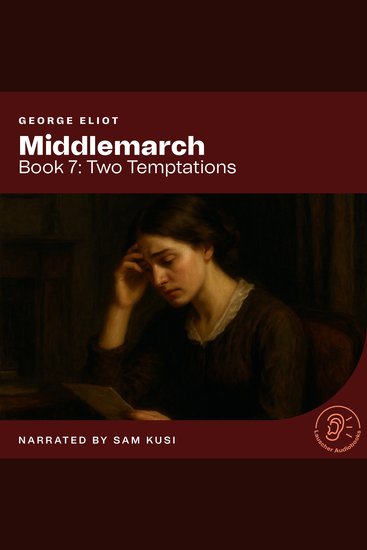
    Middlemarch (Book 7: Two Temptations), A Study of Provincial Life is a novel by English author George Eliot, the pen name of Mary Ann Evans. It appeared in eight installments (volumes) in 1871 and 1872. Set in Middlemarch, a fictional English Midlands town, from 1829 to 1832, it follows distinct, intersecting stories with many characters. Issues include the status of women, the nature of marriage, idealism, self-interest, religion, hypocrisy, political reform, and education. Leavened with comic elements, Middlemarch approaches significant historical events in a realist mode: the Reform Act 1832, early railways, and the accession of King William IV. It looks at medicine of the time and reactionary views in a settled community facing unwelcome change. Eliot began writing the two pieces that formed the novel in 1869–1870 and completed it in 1871. Initial reviews were mixed, but it is now seen widely as her best work and one of the great English novels.
    Show book