Join us on a literary world trip!
Add this book to bookshelf
Grey
Write a new comment Default profile 50px
Grey
Subscribe to read the full book or read the first pages for free!
All characters reduced
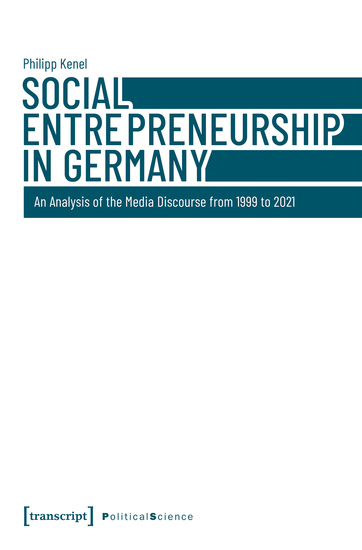
Social Entrepreneurship in Germany - An Analysis of the Media Discourse from 1999 to 2021 - cover

Social Entrepreneurship in Germany - An Analysis of the Media Discourse from 1999 to 2021

Philipp Kenel

Publisher: transcript Verlag

  • 0
  • 0
  • 0

Summary

Public and political interest in social entrepreneurship (SE) is increasing while it remains a contested and ambiguous concept. Philipp Kenel traces the popular media representation of SE in Germany over time (1999—2021), making an important empirical contribution to the sociological and political understanding of the phenomenon. He shows that until 2008, SE was mainly understood as a reform of the welfare infrastructure (including public and non-profit institutions). From 2009, SE was increasingly conceptualised as part of the economy, while sometimes challenging and other times reaffirming mainstream economic logics. More recently, in somewhat competing perspectives, SE has been framed as part of the ›start-up‹ world or as a force for deeper social and ecological transformation.
Available since: 06/30/2024.
Print length: 408 pages.

Other books that might interest you

  • The New Goliaths - How Corporations Use Software to Dominate Industries Kill Innovation - cover

    The New Goliaths - How...

    James Bessen

    • 0
    • 0
    • 0
    An approach to reinvigorating economic competition that doesn’t break up corporate giants, but compels them to share their technology, data, and knowledge 
      
    “Bessen is a master of unpacking the nuances of a complex array of interrelated trends to build a coherent story of how the promise of the democratized Internet ended up under the control of just a few. Read The New Goliaths to see how the forest came to have only room for a few tall trees with the rest of us in the undergrowth.”—Joshua Gans, coauthor of Prediction Machines: The Simple Economics of Artificial Intelligence 
      
    Historically, competition has powered progress under capitalism. Companies with productive new products rise to the top, but sooner or later, competitors come along with better innovations and disrupt the threat of monopoly. Dominant firms like Walmart, Amazon, and Google argue that this process of “creative destruction” prevents them from becoming too powerful or entrenched. 
      
    But the threat of competition has sharply decreased over the past twenty years, and today’s corporate giants have come to power by using proprietary information technologies to create a tilted playing field. This development has increased economic inequality and social division, slowed innovation, and allowed dominant firms to evade government regulation. In the face of increasing calls to break up the largest companies, James Bessen argues that a better way to restore competitive balance and dynamism is to encourage or compel these companies to share technology, data, and knowledge.
    Show book
  • Think It Over - How to Use Critical Thinking to Avoid Falsity and Failure - cover

    Think It Over - How to Use...

    Oliver L. North, David L. Goetsch

    • 0
    • 0
    • 0
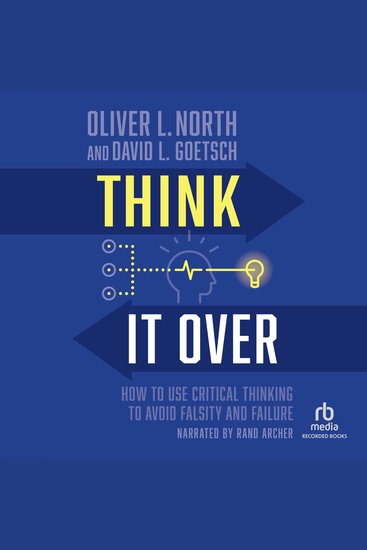
    In the past, one of the most cherished American values was the truth. When people dealt with dilemmas, issues, opinions, and decisions, their first question was “What is the truth in this situation?” Now people are concerned only with what they think, feel, and want.  
    We have lost touch with the importance of truth in our lives. This reality has resulted in a society in abject turmoil and confusion.  
     
    Perhaps the greatest failure of the American school system is in turning out generations without the ability to carefully think through what they see, read, and hear. This book is the path for our return to truth.
    Show book
  • Unequal - How extreme inequality is damaging democracy and what we can do about it - cover

    Unequal - How extreme inequality...

    David Buckham, Robyn Wilkinson,...

    • 0
    • 0
    • 0
    ‘Twenty-first-century capitalism and the democracies that enabled it are self-destructing... a sobering ― and impeccably researched ― warning of what is likely to come next’ Bruce Whitfield  
    The leading lights of the tech revolution – Gates, Bezos, Zuckerberg, Musk – have been hailed as savants and saviours of the modern age. And yet they are at the forefront of wealth inequality not seen since the heyday of the robber barons in the late 19th century, part of the slide to the First World War. Today, rampant inequality is inciting social unrest and undermining faith in the institutions of the democratic state. Citizens have been left at the mercy of unfettered capitalism – mere data subjects, endlessly surveilled, marshalled and increasingly angry and polarised. 
    The decoupling of capitalism from democracy has fostered an economic system seemingly powered by greed alone, with the marginalisation of democratic principles facilitating the rise of authoritarians and populists like Putin, Xi Jinping, Trump and Boris Johnson. 
    How has it come to this? And does the unanticipated fightback in Ukraine, with support from the West, show us the way to reclaiming the lost spirit of freedom inherent in liberal democracy?
    Show book
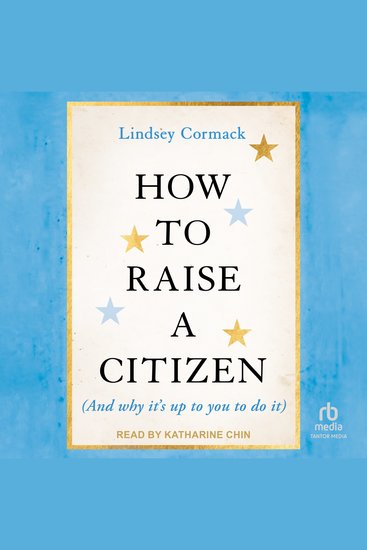
  • How To Raise A Citizen (And Why It's Up to You to Do It) - cover

    How To Raise A Citizen (And Why...

    Lindsey Cormack

    • 0
    • 0
    • 0
    An essential guide to nurturing the next generation of responsible, informed citizens 


    Lindsey Cormack's book, How to Raise a Citizen (And Why It's Up to You to Do It), speaks directly to an America in which civic knowledge is alarmingly sparse and many people dread politics. It's a tool for parents, educators, and anyone eager to fill this gap. In the book, Cormack offers an engaging and practical approach to discussing political issues and the inner workings of the US government with children. She explains why our schools can no longer be the sites of civic education that they used to be and provides parents with strategies and necessary know-how to be able to impart these lessons to their children. From the intricacies of the voting process to the foundational principles of democracy and the significance of key government documents like the Constitution, the author demystifies complex topics with clarity and insight. 


    How to Raise a Citizen is a roadmap to a future where political dialogue and civic engagement are not just encouraged but celebrated in our homes. With actionable advice and easy-to-understand explanations, it empowers listeners to instill a sense of civic responsibility and curiosity in the young minds they influence.
    Show book
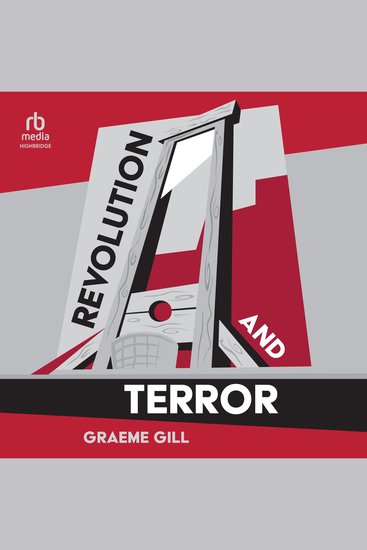
  • Revolution and Terror - cover

    Revolution and Terror

    Graeme Gill

    • 0
    • 0
    • 0
    This book is a study of the relationship between revolution and terror. Historically many have claimed that revolution inevitably devolves into terror, best reflected in the way in which after coming to power the revolutionary elite turns on itself, and one section of it uses terrorist means to eliminate another section. Graeme Gill argues that in order to understand the relationship between revolution and terror, it is necessary to distinguish between different types of terror. There are three such types: revolutionary terror, in which the aim is to destroy enemies and thereby consolidate the regime; transformational terror, designed to drive the politico-socio-economic transformation of society that is the purpose of the 'great' revolutions; and inverted terror, which is when terror is turned against part of the elite and regime more broadly. The analysis explains how these different types of terror are related to the revolutionary seizure of power, showing that revolutionary and transformational terror are organically connected to revolution while for inverted terror the connection is mediated through the leader. The argument is prosecuted through detailed analysis of the French, Russian, and Chinese revolutions. The study ends by assessing the contemporary salience of the lessons of the great revolutions in the light of the low level of violence in the negotiated revolutions of 1989.
    Show book
  • A Confession - cover

    A Confession

    Leo Tolstoy

    • 0
    • 0
    • 0
    "Is there any meaning in my life that the inevitable death awaiting me does not destroy?"
    
    This poignant and candid autobiographical work uncovers the inner turmoil of a man struggling with a mid-life existential crisis. At the height of his literary fame and faced with the inevitability of death and the stark realities of existence, Leo Tolstoy found himself searching for answers to the ultimate philosophical questions about the meaning of life. Haunted by questions of mortality, purpose, and faith, A Confession, chronicles his spiritual journey through faith and towards self-discovery.
    Leo Tolstoy (1828–1910) was a Russian novelist, philosopher, and social reformer, widely regarded as one of the greatest writers of all time. He is best known for his epic novels War and Peace and Anna Karenina, both celebrated for their intricate character development and profound exploration of moral dilemmas and human nature. In his later years, Tolstoy experienced a spiritual awakening which led him to reject materialism and embrace a life of simplicity, seeking to align his life with his beliefs about non-violence and compassion. Tolstoy's legacy endures not only through his literary masterpieces but also through his profound impact on literature and philosophy.
    Show book