Join us on a literary world trip!
Add this book to bookshelf
Grey
Write a new comment Default profile 50px
Grey
Subscribe to read the full book or read the first pages for free!
All characters reduced
The Kaiser's Escapees - Allied POW escape attempts during the First World War - cover

The Kaiser's Escapees - Allied POW escape attempts during the First World War

Philip D. Chinnery

Publisher: Pen & Sword Military

  • 0
  • 1
  • 0

Summary

Following on from the his first well-received book 'The Kaisers First POWs' Philip Chinnery now turns his attention to the attempts by allied prisoners of war to escape the Kaiser's clutches and return to their homeland. As the war progressed, the treatment of allied prisoners worsened as the blockade of Germany reduced the amount of food and material coming into the country. The majority of the prisoners were too weak or ill-equipped to attempt to escape, but there were others who were determined to pit their wits against their jailers. These included the officers at Holzminden prison, who dug a tunnel allowing twenty-eight of their number to escape; men like Canadian Private Simmons, who escaped and was recaptured twice before his third attempt saw him gain his freedom; men who jumped from moving trains or marched brazenly out of the camp gates disguised as German officers.Although Holland and Switzerland were neutral countries during the First World War, escaping from their camps, crossing miles of enemy territory and outwitting the sentries guarding the frontiers taxed even the strongest individuals. But many men did make the attempt and more than a few of them were successful. This is their story.
Available since: 05/30/2018.
Print length: 168 pages.


Other books that might interest you

  • Wabi-Sabi Unveiled: Embracing the Beauty of the Imperfect Now - A Practical Guide to Mindful Living and Inspired Creativity - cover

    Wabi-Sabi Unveiled: Embracing...

    Natalie Evans

    • 0
    • 0
    • 0
    "Wabi-Sabi Unveiled: Embracing the Beauty of the Imperfect Now - A Practical Guide to Mindful Living and Inspired Creativity" is a captivating exploration into the ancient Japanese philosophy of Wabi-Sabi, inviting readers on a transformative journey to discover the profound beauty in imperfection and the simplicity of the present moment. Authored by Natalie Evans, this book is a practical guide, offering a unique blend of mindfulness principles and creative insights to empower individuals to pursue a more meaningful and fulfilling life. 
    The essence of Wabi-Sabi lies in appreciating the beauty found in the imperfect, impermanent, and incomplete aspects of life. As readers delve into the pages of this book, they are introduced to the core principles of Wabi-sabi philosophy and its application in everyday living. The author skillfully weaves anecdotes, practical exercises, and contemplative reflections, providing readers with actionable steps to incorporate Wabi-Sabi into their lives. 
    The book goes beyond a theoretical exploration of Wabi-Sabi, offering a hands-on approach to mindful living and inspired creativity. Readers are guided through exercises encouraging them to embrace imperfections, cultivate gratitude, and develop a heightened awareness of the present moment. The author emphasizes the importance of slowing down, savoring life's nuances, finding joy in simplicity, and fostering a sense of balance and tranquility.
    Show book
  • Wars of Classical Greece The: The History of the Conflicts that Led to the Rise and Fall of the Greeks’ Dominance - cover

    Wars of Classical Greece The:...

    Charles River Editors

    • 0
    • 0
    • 0
    The ancient Greeks have long been considered the forefathers of modern Western Civilization, but the Golden Age of Athens and the spread of Greek influence across much of the known world only occurred due to one of the most crucial battles of antiquity: the Battle of Marathon. In 491 B.C., following a successful invasion of Thrace over the Hellespont, the Persian emperor Darius sent envoys to the main Greek city-states, including Sparta and Athens, demanding tokens of earth and water as symbols of submission, but Darius didn’t exactly get the reply he sought. 
    	The Peloponnesian War, as the great historian Thucydides wrote in the introduction to his eponymous book, which has become one of the greatest historical treatises of antiquity, was an event of such calamitous magnitude that Greece had never witnessed its like in all of recorded history. Not the Trojan War, not the Dorian Invasion, not even the recent Persian invasions – which had devastated mainland Greece and seen Athens herself evacuated and put to the flame, the buildings on her Acropolis razed into dust – could compare to the scale of the devastation that engulfed all of Greece for almost three decades, causing the deaths of tens, perhaps hundreds of thousands.  
    	Entire populations were displaced, whole cities destroyed, and mountainous sums of money spent, all in order for Greece’s two most famous city-states to establish who had dominion over Greece. Sparta, whose invincible armies had recently led the Greeks to victory against Xerxes’s hordes at Plataea was at the head of the Peloponnesian League. Their opponents were led by proud Athens, possessor of a fleet that virtually dominated the entire Mediterranean and decimated the Persian navy at Salamis and Mycale, at the head of the Delian League. Sparta was insular and old-fashioned, while Athens was dynamic and democratic, but both were bent on imperialistic expansion.
    Show book
  • The Dictionary of Body Language - A Field Guide to Human Behavior - cover

    The Dictionary of Body Language...

    Anonymous

    • 0
    • 0
    • 0
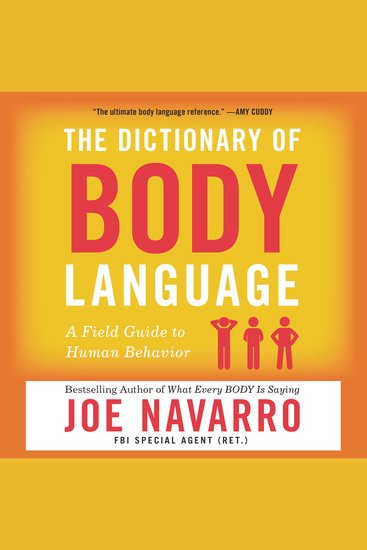
    From the world’s #1 body language expert* comes the essential audiobook for decoding human behavior 
    “The ultimate body language reference. I’ll be both referring to and recommending this book on a daily basis for many years to come.” —Amy Cuddy 
    Joe Navarro has spent a lifetime observing others. For 25 years, as a Special Agent for the FBI, he conducted and supervised interrogations of spies and other dangerous criminals, honing his mastery of nonverbal communication. After retiring from the bureau, he has become a sought-after public speaker and consultant, and an internationally bestselling author. Now, a decade after his groundbreaking book What Every BODY is Saying, Navarro returns with his most ambitious work yet. The Dictionary of Body Language is a pioneering “field guide” to nonverbal communication, describing and explaining the more than 400 behaviors that will allow you to gauge anyone’s true intentions. 
    Moving from the head down to the feet, Navarro reveals the hidden meanings behind the many conscious and subconscious things we do. Readers will learn how to tell a person’s actual feelings from subtle changes in their pupils; the lip behaviors that betray concerns or hidden information; the many different varieties of arm posturing, and what each one means; how the position of our thumbs when we stand akimbo reflects our mental state; and many other fascinating insights to help you both read others and change their perceptions of you. 
    Listeners will turn to The Dictionary Body Language again and again—a body language bible for anyone looking to understand what their boss really means, interpret whether a potential romantic partner is interested or not, and learn how to put themselves forward in the most favorable light. 
    *GlobalGurus.org
    Show book
  • How To Get Out Of Work - "A Framework For Manipulation Deception And Misdirection" - cover

    How To Get Out Of Work - "A...

    Alexander Oakes

    • 0
    • 0
    • 0
    Nothing is really real, even if it is. 
    Everything we do is self-serving, even nice/kind things. 
    There is no objective right or wrong and anyone telling you otherwise is either a fool or lying.  
    All communications at their core are manipulations, and therefore, every time we communicate with another person, verbal or non-verbal, we are manipulating them. 
    Oh yeah, and life is fucked. 
    If you want to know more read the Goddamn book.
    Show book
  • A Grotesque Animal - cover

    A Grotesque Animal

    Amy Lee Lillard

    • 0
    • 0
    • 0
    At the age of forty-three, Amy Lee Lillard learned she was autistic. She learned she was part of a community of unseen women who fell through the gaps due to medical bias and social stereotypes. 


    A Grotesque Animal explores the making, unmaking, and making again of a woman with an undiagnosed disorder. How did a working-­class background and a deep-rooted Midwest culture of silence lead to hiding in plain sight for decades? How did sexuality and anger hide the roots of trauma among the women in her family? And what does it mean to be a queer, disabled, aging woman, a descendant of wild but tamed mothers and a survivor of the things patriarchy inflicts? 


    Through wide-ranging styles and a combination of personal storytelling and cultural analysis, Lillard dissects anger, sexuality, autistic masking, bodies, punk, and female annihilation to create a new picture of modern women.
    Show book
  • Healing with Trauma-Focused DBT - A Trauma Survivor’s Guide to Manage Intense Emotions and Reclaim Your Life with Polyvagal Theory and Dialectical Behavior Therapy - cover

    Healing with Trauma-Focused DBT...

    PhD Kirby Reutter

    • 0
    • 0
    • 0
    If you've experienced trauma, your nervous system may be stuck in "fight-or-flight" mode—leading to symptoms such as hypervigilance, extreme anxiety, and distrust of others. You may struggle with intense emotions, or have nightmares and flashbacks. And you may even experience physical symptoms such as an upset stomach, a pounding heart, or shakiness. This compassionate guide offers a breakthrough approach to bring your mind and body back into balance. 
     
    Healing with Trauma-Focused DBT combines cutting-edge somatic practices from polyvagal theory with evidence-based dialectical behavior therapy (DBT) skills to help you heal unresolved wounds, manage the physical effects of trauma, and find emotional balance. Using the four skills of DBT—mindfulness, distress tolerance, emotion regulation, and interpersonal effectiveness—you'll learn to work through difficult thoughts and feelings and stay grounded in the moment. You'll also discover polyvagal techniques to help you soothe an overwhelmed nervous system and feel safe and at home in your body. 
     
    If you're seeking relief from the mental, emotional, and physical effects of trauma, this workbook offers innovative strategies and exercises to help you move beyond experiences of your past and find your way back to peace, stability, and the life you want.
    Show book