Join us on a literary world trip!
Add this book to bookshelf
Grey
Write a new comment Default profile 50px
Grey
Subscribe to read the full book or read the first pages for free!
All characters reduced
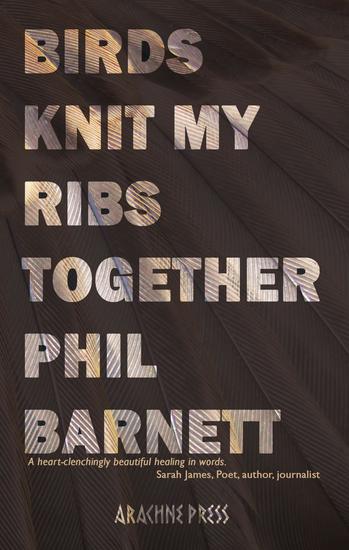
Birds Knit My Ribs Together - cover

Birds Knit My Ribs Together

Phil Barnett

Publisher: Arachne Press

  • 0
  • 0
  • 0

Summary

what if / I actually – am – a bird / my cupped hands / opening to release me... Phil Barnett's relationship with birds is so close that his poetry blurs the distinctions between himself and the birds - a kind of ornimorphology where rather than giving the birds human characteristics, the reverse happens, and he imagines himself as a bird. Phil Barnett is a photographer, writer, musician, artist and naturalist, who has a passion for the birds that kept him company through a long hard illness. His photography and poetry have quite a following on social media, which is where we found him, on The Daily Haiku. His skill as a photographer leads to an acute visual sensibility, and his slow recovery moves from a tick sheet his mother had to fill in for him, to extraordinary poetry - full of wit and wonder and spectacular language.
Available since: 01/25/2024.
Print length: 56 pages.

Other books that might interest you

  • Raging: Three Plays Seven Years of Warfare in Ireland (NHB Modern Plays) - Wild Sky Embargo & Outrage - cover

    Raging: Three Plays Seven Years...

    Deirdre Kinahan

    • 0
    • 0
    • 0
    A trilogy of landmark plays commemorating seven years of warfare in Ireland, from the 1916 Easter Rising to the Civil War which began in 1922.
    Wild Sky is a story of interlocking lives: of the politicised Josie Dunne, and of Tom Farrell, who is driven only by his love for her. As the Rising plays out, there are unforeseen consequences for everyone involved...
    Embargo focuses on a pivotal moment during the Irish War of Independence in 1920, when dockers and railmen refused to transport armed troops or handle any weapons arriving from Britain.
    Outrage follows two sisters, Alice and Nell, who play key roles in organising civic resistance and the propaganda war. Like everyone else in Ireland, they become deeply conflicted as the country spins toward a devastating Civil War.
    Each of the three plays was first performed a century after the event which it depicts, and they were commissioned and performed by companies including Fishamble: The New Play Company, Meath County Council Arts Office, Dublin Port Company and Iarnród Éireann.
    Together, they challenge the historical narrative, mixing true-life testimonies with powerful drama to create a theatrical hurricane of empathy, action and truth.
    Show book
  • One Visit - A gritty North Wales set psychological family drama - cover

    One Visit - A gritty North Wales...

    George Veck

    • 0
    • 0
    • 0
    In sleepy, rural North Wales, Frankie Gibbs, a recently laid off, aimless twenty-year-old on Universal Credit, wants nothing more than to keep his younger brother out of the care system. He single-handedly takes this upon himself while their alcoholic, cocaine-addict, single-parent father, Guy Gibbs, heaps misery on their lives through systematic abuse and his never-ending wild parties. After Guy is sent to prison, Frankie is coerced into opening his home to Justin, an acquaintance from his school days now turned drug dealer, while his own addiction and self-worth spiral beyond recognition. 
    ''One visit is an astonishing debut. It's raw, shocking, disturbing, insightful and dark, pretty much from start to finish. There are flashes of wit but, in the main, it's a full-frontal assault with the truth of physical, psychological, social and political deterioration in a beautiful part of Wales.'' 
    Narration by Hannah Price 
    Damo - Dominic Robinson 
    Alfie Fenner - Aidan Butler 
    Guy Gibbs - Robin Lee 
    Glesni & Delyth - Shannon Griffiths 
    Joss Gibbs - Victoria Simmonds 
    Gwyn - Jay Rolfe 
    Dolly – Heather Russell-Kay 
    Ben - Stephen Kelsall 
    Anthony Martin – Dyfrig Rowlands 
    Sir – Ian Chance 
    Bangor Mountain Dealer - Alan Gervin 
    Brenda – Kiara Kedare 
    Garage checkout assistant - Rebekah Allen 
    Ioan Ellis and Karl - Phillip Wright 
    Naboo - Zain Ali – Naboo (Got) 
    Jez – Julian Sudbury 
    Cowley and Hugh - Edward Osredkar 
    Meirion - Wayne Dobson 
    Stacey & Checkout server 2 - Amorette Frances
    Show book
  • Testament to Beauty - A former Poet Laureate demonstrates his poetic talents in this tender and beautiful verse - cover

    Testament to Beauty - A former...

    Robert Seymour Bridges

    • 0
    • 0
    • 0
    Robert Seymour Bridges, OM was born on 23rd October 1844 at Walmer in Kent where he spent his early childhood in a house overlooking the anchoring ground of the British fleet.  
    His father died aged only 47 in 1853. A year later his mother remarried and the family relocated to Rochdale, where his stepfather was the vicar.  
    In 1854 Bridges was sent to Eton College and attended until 1863.  After Eton he went to Corpus Christi College at Oxford. There he became good friends with Gerard Manley Hopkins and would later compile an edition of his poems that is now considered a major contribution to English literature. 
    He graduated from Oxford, in 1867, with a second-class degree in literae humaniores.  Initially he planned to join the Church of England and travelled to the Middle East to broaden his religious horizons.  However, he soon decided that life as a physician would be a better path and, after 8 months studying German (that being the language of many scientific papers at the time) he began his study of medicine at St. Bartholomew's Hospital in 1869.  His long-term ambition was that by the age of forty he could retire from medicine to devote himself to writing. 
    Unfortunately Bridges failed his final medical examinations in 1873 and, as unable to immediately retake the papers, spent six months in Italy learning Italian as well as immersing himself in its art. In July 1874 he went to Dublin to continue his medical studies. Re-examined in December he passed and became a house physician at St Bartholomew's Hospital. It was whilst here that he engaged in a series of highly critical remarks about the Victorian medical establishment. One such was his claim that whilst working as a young doctor he saw a staggering 30,940 patients in one year. 
    A bout of severe pneumonia and lung disease forced his retirement from the medical profession in 1882 and so, slightly ahead of schedule, he began his literary career in earnest.  He already been writing for several years and had published his first poetry collection in 1873.  
    After his illness and a trip to Italy, Bridges moved, with his mother, to Yattendon in Berkshire.  It was during this time, from 1882 to 1904, that Bridges wrote most of his best-known lyrics as well as eight plays and two masques, all in verse.  
    It was also here, in 1884, that he married Monica Waterhouse. They would go on to have three children and spend the rest of their lives in rural seclusion, in an idyllic marriage, first at Yattendon, then at Boars Hill, Oxford. 
    Bridges made an important contribution to hymnody with the publication in 1899 of his Yattendon Hymnal. This collection of hymns became a bridge between the Victorian hymnody of the late 19th century and the modern hymnody of the early 20th century. He was also a chorister at Yattendon church for 18 years. 
    In 1902 Monica and his daughter Margaret became seriously ill with tuberculosis, and a move from Yattendon to a healthier climate was in order. After several temporary homes they moved abroad to spend a year in Switzerland before returning to settle again in England at Chilswell House, which Bridges had designed, and built on Boar's Hill overlooking Oxford University.   
    His greatest achievement though was still some years ahead of him.  The office of Poet Laureate was held by Alfred Austin but with his death it was offered first to Rudyard Kipling, who refused it, and then to Bridges. He was appointed Poet Laureate in 1913 by George V, the only medical graduate to have ever held the office. Bridges, at this time, was neither highly regarded nor well known but a safe pair of hands in a World rapidly being overshadowed by the storms about to erupt over Europe and the First World War. 
    The events of this War, including the wounding of his son, Edward, had a sobering effect on Bridges' poetry. His work became fiercely patriotic. In 1915 edited a volume of prose and poetry, The Spirit of Man, intended to appeal to readers living in war time
    Show book
  • Top 10 Poets – England The - The South East - Five poems each from poets born in the English South East - cover

    Top 10 Poets – England The - The...

    James Weldon Johnson, Georgia...

    • 0
    • 0
    • 0
    The language of Poetry is an art that most of us attempt at some point in our lives.  Although its commonplace exposure has been somewhat marginalised in today’s often fast-paced lives we all recognise good verse that can empathise with our thoughts or open us up to experience new things in new ways, to better understand and to enjoy the many strands of our lives. 
    But finding a starting point can be overwhelming, even off-putting, so in this series we offer up our Top 10 classic poets, who brim with talent and verse, on a range of subjects and themes that we can all enjoy. 
    For centuries England has always had a leading and admired reputation for its poets and poetry.  In this volume we explore those born in the South-East who created such revered, enduring and respected verse.
    Show book
  • Republic - cover

    Republic

    Nerys Williams

    • 0
    • 0
    • 0
    Nerys Williams' new collection questions what makes a  Republic? Machinations of power? The speeches of politicians? The broad sweep of official histories? This sequence of 80 prose-poems, each constructed in 20 sentences, has arisen from the author's need to tell a more intimate history, to commit an untold oral history to paper. Williams returns to the meaning of "republic" in its Latin origins which meant "wealth of the people". 
    The poems tell the story of  a young Welsh woman growing up and coming of age in the 1980s and 90s, a time that culminated with new devolutionary powers in Wales. The explosion of the arts and culture looms large, through bands from New Order to my bloody valentine, but it is explored specifically through Cŵl Cymru', and the power of Welsh-language bands like Datblygu. This story is also about class, as we explore a family history of hard work in jobs from retail to caregiving. The poems introduce us to family influences, from a father who urges the narrator as a child to 'own the stage' in an early school Eisteddfod, to a grandmother who worked long hours in her rural shop, and a mother who was the local midwife.
    There are stories told, overheard, handed down, sometimes translated from Welsh. Together, they create an expansive portrait of the era, including the challenges for women, Welsh-speakers, and other marginalized groups. Ferocious remarks about the Welsh in the popular media are dissected with satirical humour and appalled fascination, while other poems describe being a token woman and political outsider on a TV current affairs show panel, tolerated but ostracized.
    From her more recent home, the republic of Ireland, Williams poses the possibilities of a nation looking at itself and its history from afar. Wales has not been allowed to be a republic, but is subject to a state that has military claims on its landscape and a second home explosion which has a severe impact on its communities. There is rebellion to be found in the older meaning of "republic": since the wealth of the people is a wealth of sounded stories, culture, art, and history.
    'Nerys Williams's Republic is a tour de force, a masterful account of the intellectual, political and personal development of a young woman from Welsh-speaking rural Wales and out in the world. Pitched against nostalgia, Nerys Williams's prose poems are tough-minded, shrewd and hugely evocative of the times she chronicles. She deploys details so vividly and with such a light a touch that she's created a new music all of her own. This book, like a waistcoat belt she describes, is a 'steel buckle, once harnessed to silk'.' —Gwyneth Lewis
    'The poetry of Nerys Williams is both playful and sharply preceptive, drawing on a wide range of often unexpected influences. She brings a unique set of interests to bear not just poetry in Wales, but on poetry generally.'—Zoë Skoulding
    'Nerys Williams brings precision, scrutiny, and synaesthesia to her terse, contemplative poems.' -Ben Wilkinson, The Guardian
    '…a strong imagism and an engaging 'I' voice that sometimes subverts expectations, allowing for a shift into more collective concerns. In addition, her deft handling of soundplay (especially the use of alliteration and assonance) greatly add to the experience of the poem as art.' -Michael S. Bengal  Poetry Ireland 
    Show book
  • Heartbreak agony & pain - poetry and prose - cover

    Heartbreak agony & pain - poetry...

    D. R. Nguyen

    • 0
    • 0
    • 0
    heartbreak agony & painis a collection of poetry and prose that takes the reader on an odyssey of heartache, grief, agony, and pain coping with the aftermath of a breakup.
    Show book