Join us on a literary world trip!
Add this book to bookshelf
Grey
Write a new comment Default profile 50px
Grey
Subscribe to read the full book or read the first pages for free!
All characters reduced
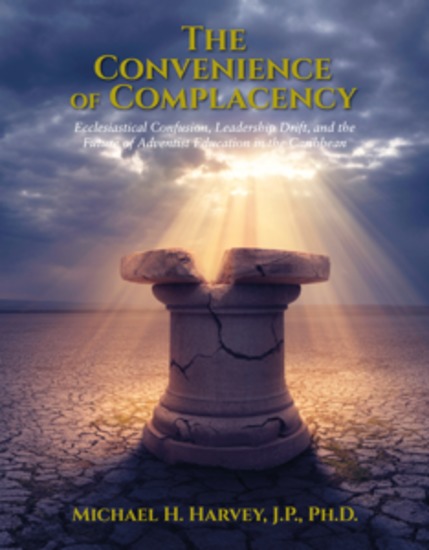
The Convenience of Complacency - Ecclesiastical Confusion Leadership Drift and the Future of Adventist Christian Education in the Caribbean - cover

The Convenience of Complacency - Ecclesiastical Confusion Leadership Drift and the Future of Adventist Christian Education in the Caribbean

PHD Michael H. Harvey JP

Publisher: Spines

  • 0
  • 0
  • 0

Summary

In the Caribbean, Adventist academic institutions grapple with complacency amidst a legacy of faith-based education. The call for visionary leadership and innovation rings out, to revive the spirit of learning and service that once defined them. This narrative urges a blending of tradition with fresh fervor, challenging educators to cultivate minds for a higher purpose and to renew their commitment to transformative education, balancing scholarship with unwavering faith, and shaping destinies.
Available since: 01/08/2026.
Print length: 312 pages.

Other books that might interest you

  • A Rare Recording of Otto Frank Father of Anne Frank - cover

    A Rare Recording of Otto Frank...

    Otto Frank

    • 0
    • 0
    • 0
    Otto Heinrich Frank (May 12, 1889 - August 19, 1980) was a German businessman, and the father of Anne Frank. He edited and published the first edition of her diary in 1947 (subsequently known in English as The Diary of a Young Girl) and advised on its later theatrical and cinematic adaptations. In the 1950s and the 1960s, he established European charities in his daughter's name and founded the trust which preserved his family's wartime hiding place, the Anne Frank House, in Amsterdam. The following first two audio clips are in English; the third is in Dutch.
    Show book
  • Digital Pilgrims - Towards a Quantum Humanity - cover

    Digital Pilgrims - Towards a...

    Adrián Sicilia

    • 0
    • 0
    • 0
    The present has the texture of the future. Hyper-digitalization has made all questions outdated, especially: what are we going to do? For decades, we have been inhabiting and moving within the Digital Environment. Today, the unavoidable question is: what and who are we going to be? 
    Digital Pilgrims proposes novel and urgent debates for a society that has been digitalizing itself for over fifty years. Our coexistence with mature artificial intelligences demands definitions. We are cyborgs moving in environments that exceed time and space, humans in search of meaning for this quantum reality.  
    It is not difficult to speculate about possible futures; the real challenge is to find a path forward in the face of the singularity that is starting to reveal itself, and in the face of the social impact we are just beginning to see. In the middle of the explosion, this book outlines the debates we cannot put off any longer. There are no answers here but rather a guide for us to finally discuss how to orient ourselves on this dizzying voyage.
    Show book
  • The Don't Sweat Guide To Your Finances - Planning Saving and Spending Stress-Free - cover

    The Don't Sweat Guide To Your...

    Don't Sweat Press, Richard Carlson

    • 0
    • 0
    • 0
    With the dips and turns in the economy, it can be difficult not to stress over one's living expenses, savings (or lack thereof), college tuition, and more. Yet worrying doesn't help these matters, and indeed can make things worse. 
     
    The Don't Sweat Guide to Your Finances shows readers how to relax and take control of your resources and financial planning, in a series of helpful essays including: 
     
    -- Clarity Creates Money. 
    -- Free Money From Your Employer. 
    -- Discussing Your Expectations. 
    -- Dig Yourself Out of Debt. 
    -- Daily Finances in Five Minutes a Day. 
    -- Let Charitable Giving Enrich Your Life. 
     
    And many more. This audiobook is the perfect guide for people who want to stress less over their money.
    Show book
  • Code Work - Hacking across the US México Techno-Borderlands - cover

    Code Work - Hacking across the...

    Héctor Beltrán

    • 0
    • 0
    • 0
    How Mexican and Latinx hackers apply concepts from coding to their lived experiences 


    In Code Work, Héctor Beltrán examines Mexican and Latinx coders' personal strategies of self-making as they navigate a transnational economy of tech work. Beltrán shows how these hackers apply concepts from the code worlds to their lived experiences, deploying batches, loose coupling, iterative processing (looping), hacking, prototyping, and full-stack development in their daily social interactions—at home, in the workplace, on the dating scene, and in their understanding of the economy, culture, and geopolitics. Merging ethnographic analysis with systems thinking, he draws on his eight years of research in México and the United States—during which he participated in and observed hackathons, hacker schools, and tech entrepreneurship conferences—to unpack the conundrums faced by workers in a tech economy that stretches from villages in rural México to Silicon Valley. 


    Beltrán's highly original, wide-ranging analysis uniquely connects technology studies, the anthropology of capitalism, and Latinx and Latin American studies.
    Show book
  • Sioux - History of Its Causes and Consequences - cover

    Sioux - History of Its Causes...

    Kelly Mass

    • 0
    • 0
    • 0
    The Sioux, also called the Oceti Sakowin are a North American people of Native American tribe and First Countries tribes. The contemporary Sioux are split into 2 significant groups based upon language: Dakota and Lakota; they're called together as the Ohéthi akówi ("7 Council Fires"). The term "Sioux" is an exonym stemmed from a French transliteration of the Ojibwe term "Nadouessioux," and can apply to any ethnic group or language dialect within the Great Sioux Country. 
    The Dakota War of 1862 came from the United States' failure to make agreement payments on time, and also an absence of food supply. The Dakota were banished from Minnesota to many bookings in Nebraska, North and South Dakota, and Canada. After 1870, the Dakota people started to return to Minnesota, developing the state's existing reserves. Before relinquishing their terrain and transferring to South Dakota in 1858, the Yankton and Yanktonai Dakota (Iháktuwa and Iháktuwana; "Village-at-the-End" and "Little village-at-the-End") resided in the Minnesota River area. 
    If any of this sounds fascinating to you, then go ahead and start reading or listening to the audiobook.
    Show book
  • The Thirty Years War - cover

    The Thirty Years War

    Friedrich Schiller

    • 0
    • 0
    • 0
    In "The Thirty Years War," Friedrich Schiller intricately chronicles one of Europe's most tumultuous and transformative conflicts. Spanning the early 17th century, this detailed narrative weaves political intrigue, religious strife, and the relentless pursuit of power. Schiller brings to life the era's major figures and battles, revealing the war's profound impact on shaping modern Europe. With a blend of historical detail and literary elegance, he illuminates the deep complexities of this pivotal period.
    Show book