Join us on a literary world trip!
Add this book to bookshelf
Grey
Write a new comment Default profile 50px
Grey
Subscribe to read the full book or read the first pages for free!
All characters reduced
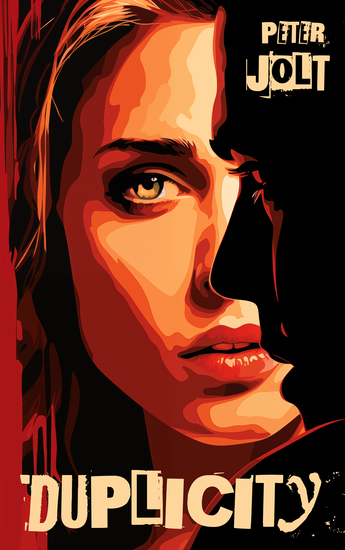
Duplicity - A Psychological Suspense Short Story - cover

Duplicity - A Psychological Suspense Short Story

Peter Jolt

Publisher: Jolt Fiction

  • 0
  • 0
  • 0

Summary

Invading her mind will expose her lies, but the truth comes at a terrible cost.
 
Eric will do anything to uncover the truth about his wife Lily, even if it means crossing ethical lines. When experimental mind-reading technology falls into his hands, he sees a chance to hear Lily's innermost thoughts. But as Eric eavesdrops on his wife's mind, he uncovers secrets far darker than an affair. Will this technology help save his marriage or destroy it forever?Please note: this is a short story (33 pages) - not a full-length novel.
Available since: 02/16/2024.
Print length: 33 pages.

Other books that might interest you

  • Elusive Charity - A Charity Styles Novel - cover

    Elusive Charity - A Charity...

    Wayne Stinnett

    • 0
    • 0
    • 0
    Since the recent death of a wealthy, yet perverted, businessman, Charity Styles has been hiding in plain sight, as if challenging anyone to come after her. 
    She’s on her own once more, living day to day on her beloved Wind Dancer, anchored near a quaint little Gulf Coast town in the Florida Panhandle. But when the son of a fishing client ends up dead, the father’s employer hires Charity to find the person responsible. 
    Intrigue mounts faster than the list of suspects and Charity finds new purpose and direction, and possibly a guide. But will her new outlook make her fall prey to the local crime boss? Very few know of her abilities and many have come up short in trying to take her. Will this be Charity’s final downfall from grace?
    Show book
  • Casting the Runes & Other Ghost Stories - cover

    Casting the Runes & Other Ghost...

    M. R. James

    • 0
    • 0
    • 0
    When we think of ghost stories, we tend to think of cub scouts cringing by a fire, s'mores at the ready, as some aging camp counselor tries to scare them witless with yet another tale from the crypt.  
    M.R. James had a great, and simple, formula for writing ghost stories. Establish the mundane and everyday detail (which is heightened by the Victorian academic settings), and then introduce, briefly, the supernatural, which cracks the surface of everything normal that has been so carefully established. 
    This IS a book of CLASSIC horror stories. They don't depend nor do they need buckets of blood slung against a wall or descriptions of disembowelments or decapitations. 
    "M. R. James is to the ghost story as Petrarch to the sonnet: he didn't invent the form but he perfected it and no one since has been able to write one without acknowledging the master."
    Show book
  • Poirot Investigates - cover

    Poirot Investigates

    Agatha Christie

    • 0
    • 0
    • 0
    The very first collection of superb short stories featuring Hercule Poirot and Captain Hastings…First there was the mystery of the film star and the diamond… then came the 'suicide' that was murder… the mystery of the absurdly cheap flat… a suspicious death in a locked gun-room… a million dollar bond robbery… the curse of a pharaoh's tomb… a jewel robbery by the sea… the abduction of a Prime Minister… the disappearance of a banker… a phone call from a dying man… and, finally, the mystery of the missing will.What links these fascinating cases? Only the brilliant deductive powers of Hercule Poirot!1. The Adventure of The Western Star2. The Tragedy at Marsdon Manor3. The Adventure of The Cheap Flat4. The Mystery of Hunter's Lodge5. The Million Dollar Bond Robbery6. The Adventure of The Egyptian Tomb7. The Adventure of the Clapham Cook8. The Kidnapped Prime Minister9. The Disappearance of Mr. Davenheim10. The Adventure of The Italian Nobleman11. The Case of The Missing Will
    Show book
  • Bellerophon To Anteia - From their pens to your ears genius in every story - cover

    Bellerophon To Anteia - From...

    Mary Butts

    • 0
    • 0
    • 0
    Mary Frances Butts was born on 13th December 1890 in Poole, Dorset. 
    Her early years were spent at Salterns, an 18th-century house overlooking Poole Harbour.  Sadly in 1905 her father died, and she was sent for boarding at St Leonard's school for girls in St Andrews. 
    Her mother remarried and, from 1909, Mary studied at Westfield College in London, and here, first became aware of her bisexual feelings.  She was sent down for organising a trip to Epsom races and only completed her degree in 1914 when she graduated from the London School of Economics.  By then Mary had become an admirer of the occultist Aleister Crowley and she was given a co-authorship credit on his ‘Magick (Book 4)’. 
    In 1916, she began the diary which would now detail her future life and be a constant reference point for her observations and her absorbing experiences. 
    During World War I, she was doing social work for the London County Council in Hackney Wick, and involved in a lesbian relationship.  Life changed after meeting the modernist poet, John Rodker and they married in 1918. 
    In 1921 she spent 3 months at Aleister Crowley's Abbey of Thelema in Sicily; she found the practices dreadful and also acquired a drug habit.  Mary now spent time writing in Dorset, including her celebrated book of short stories ‘Speed the Plough’ which saw fully develop her unique Modernist prose style. 
    Europe now beckoned and several years were spent in Paris befriending many artists and writing further extraordinary stories.   
    She was continually sought after by literary magazines and also published several short story collections as books. Although a Modernist writer she worked in other genres but is essentially only known for her short stories.  Mary was deeply committed to nature conservation and wrote several pamphlets attacking the growing pollution of the countryside. 
    In 1927, she divorced and the following year her novel ‘Armed with Madness’ was published.  A further marriage followed in 1930 and time was spent attempting to settle in London and Newcastle before setting up home on the western tip of Cornwall.  By 1934 the marriage had failed. 
    Mary Butts died on 5th March 1937, at the West Cornwall Hospital, Penzance, after an operation for a perforated gastric ulcer. She was 46.
    Show book
  • Bertie's Christmas Eve - cover

    Bertie's Christmas Eve

    Saki Saki

    • 0
    • 0
    • 0
    On Christmas Eve, Bertie Steffink, a rebellious nephew, finds himself locked in the family's cow-house as a punishment for his unruly behavior. While the rest of the family enjoys the festivities, Bertie is left alone to contemplate his upcoming exile to Rhodesia. As the night wears on, Bertie's mischievous spirit takes over, leading him to prank his family and guests with a midnight party.
    Show book
  • The Odyssey - cover

    The Odyssey

    Homer

    • 0
    • 0
    • 0
    The Odyssey is one of two major ancient Greek epic poems attributed to Homer. It is one of the oldest extant works of literature still widely read by modern audiences. As with the Iliad, the poem is divided into 24 books. It follows the Greek hero Odysseus, king of Ithaca, and his journey home after the Trojan War. After the war, which lasted ten years, his journey lasted for ten additional years, during which time he encountered many perils and all his crew mates were killed. In his absence, Odysseus was assumed dead, and his wife Penelope and son Telemachus had to contend with a group of unruly suitors who were competing for Penelope's hand in marriage.The Odyssey was originally composed in Homeric Greek in around the 8th or 7th century BCE and, by the mid-6th century BCE, had become part of the Greek literary canon. In antiquity, Homer's authorship of the poem was not questioned, but contemporary scholarship predominantly assumes that the Iliad and the Odyssey were composed independently and that the stories formed as part of a long oral tradition. Given widespread illiteracy, the poem was performed by an aoidos or rhapsode and was more likely to be heard than read.
    Show book