Join us on a literary world trip!
Add this book to bookshelf
Grey
Write a new comment Default profile 50px
Grey
Subscribe to read the full book or read the first pages for free!
All characters reduced
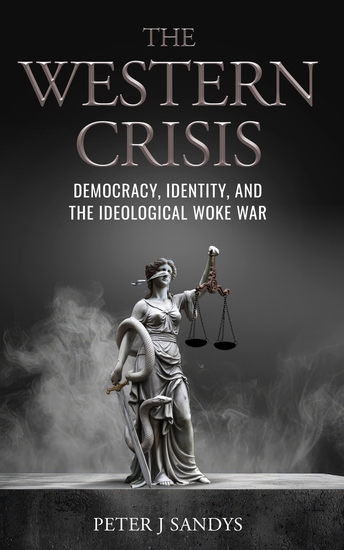
The Western Crisis - Democracy Identity and the Ideological Woke War - cover

The Western Crisis - Democracy Identity and the Ideological Woke War

Peter J. Sandys

Publisher: Defiance Press and Publishing

  • 0
  • 0
  • 0

Summary

For decades, the Western world has embraced "liberal democracy" and "human rights" as its guiding principles. But beneath these ideals lurks a dangerous globalist agenda, eroding Western culture from within. Once a beacon of faith and tradition, the West now finds itself divided: its best citizens are disillusioned, while its worst are emboldened by a toxic zeal. Leftist intellectuals, with the help of elites, have spread their ever-shifting ideologies—merging democracy, socialism, and liberalism—leading to the capture of Western civilization by progressive, socialist, and left-liberal forces.As Western societies struggle with identity and values, the battle over diversity, nationalism, patriotism, and race intensifies. A suicidal dogma of wokeness, historical revisionism, and divisive politics masquerades as "democracy" and "equality," pushing progressivism and utopianism as the new religion. Meanwhile, non-Western, national-conservative states uphold independence and traditional moral values, presenting a stark contrast to the West's ideological collapse.This book presents a politically incorrect and radical narrative that challenges the foundations of liberal democracy. It calls for readers to reject despair, awaken to the truth, and take action against the forces tearing the West apart. The "Disunited States of America" has become a modern echo of the Soviet Union, while the so-called "Wokers' Paradise" harbors the seeds of modern barbarism. America's identity crisis reflects a deeper fracture across the entire Western world—one driven by cultural decline, economic deception, and the abandonment of democratic values.With bold insight, this book exposes how woke-globalist agendas and rainbow capitalism conceal a Marxist worldview, threatening the very fabric of Western civilization. The fight for the future of the West is more than a clash between democracy and autocracy—it is an ideological and cultural war, and the stakes have never been higher. The time to act is now.
Available since: 04/07/2025.
Print length: 389 pages.
Other books that might interest you

  • When Left Moves Right - The Decline of the Left and the Rise of the Populist Right in Postcommunist Europe - cover

    When Left Moves Right - The...

    Maria Snegovaya

    • 0
    • 0
    • 0
    Over the past two decades, postcommunist countries have witnessed a sudden shift in the electoral fortunes of their political parties: previously successful center-left parties suffered dramatic electoral defeats and disappeared from the political scene, while right-wing populist parties soared in popularity and came to power. This dynamic echoed similar processes in Western Europe and raises a question: Were these dynamics in any way connected? When Right Moves Left argues that they were. And that the root of the connection between them lies in the pro-market rebranding of the ex-communist left—the key explanatory variable. This book asserts that, though the left's pro-market shift initially led to electoral rewards, it had a less straightforward impact on left-wing parties' electoral fortunes in the long run. 


    The book draws upon different levels of analysis: cross-country observational data, case studies, and individual-level experimental surveys. It argues that scholars should incorporate the economic policy dimension when explaining the demise of the left and the rise of the populist right in the region. It also examines important parallels between the dynamics of Western and postcommunist countries by arguing that the idiosyncrasy of Eastern European politics has been overstated in scholarly literature.
    Show book
  • Dissidently Speaking - Change the Words Change the War - cover

    Dissidently Speaking - Change...

    Brent Hamachek

    • 0
    • 0
    • 0
    Mostly Americans need to take a fresh look at ourselves. To do that we need to apply critical thinking, add some skepticism, and be willing to replace answers with questions. 
    Compiled from a decade of writings and contemplation, and further aided by a forty-year career in the world of business dealing with hundreds of companies, this book represents a synthesis between the theoretical and the empirical. Each chapter stands entirely on its own, but each stands stronger when joined with the others. The author’s goal is simply to have the reader challenge their preconceived notions. 
    This book is for you if you feel confident enough to challenge everything you might think about the American political dynamic, how honestly and effectively you communicate with others, and how you process what you find in the news or on social media. Do you have what it takes to become a political dissident? Find out. Finally, and most difficult of all, are you up to taking a look into the mirror and asking yourself: Am I ethical? 
    Get ready to have your toy box dumped all over the floor. Prepare to check all your premises. Be willing to think!
    Show book
  • The Psychology of Spies and Spying - cover

    The Psychology of Spies and Spying

    John Taylor, Adrian Furnham

    • 0
    • 0
    • 0
    The Psychology of Spies and Spying tells the story of the people involved in spying: the human sources (agents) who betray their country or organisation and the professional intelligence officers who manage the collection and reporting process. It provides a rigorous psychological analysis of the personality and motivation of individuals involved in spying.
    This book shows the importance of developing trust between agents and handlers, between agencies and their government and ultimately the public. It shows how agent handlers, operating in environments of complete secrecy, need to manage dark side behaviours because agents are selected for their access to secrets, not for their qualities. It explains why motivation is rarely simple since it is invariably a combination of many issues.It explains how fiction writers are good at developing plots and the characterisation of spies, but few capture the motivation of agents well. Finally spy gadgets and techniques are also described in detail. Included are twelve agent case studies in which most were motivated by ideology, had significant misfortune in their youth and offered their services rather than being coerced into betrayal.
    The Psychology of Spies and Spying promotes the view that in the world of intelligence, it is trust not betrayal which dominates the mindset.
    Show book
  • The Prince - cover

    The Prince

    Niccolo Machiavelli

    • 0
    • 0
    • 0
    When Lorenzo de Medici seized control of the Florentine Republic in 1512, he fired the Secretary to the Second Chancery of the Signoria, Niccolo Machiavelli, which set in motion a fundamental change in the way we think about politics. Suddenly finding himself without a job after 14 years of patriotic service, Machiavelli set a precedent for many a politician to come—by becoming a pundit and commentator through one of the only means available to him at the time: writing a book. In The Prince, Machiavelli set forth the then-revolutionary idea that theological and moral imperatives have no place in the political arena. He asserted that it is, "often necessary to act against mercy, against faith, against humanity, against frankness, against religion, in order to preserve the state."
    Show book
  • The Ethiopian Great Famine of 2000 - A Modern Humanitarian Crisis - cover

    The Ethiopian Great Famine of...

    Sarah Willards

    • 0
    • 0
    • 0
    The Ethiopian Great Famine of 2000 was not an isolated event, but rather the culmination of a complex and interconnected set of factors rooted in the country's historical, environmental, and political landscape. To understand the origins of this crisis, it is essential to look back at Ethiopia’s long history of food insecurity and vulnerability to famine. While droughts have long been a natural part of Ethiopia’s climate cycles, the frequency and impact of famine have often been magnified by human elements, particularly governance and socio-economic structures. 
    In the years leading up to 2000, Ethiopia experienced several severe droughts, but the early signs of the looming crisis were evident by the late 1990s. Climatic shifts, including the failure of critical rainy seasons, devastated crop yields and dried up grazing lands, particularly in the country's eastern and southern regions. For a population heavily dependent on subsistence agriculture, these environmental changes meant immediate food shortages and a rapid decline in household resilience. What might have remained a regional hardship quickly evolved into a nationwide emergency due to the lack of sufficient preventative action. 
    Government response in the early stages was slow and limited by bureaucratic challenges and political distractions, including the aftermath of the Ethiopia-Eritrea war that ended in 2000. Resources were stretched thin, and infrastructure remained underdeveloped, particularly in rural areas where the famine was most severe. Early warning systems existed but were either underutilized or their signals ignored, contributing to the delayed mobilization of aid. The country’s centralization of power also complicated coordination with local authorities, which further hindered rapid intervention efforts.
    Show book
  • Britain Needs Change - The Politics of Hope and Labour's Challenge - cover

    Britain Needs Change - The...

    Simon Barrow, Gerry Hassan

    • 0
    • 0
    • 0
    After fourteen years of Conservative government – combined with Brexit, a global pandemic, the rise of a populist far right and the existential threat of climate change – many see Britain as undergoing serious social, economic and cultural decline. This is the context in which Labour have taken office at Westminster after a decade and a half in opposition. With recent ways of doing politics, government and statecraft in crisis, how can a serious, humane alternative emerge? What scale and type of change is coming, and will it be for the better?
    All this raises serious questions about the future of the UK and its constituent nations, Labour's ability to govern progressively, and the incoming government's confidence and capacity to take on the entrenched vested interests of present-day Britain while also having an honest, mature conversation with the public and its own supporters about the nature of these challenges.
    In Britain Needs Change, some of our best thinkers and commentators dissect the challenges facing the new government in a series of wide-ranging, penetrative essays. Featuring contributions from Helena Kennedy, John Curtice, Mariana Mazzucato, Neal Lawson, Aditya Chakrabortty, Ann Pettifor, Gavin Esler, Hilary Cottam, Sunder Katwala, Savitri Hensman, Fintan O'Toole and Andrew Gamble among others, this is required reading for anyone interested in the future of our country.
    Show book