Rejoignez-nous pour un voyage dans le monde des livres!
Ajouter ce livre à l'électronique
Grey
Ecrivez un nouveau commentaire Default profile 50px
Grey
Abonnez-vous pour lire le livre complet ou lisez les premières pages gratuitement!
All characters reduced
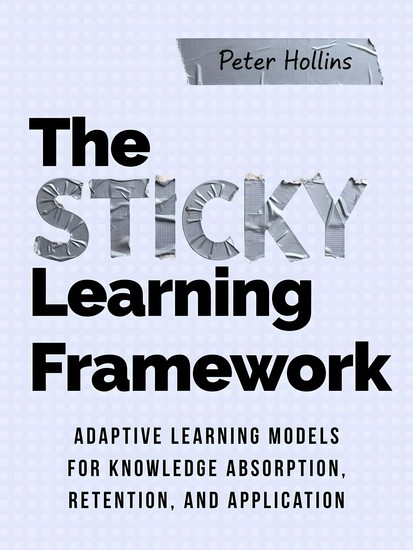
The Sticky Learning Framework - cover

The Sticky Learning Framework

Peter Hollins

Maison d'édition: Publishdrive

  • 0
  • 0
  • 0

Synopsis

Do you want to absorb knowledge faster, retain it longer, and actually use it when it counts?If you’re tired of forgetting what you learn, wasting hours on shallow study, and struggling to apply knowledge in real life—this book gives you the framework you’ve been missing.
 
Step-by-step methods and habits to make learning stick.The Sticky Learning Framework is your proven field guide to deep learning. This is NOT another “study harder” book full of vague tips like “highlight your notes” or “get more sleep.” These are actionable, science-backed strategies to rewire how you learn—so information moves from short-term memory to lasting knowledge you can apply anywhere.
 
Become a master learner and unlock your full potential.Peter Hollins has studied psychology, neuroscience, and peak human performance for years. This book condenses cutting-edge research and real-world techniques into a practical system for accelerating learning in any field.
 
Learn smarter and save your valuable time.
 
The power of a growth mindset and deliberate practice—why quality beats quantity in true mastery.
 
How spaced repetition and interleaving build long-term memory without cramming.
 
Why gamifying your learning keeps you focused and motivated in the “Goldilocks zone.”
 
The role of cognitive load management and micro-breaks in sharper focus and recall.
 
How asking, predicting, and quizzing yourself ignite curiosity and boost retention.
 
The secret of multimodal learning—combining words, images, and movement for deeper understanding.
 
How to balance stress for optimal learning, using the Yerkes-Dodson curve to your advantage.
 
Transform your life with sharper focus and deeper knowledge.Learning to learn is the ultimate superpower. Imagine picking up new skills in weeks instead of months. Imagine remembering and applying what matters most—without endless rereading or cramming.
 
Success in school, business, creativity, and life all depend on one thing: learning that sticks. With The Sticky Learning Framework, you’ll finally have the tools to make that happen.
Disponible depuis: 06/09/2025.
Longueur d'impression: 241 pages.

D'autres livres qui pourraient vous intéresser

  • If - cover

    If

    Rudyard Kipling

    • 0
    • 0
    • 0
    Rudyard Kipling’s If is a reflective poem that explores the formation of character under pressure. Rather than describing grand achievements, the poem focuses on inner discipline: the ability to remain calm when others panic, to persist when effort seems wasted, and to endure both success and failure without being morally altered by either. The repeated conditional structure suggests that maturity is not guaranteed, but earned through consistent ethical choices.
    Voir livre
  • Rational Positive Thinking - Why Optimism Is More Rational Than Doom - cover

    Rational Positive Thinking - Why...

    TJ Walker

    • 0
    • 0
    • 0
    Positive thinking is often dismissed as naïve, unrealistic, or intellectually weak. But what if a constructive outlook is actually the more rational response to life? 
     
    Rational Positive Thinking offers a practical approach to optimism for listeners who dislike empty affirmations, exaggerated promises, and feel-good advice disconnected from reality. It explains how negativity bias, constant exposure to alarming news, and repeated pessimistic messages can distort the way people interpret their lives and the future. 
     
    Through clear explanations and practical examples, listeners will discover how positive thinking can strengthen emotional resilience, improve relationships, support healthier behavior, increase persistence, and make opportunities easier to recognize. 
     
    The audiobook explores gratitude, human progress, failure, health, longevity, adaptability, emotional conditioning, and the connection between mindset and action. It also introduces the Ultamize Two-Minute Reset, a concise reinforcement exercise designed to help listeners repeat and strengthen the audiobook's most important ideas. 
     
    This is not an argument for ignoring problems or pretending that everything is perfect. It is a guide to seeing reality with greater balance, responding to setbacks more effectively, and developing an optimistic mindset grounded in perspective, logic, and constructive action. 
     
    For intelligent skeptics who want practical personal development without unrealistic positivity, this audiobook offers a clearer and more resilient way to think about life.
    Voir livre
  • Runes for Beginners - cover

    Runes for Beginners

    Melissa Smith

    • 0
    • 0
    • 0
    The Elder Futhark has been around for 2,000 years or more. Many historical cultures have practiced the casting of runes for divination, spells, magic, and rituals to help improve their lives.Throughout this book, I will help you begin your journey of enlightenment and show you the wonders that the runes have to offer. We will cover the rituals that will become the basis of all those that follow, and we will touch on the spells that will become a part of your everyday life.From Fehu to Othala, we will cover each rune meticulously and show you how to bring their wonderful energies into our modern world, where they are needed now more than ever.We will cover the Norse people that brought them to us and the magic and divination that was passed down through the generations. What you will learn is that magic has always been around you, but until now, it has remained just out of reach.You will learn how to choose the runes that suit you best, how to care for them, and of course, how to cast them and embrace their positive energies.So, let me take you to the starting point of your voyage and give you the tools you need to cast off on your journey of enlightenment.The Elder Futhark and the magic of our ancestors is free to take, you just need to open your mind a little.Would you like to know more? Scroll up, hit the "buy" button, and start this amazing journey!
    Voir livre
  • On Guerrilla Warfare - cover

    On Guerrilla Warfare

    Mao Tse-Tung

    • 0
    • 0
    • 0
    "On Guerrilla Warfare" by Mao Tse Tung is a foundational text that elaborates on the strategies and philosophies behind guerrilla warfare, authored by the revolutionary leader during the tumultuous period of the Chinese Civil War and the Japanese invasion of China in the 20th century. Mao's work is not just a military manual but a profound treatise on the application of guerrilla tactics as a form of irregular warfare by a smaller, mobile force against a larger, more conventionally equipped enemy. Through this work, Mao emphasizes the importance of political ideology, the support of the local population, and the use of the terrain to the guerrilla fighter's advantage. His insights into the interplay between politics and military strategy have made this work a staple reference in the study of revolutionary warfare and insurgency movements globally, influencing numerous conflicts and shaping the tactics of various liberation movements.
    Voir livre
  • The Menace of Prosperity - New York City and the Struggle for Economic Development 1865–1981 - cover

    The Menace of Prosperity - New...

    Daniel Wortel-London

    • 0
    • 0
    • 0
    Many local policymakers make decisions based on a deep-seated belief: what’s good for the rich is good for cities. Convinced that local finances depend on attracting wealthy firms and residents, municipal governments lavish public subsidies on their behalf. Whatever form this strategy takes—tax-exempt apartments, corporate incentives, debt-financed mega projects—its rationale remains consistent and assumed to be true. But this wasn’t always the case. Between the 1870s and the 1970s, a wide range of activists, citizens, and intellectuals in New York City connected local fiscal crises to the greed and waste of the rich. These figures saw other routes to development, possibilities rooted in alternate ideas about what was fiscally viable. 
      
    In The Menace of Prosperity, Daniel Wortel-London argues that urban economics and politics are shaped by what he terms the “fiscal imagination” of policymakers, activists, advocates, and other figures. His survey of New York City during a period of explosive growth shows how residents went beyond the limits of redistributive liberalism to imagine how their communities could become economically viable without the largesse of the wealthy. Their strategies—which included cooperatives, public housing, land-value taxation, public utilities, and more—centered the needs and capabilities of ordinary residents as the basis for local economies that were both prosperous and just. 
      
    Overturning stale axioms about economic policy, The Menace of Prosperity shows that not all growth is productive for cities. Wortel-London’s ambitious history demonstrates the range of options we’ve abandoned and hints at the economic frameworks we could still realize—and the more democratic cities that might result.
    Voir livre
  • How to Make Money - An Ancient Guide to Wealth Management (series: Ancient Wisdom for Modern Readers) - cover

    How to Make Money - An Ancient...

    PLINY

    • 0
    • 0
    • 0
    Ancient Romans liked money. But how did they make a living and sometimes even become rich? The Roman economy was dominated by agriculture, but it was surprisingly modern in many ways: the Romans had companies with CEOs, shareholders, and detailed contracts regulated by meticulous laws; systems of banking and taxation; and a wide range of occupations, from merchant and doctor to architect and teacher. The Romans also enjoyed a relatively open society, where some could start from the bottom, work, invest, and grow rich. How to Make Money gathers a wide variety of ancient writings that show how Romans thought about, made, invested, spent, lost, and gave away money. 


    The Roman elite idealized farming and service to the state but treated many other occupations with suspicion or contempt, from money lending to wage labor. But whatever their attitudes, pecunia made the Roman world go round. In the Satyricon, Trimalchio brags about his wealth. Seneca accumulated a fortune—but taught that money can't buy happiness. Eumachia inherited a brick factory from her father, married well, and turned to philanthropy after she was widowed. How to Make Money also takes up some of the most troubling aspects of the Roman economy, slavery and prostitution, which the elite deemed unrespectable but often profited from.
    Voir livre