Join us on a literary world trip!
Add this book to bookshelf
Grey
Write a new comment Default profile 50px
Grey
Subscribe to read the full book or read the first pages for free!
All characters reduced
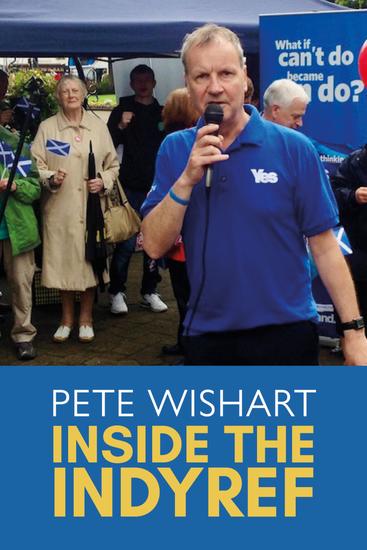
Inside the Indyref - cover

Inside the Indyref

Pete Wishart

Publisher: Luath Press

  • 0
  • 0
  • 0

Summary

Indyref: the Scottish Referendum of 2014 in which 84.6% of the Scottish public voted, making it one of the largest voter turnouts in British political history.

This book is an inside account of the independence referendum campaign. It captures the highs and lows and twists and turns from a perspective close to the decision-making frontline, but far enough removed to offer a dispassionate and personal perspective of the unfolding events. Wishart takes the reader back to the energy, excitement and drama of the biggest political decision the Scottish people have ever been asked to participate in – a truly immersive experience, with people previously uninterested in political campaigning engaged in trying to win for their respective camp. 

The referendum changed everything in Scottish political life and its influence is felt in every one of our political institutions, and remains indelibly embedded in our political culture.

There is a very real sense that the many promises made around more powers for Scotland, made during the independence referendum 
by the uk Government, have not been realised.

The independence referendum itself may be long concluded, but its impacts, effects and legacy remain very much live. There can be no doubt that many of the constitutional debates that continue to take place today have their origins in the absorbing and beguiling campaign for independence.
Available since: 09/12/2024.
Print length: 240 pages.
Other books that might interest you

  • The Chinese Great Leap Forward Famine - A Social and Political Catastrophe - cover

    The Chinese Great Leap Forward...

    Sarah Willards

    • 0
    • 0
    • 0
    The origins of the Great Leap Forward are deeply rooted in the political ambition and ideological vision of Mao Zedong, the founding leader of the People’s Republic of China. Following the success of the Communist revolution in 1949, Mao sought not only to rebuild a war-torn nation but to rapidly transform it into a socialist utopia capable of rivaling the industrial powers of the West. By the mid-1950s, China had already launched its First Five-Year Plan, modeled after the Soviet approach to centralized economic planning. Encouraged by early gains in heavy industry, Mao envisioned a second phase of development that would leap over traditional stages of economic growth. 
    At the heart of this vision was a push for mass mobilization. Mao believed that the sheer size of China's population could be harnessed as a revolutionary force capable of achieving miraculous feats. The Great Leap Forward, initiated in 1958, was designed to propel China into a modern communist society by emphasizing agricultural collectivization and rural industrialization simultaneously. Rather than relying on expert knowledge or slow-paced industrial planning, Mao favored decentralized enthusiasm and ideological commitment, trusting that the collective will of the people would overcome any technical limitations. 
    One of the most radical elements of this plan was the establishment of people’s communes, which replaced the traditional family unit and private farming with large-scale collective labor. Households were merged into communes comprising thousands of individuals, who would eat, sleep, and work under strict communal arrangements. The idea was to increase efficiency and free up labor for industrial production, especially in rural areas where backyard furnaces were set up to produce steel. This was accompanied by an aggressive campaign to eliminate what were seen as capitalist tendencies, including private plots and individual incentives.
    Show book
  • The Racial Wealth Gap - A Brief History - cover

    The Racial Wealth Gap - A Brief...

    Mehrsa Baradaran

    • 0
    • 0
    • 0
    Why has the racial wealth gap between the median white households and median Black households remained stagnant over the past century, never narrowing below six to one? Leading expert on race and financial equality Mehrsa Baradaran attempts to answer this question in this sweeping yet accessible history. She shows how decades of the laws rooted in white supremacy have restricted Black access to capital, credit, homeownership, and other mechanisms of wealth creation while subsidizing the rising economic fortunes of white families. 
     
    In The Racial Wealth Gap, Baradaran outlines two tectonic forces that have driven apart the economic fortunes of white and Black families: wealth creation for white Americans, who have been systematically receiving financial subsidies in the century and a half since emancipation, and wealth destruction for Black Americans—either by vigilante violence or by official means, such as allowing Black banks to collapse or building highways through segregated Black communities. These forces, combined with the racist notion that Black communities fail to rise because of their own moral, intellectual, or economic shortcomings, have kept Black families behind their white counterparts, despite decades of civil rights activism and national economic growth—a deep injustice that can only be achieved through reparations.
    Show book
  • Why So Many Jobs Feel Useless in Today’s World - Discover why so many jobs feel useless today! Unleash captivating audio insights for profound understanding - cover

    Why So Many Jobs Feel Useless in...

    Bastian Cresswell

    • 0
    • 0
    • 0
    Why So Many Jobs Feel Useless in Today’s World:  
    ⭐⭐ Simplified Audio Guide with Explanations ⭐⭐ 
    Are you seeking to advance in understanding the modern job landscape and find purpose in your work? 
    Looking for a comprehensive resource that provides all the insights you need to navigate today's work environment? 
    Look no further! 
    This guide is your ultimate companion for deepening your understanding, applying your skills, and engaging in practical reflections on the modern job market. With this, you're prepared for a fulfilling professional journey. 
    Updated to reflect current work trends and dynamics. 
    Key features of this enriched guide: 
    - Profound insights about discovering purpose and connection in today's work landscape. 
    - Detailed explanation of the modern workplace environment. 
    - Effective strategies for finding meaning and engagement in your career. 
    Our guide stands out with comprehensive coverage, crucial for unlocking your potential in the work world. Concepts are explored with depth and precision. 
    Please note that this guide is an independent resource intended solely for your benefit. 
    Designed with a structured format and easy-to-understand language, our guide ensures smooth transitions between topics. Say goodbye to complex jargon and embrace clear, precise, and insightful content. 
    Ready to explore the depths of meaningful work? Click the BUY NOW button, secure your guide, and embark on your journey to understanding why so many jobs feel useless in today's world! 
    Why wait? Start your journey towards a more meaningful career today!
    Show book
  • The Ride - Paul Revere and the Night That Saved America - cover

    The Ride - Paul Revere and the...

    Kostya Kennedy

    • 0
    • 0
    • 0
    “Audiobook narrator Johnny Heller has a brisk, ardent manner, moving through events at a spirited trot, conveying the urgency and high stakes of Revere’s mission.”—The Washington PostTimed for the 250th anniversary of one of America’s most famous founding events: Paul Revere’s legendary ride, newly told with fresh research into little-known aspects of the story Americans have heard since childhood but hardly understoodOn April 18, 1775, a Boston-based silversmith, engraver, and anti-British political operative named Paul Revere set out on a borrowed horse to fulfill a dangerous but crucial mission: to alert American colonists of advancing British troops, which would seek to crush their nascent revolt.Revere was not the only rider that night, and indeed, he had completed at least 18 previous rides across New England and other colonies, disseminating intelligence about British movements. But this ride was like no other, and its consequences in the months and years to come—as the American Revolution morphed from isolated skirmishes to a full-fledged war—became one of our founding legends.In The Ride, Kostya Kennedy presents a dramatic new narrative of the events of April 18 and 19, 1775, informed by fresh primary and secondary source research into archives, family letters and diaries, contemporary accounts, and more. Kennedy reveals Revere’s ride to be more complex than it is usually portrayed—a loosely coordinated series of rides by numerous men, near-disaster, capture by British forces, and finally success. While Revere was central to the ride and its plotting, Kennedy reveals the other men (and, perhaps, a woman with information about the movement of British forces) who helped to set in motion the events that would lead to America’s independence.Thrillingly written in a dramatic, unstoppable narrative, The Ride retells an essential American story for a new generation of listeners.A Macmillan Audio production from St. Martin’s Press.
    Show book
  • The Shocking Truth about Gender Equality - cover

    The Shocking Truth about Gender...

    Zoey Fraisers

    • 0
    • 0
    • 0
    Gender equality is one of the most discussed and debated topics in modern society. It influences nearly every aspect of life, from economic opportunities and political representation to cultural expectations and personal freedoms. Despite the progress made over the decades, disparities between genders persist, often in ways that are not immediately visible. While some argue that true equality has already been achieved, the reality is far more complex. Deep-rooted biases, systemic barriers, and societal norms continue to shape the way individuals experience the world based on their gender.  
      
    Historically, gender roles were rigidly defined, with men and women assigned specific duties and responsibilities. In many ancient civilizations, men held positions of power and authority, while women were expected to focus on domestic duties and child-rearing. Over time, these roles began to shift, particularly with movements advocating for women’s rights, suffrage, and equal opportunities. The 20th century saw monumental changes, including women gaining the right to vote, increased access to education, and entry into the workforce. Yet, even in the 21st century, inequalities remain, with gender wage gaps, political underrepresentation, and cultural biases still shaping societal structures.  
      
    The concept of gender equality extends beyond just men and women. It also encompasses issues related to gender identity and expression, ensuring that people of all gender identities have equal rights and opportunities. In recent years, discussions about gender have become more nuanced, recognizing the experiences of non-binary and transgender individuals who face unique challenges in accessing equal treatment. True gender equality means breaking down barriers for all individuals, regardless of how they identify, and fostering an inclusive society that values everyone’s contributions. 
    Show book
  • The New Negro - An Interpretation - cover

    The New Negro - An Interpretation

    Alain Locke

    • 0
    • 0
    • 0
    "Of all the voluminous literature on the Negro, so much is mere external view and commentary…We turn therefore in the other direction to the elements of truest social portraiture, and discover in the artistic self-expression of the Negro to-day a new figure on the national canvas and a new force in the foreground of affairs.” 
      
    The New Negro Movement of the 1920s marked a shift in the pursuit of African American equality. African American soldiers were returning home from World War I, and after fighting for freedoms abroad, they were inspired to continue that fight on their own soil. The “old” ways had focused on passively accepting social policies, but the “new” ways would harness their collective voices in defining their own identity. The intellectual and artistic movement of the Harlem Renaissance stirred a tremendous wave of social change. 
      
    The New Negro was edited by Dr. Alain LeRoy Locke, a great intellectual and social visionary who is also considered the father of the Harlem Renaissance. This collection features works from many influential African American writers, such as Langston Hughes, Zora Neale Hurston, and Countee Cullen. 
      
    Alain Locke dedicates this book to future generations. In keeping with his vision, inAudio is honored to share this audiobook production with an enduring legacy of listeners.
    Show book