Join us on a literary world trip!
Add this book to bookshelf
Grey
Write a new comment Default profile 50px
Grey
Subscribe to read the full book or read the first pages for free!
All characters reduced
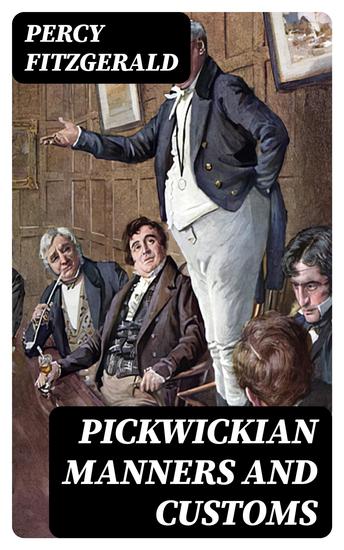
Pickwickian Manners and Customs - cover

Pickwickian Manners and Customs

Percy Fitzgerald

Publisher: DigiCat

  • 0
  • 0
  • 0

Summary

In "Pickwickian Manners and Customs," Percy Fitzgerald explores the cultural nuances and societal norms of the early 19th century through a lens that echoes the satirical spirit of Charles Dickens' original "The Pickwick Papers." Fitzgerald's literary style is marked by rich, vivid descriptions and keen observations that evoke both humor and reflection. The book serves as a companion piece, delving into the peculiarities of the Pickwick Club and its members, while illuminating issues of class, etiquette, and the burgeoning Victorian social landscape amidst the backdrop of a rapidly changing England. Percy Fitzgerald, an esteemed Victorian writer, critic, and biographer, was well immersed in the literary world of his time. His close association with Dickens and his appreciation for the interplay of humor and social commentary significantly influenced his decision to write this book. Fitzgerald's own experiences as a traveler and observer enriched his narrative, providing an authentic perspective on the manners and customs that defined a complex era. "Pickwickian Manners and Customs" is a delightful read for scholars and enthusiasts of Victorian literature alike. Fitzgerald invites readers to engage with the past, drawing connections between historical customs and contemporary society. This work not only entertains but also enriches our understanding of cultural evolution, making it a must-read for those interested in the intersection of literature, history, and social critique.
Available since: 09/16/2022.
Print length: 196 pages.

Other books that might interest you

  • Ottoman Edges - cover

    Ottoman Edges

    Anonymous

    • 0
    • 0
    • 0
    This book offers a vivid, ground-level narrative of how the Ottoman Empire navigated two turbulent centuries of war, diplomacy, and reinvention. From the Treaty of Zsitvatorok to the French invasion of Egypt, this book follows shifting frontiers in the Balkans, the Caucasus, and the Arab provinces; the rise of provincial notables; the transformation of the Janissaries; the monetized pressures of silver and global trade; the aesthetics and politics of the Tulip Period; and the Empire’s steadily sharpening view of Europe. It explores how Russia and Austria surged, how forts and bridges became social institutions, how markets whispered the first warnings of defeat and recovery, and how knowledge—maps, manuals, and newspapers—turned into instruments of power. Bringing cities, soldiers, scholars, and merchants to life, the book reframes “decline” as an intense school of adaptation that culminated in the shock of 1798 Egypt—an ending that seeded the next Ottoman century of reforms.
    Show book
  • Second Treatise of Government - cover

    Second Treatise of Government

    John Locke

    • 0
    • 0
    • 0
    The Second Treatise of Government is a political treatise written by English philosopher John Locke in 1689. It is considered one of the most important works on political philosophy, as it presents Locke's ideas on the natural rights of individuals and the proper role and limits of government in a society based on the consent of the governed. 
    In the Second Treatise, Locke argues that all individuals have natural rights to life, liberty, and property, which cannot be taken away by any authority, including the government. These rights are inherent and universal, and are not granted by any social contract or agreement. 
    Locke also argues that governments are formed by the consent of the governed, and are therefore obligated to protect the natural rights of their citizens. He asserts that the purpose of government is to promote the common good, and that governments that fail to do so may be overthrown by the people. 
    Moreover, Locke suggests that there are limits to the power of government, and that individuals have the right to resist or even overthrow a government that becomes tyrannical or violates their natural rights. 
    The Second Treatise of Government has had a significant impact on political theory and the development of democratic governance. It influenced the United States Declaration of Independence and the Constitution, as well as many other constitutions around the world.
    Show book
  • Archaeology of the Anunnaki Sumerians - Revealing Strange Artifacts and Mesopotamia Mysteries - cover

    Archaeology of the Anunnaki...

    Faruq Zamani

    • 0
    • 0
    • 0
    Leonard Woolley, an archaeologist from Britain, returned to Iraq in 1922, almost 4,000 years after the nuclear ancient catastrophe, to uncover ancient Mesopotamia.An imposing ziggurat standing out in the desert plain drew him to the nearby site of Tell el-Muqayyar, where he began excavating. As old walls, artifacts, and inscriptions were unearthed, he realized he was digging up ancient Ur-Ur of the Chaldees. 
    Twelve years of his work were conducted through a joint expedition between the British Museum in London and the University of Pennsylvania Museum in Philadelphia. For those institutions, Sir Leonard Woolley found some of the most dramatic objects and artifacts in Ur. However, what he discovered may well surpass anything ever exhibited before. 
    In the course of removing layers of soil deposited by desert sands, the elements, and time from the ruins, the ancient city began to take shape-here were the walls, there were the harbors and canals, the residential quarters, the palace, and the Tummal, the elevated sacred area. Woolley's discovery of a cemetery dated thousands of years ago included unique 'royal' tombs discovered by digging at its edge is the find of the century.
    Show book
  • Battle of Dunkirk: Operation Dynamo - The Miracle of the Dunkirk Evacuation During World War 2 - cover

    Battle of Dunkirk: Operation...

    Liam Dale

    • 0
    • 0
    • 0
    Join The History Journals for an hourly history tour. In this edition, uncover the true tale of the Battle of Dunkirk and the heroism of civilians who rescued Allied troops from the Nazis. 
     
    The phrase "spirit of Dunkirk" embodies the indomitable British mentality, but many know little beyond its association with WWII and its location in France. However, Dunkirk's story, marked by incredible bravery of both military and civilians, is profoundly moving and inspirational. This journal transports you to 1940, a journey to discover true courage amid dire adversity. 
     
    Winston Churchill coined it the "miracle" of Dunkirk, a dramatic escape occurring in May and June 1940. To fully appreciate this event, it's essential to grasp its context - a Europe in turmoil under Adolf Hitler's relentless pursuit of global supremacy.
    Show book
  • Bernhard Sindberg - The Schindler of Nanjing - cover

    Bernhard Sindberg - The...

    Peter Harmsen

    • 0
    • 0
    • 0
    In December 1937, the Chinese capital, Nanjing, falls and the Japanese army unleash an orgy of torture, murder, and rape. Over the course of six weeks, hundreds of thousands of civilians and prisoners of war are killed. At the very onset of the atrocities, the Danish supervisor at a cement plant just outside the city, 26-year-old Bernhard Arp Sindberg, opens the factory gates and welcomes in 10,000 Chinese civilians to safety. He becomes an Asian equivalent of Oskar Schindler, the savior of Jews in the Holocaust. 


    This biography follows Sindberg from his childhood and on his first adventures as a sailor and a Foreign Legionnaire to the 104 days as a rescuer of thousands of helpless men, women, and children in the darkest hour of the Sino-Japanese War. After his remarkable achievement, he receded back into obscurity, spending decades at sea and becoming a naturalized American citizen, before dying of old age in Los Angeles in 1983. 


    The book sets the record straight by providing the first complete account of Sindberg's life in English. What emerges is the surprising tale of a person who was average in every respect but rose to the occasion when faced with unimaginable brutality, discovering an inner strength and courage that transformed him into one of the great humanitarian figures of the twentieth century and an inspiration for our modern age.
    Show book
  • Cajuns and Creoles The: The History and Legacy of the Unique Ethnic Groups in the American South and Caribbean - cover

    Cajuns and Creoles The: The...

    Editors Charles River

    • 0
    • 0
    • 0
    Deep within the bayous and swamps of Louisiana resides a population descended from an exodus. These people, called Cajuns or Acadians, were expelled from their homelands. Persecuted and homeless, they traveled hundreds of miles south in search of a new home and ultimately settled in the Pelican State, where they made new lives for themselves free from their British conquerors. Though not always warmly welcomed, they were accepted, allowing them to practice their different culture amidst their new neighbors. 
    	Though their home has changed flags over the centuries, the people themselves have remained, retaining a culture that goes back several centuries. While people continue to assimilate, some have continued to live same lifestyles their ancestors did for generations, and they continue to fascinate outsiders, so much so that they occasionally end up being featured on the History Channel. 
    	Contrary to popular belief, the term “Creole” is not restricted to the Louisiana Creole, nor the Creoles of color, which collectively refers to the overall ethnic group and different local Creole cultures that blossomed across the Spanish and French colonies in Louisiana, Mississippi, and northwestern Florida. Today, the term is much more complex and may be applied to any of the various Creole cultures around the globe. The word may also be used to describe any language that has spawned from a mixture of languages, or specifically the associated, but distinct tongues developed within Creole communities, as well as the speakers of these languages themselves.  
    Generally speaking, however, the word “Creole” refers to the cultures birthed from the colonial-era racial and cultural mixing between Europeans (mostly of French, Spanish, or Portuguese descent) and Africans, as well as Native Americans, and other local or indigenous peoples in French, Spanish, and Portuguese territories.
    Show book