Join us on a literary world trip!
Add this book to bookshelf
Grey
Write a new comment Default profile 50px
Grey
Subscribe to read the full book or read the first pages for free!
All characters reduced
Scarabs: An Introduction to the Study of Egyptian Seals and Signet Rings - Unveiling the Mysteries of Ancient Egyptian Seals and Symbols - cover

Scarabs: An Introduction to the Study of Egyptian Seals and Signet Rings - Unveiling the Mysteries of Ancient Egyptian Seals and Symbols

Percy E. Newberry

Publisher: Good Press

  • 0
  • 0
  • 0

Summary

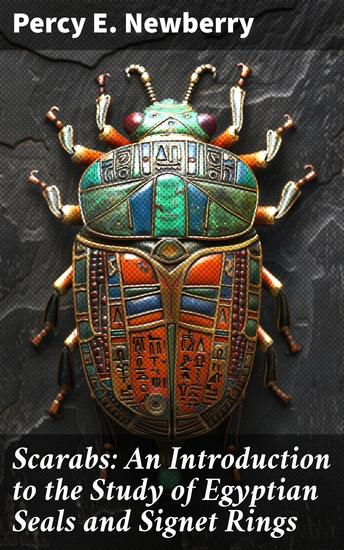
In "Scarabs: An Introduction to the Study of Egyptian Seals and Signet Rings," Percy E. Newberry provides a comprehensive examination of ancient Egyptian scarabs, artifacts that played a pivotal role in the cultural and religious life of the civilization. Through meticulous analysis and vivid illustrations, Newberry delves into the intricate artistry and symbolic meanings behind these seals and signet rings, exploring their use in governance, commerce, and funerary practices. His scholarly approach seamlessly combines philology and archaeology, establishing a rich contextual framework that nurtures the reader's understanding of these historically significant objects as reflections of societal values and beliefs. Percy E. Newberry was a prominent British Egyptologist whose scholarly pursuits were deeply influenced by his extensive fieldwork in Egypt and participation in early excavations. His passion for Egyptian antiquities and his role in raising public awareness of Egyptology during his career lend a personal dimension to the text. Newberry's insights are rooted in his firsthand experiences and scholarly rigor, making his contributions invaluable to the field. This book is a must-read for anyone interested in Egyptology, archaeology, or art history. Newberry's authoritative yet accessible narrative not only enriches academic discussions but also captivates the general reader eager to learn about the fascinating world of ancient Egypt. It serves as both a foundational text for newcomers and a poignant resource for seasoned scholars.
Available since: 11/14/2023.
Print length: 202 pages.


Other books that might interest you

  • Kaizen - 1% Better Every Day - cover

    Kaizen - 1% Better Every Day

    Araki Yoshikawa

    • 0
    • 0
    • 0
    Have you also often tried to change your life and found that it is not so easy? Maybe it was trying to lose weight, personal development, sports, finances or self-employment, etc. Do you remember the attempts you failed at? When you gave in to your inner pig for the sake of peace, or when you were no longer able or willing to withstand the pressure and you felt put on the defensive?Then you should definitely take a look at the Japanese change philosophy "Kaizen". With this philosophy you will learn how to approach your success and your goals with small steps but with high efficiency and how to reach your goals after all. Would you like to revive dreams and goals that have long since been filed away and to come closer step by step, without much effort, until the realization is inevitable? Wouldn't life immediately become much more meaningful again?Then turn to this book with its Japanese philosophy, which found its origin in large business groups and has continued its successful path into personal development. Kaizen means to approach improvements step by step instead of trying to bring about radical changes. The goal of the method is to continuously bring about minimal change and thus come inevitably closer to the goal.
    Show book
  • How to Recognize Toxic Anxiety - cover

    How to Recognize Toxic Anxiety

    Olivia Werner

    • 0
    • 0
    • 0
    [How to Recognize Toxic Anxiety] delves into the intricate landscapes of modern anxiety with unflinching precision and intimate understanding. Through lyrical prose that echoes the quiet moments of psychological struggle, this groundbreaking exploration maps the subtle territories where anxiety infiltrates daily life. With remarkable attention to detail, the book illuminates how anxiety transforms ordinary experiences—from morning coffee rituals to midnight thoughts—into complex negotiations with fear. Drawing on rich metaphorical frameworks of weather patterns, architecture, and internal chemistry, it offers readers a revolutionary lens for understanding their own experiences of anxiety. What sets this work apart is its masterful balance of scientific insight and emotional resonance, weaving together the biological underpinnings of anxiety with the deeply personal experience of navigating its presence in contemporary life. The narrative doesn't just describe anxiety; it captures its essence in the spaces between heartbeats, in the pauses between breaths, in the moments between thoughts—making visible what has long remained unseen.
    Show book
  • Love To Hate You - cover

    Love To Hate You

    Olivia Lucas

    • 0
    • 0
    • 0
    Chatty, down to earth, Chelsea Roberts is cruising through life – successful career, great circle of friends, cute dog. Sure, her love life could use an intervention, but everything else is kind of perfect. That is until a new roommate blows in unexpectedly on New Year’s Day and turns everything upside down. 
    Doctor-to-be Lucy Walker. 
    Moody. 
    Conversation-killer. 
    Jerkette. 
    And the hottest woman in the universe. 
    Chelsea is beside herself and plots to get rid of her. While Lucy tries to avoid any type of interaction, even if it means crawling out the window. Things spiral quickly, and it doesn’t take long until they get caught up in a series of tit-for-tat pranks and bad behavior trying to drive each other crazy. 
    Yet as time goes on, something begins to change. Chelsea slowly pulls back the layers of her roommate and discovers there may be more to her than she thought. Lucy seems to ‘hate’ her with less conviction, and the two women almost begin to enjoy hanging out. 
    Life soon forces these sworn enemies to work out the true extent of their feelings before one of them walks away.
    Show book
  • Much Ado About Numbers - Shakespeare’s Mathematical Life and Times - cover

    Much Ado About Numbers -...

    Rob Eastaway

    • 0
    • 0
    • 0
    Shakespeare's era was abuzz with mathematical progress, from the new concept of "zero" to Galileo's redraft of the heavens. Now, Rob Eastaway uncovers the many surprising ways math shaped Shakespeare's plays—and his world—touring astronomy, code-breaking, color theory, navigation, music, sports, and more. 


    ● How reliable was a pocket sundial? 


    ● Was math illusionist John Dee the real-life Prospero? 


    ● How long was a Scottish mile, and what could you buy for a groat? 


    ● How did ordinary people use numbers day to day? 


    ● And might Shakespeare have tried that game-changing invention—the pencil? 


    Full of delights for devotees of both Tudor history and the Bard, Much Ado About Numbers is proof that the arts and sciences have always danced together.
    Show book
  • The Mythology of the Slavs - Folk Tales and Legends from Eastern Europe - cover

    The Mythology of the Slavs -...

    Odessa Nightshade

    • 0
    • 0
    • 0
    Slavic mythology is a rich and complex tradition that has been shaped by centuries of oral storytelling, cultural exchanges, and historical transformations. Rooted in the beliefs of ancient Slavic tribes, this mythology reflects a deep connection to nature, a reverence for powerful deities, and a world teeming with spirits, gods, and legendary heroes. Unlike the more widely documented mythologies of the Greeks and Romans, Slavic myths were primarily passed down through oral tradition, making them fluid and ever-evolving. As a result, variations exist across different Slavic nations, yet common themes and figures remain central to the mythology as a whole.  
    The natural world played a crucial role in shaping Slavic beliefs. The Slavs were deeply tied to the cycles of the seasons, the power of the sun, and the mysteries of the forests and rivers. Deities like Perun, the god of thunder, and Veles, the god of the underworld, represented the dual forces of order and chaos, life and death. Forest spirits like the Leshy guarded the woods, while the Rusalka, eerie water nymphs, were believed to lure unsuspecting travelers to a watery grave. These myths not only explained the forces of nature but also provided a spiritual framework for daily life.  
    Storytelling was the primary means of preserving these myths. Legends were shared around fires, during village gatherings, and at seasonal festivals. Oral tradition allowed for constant reinterpretation, with each storyteller adding new details to fit the cultural and historical context of their time. Folklore heroes, such as Ilya Muromets and Dobrynya Nikitich, emerged as symbols of courage and perseverance, their tales reinforcing the values of strength, loyalty, and wisdom. These stories also carried moral lessons, cautioning against greed, deceit, and disrespect for the natural and supernatural world. 
    Show book
  • The New Jersey Radium Girls - True Story of The Radioactive Women Who Suffered For Corporate Greed - cover

    The New Jersey Radium Girls -...

    Daniel Turmoil

    • 0
    • 0
    • 0
    These days, it appears that there is always a trendy ingredient capturing everyone's attention. At present, activated charcoal has taken the spotlight and can be found in various beauty products, health supplements, and even food items. Back in the early 20th century, radium, a naturally occurring metal with an atomic number of 88 and symbol RA on the periodic table, was the new and exotic substance. This ingredient found its way into toothpaste, beauty creams, lotions, corsets, watches, and even water. For the women working at the US Radium Corporation, this would become their own personal nightmare.
    Show book