Join us on a literary world trip!
Add this book to bookshelf
Grey
Write a new comment Default profile 50px
Grey
Subscribe to read the full book or read the first pages for free!
All characters reduced
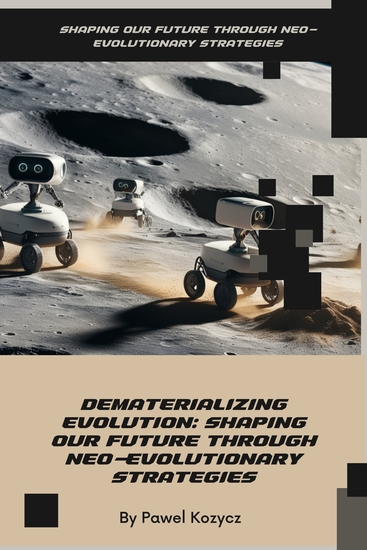
Dematerializing Evolution - Shaping Our Future Through Neo-Evolutionary Strategies - cover

Dematerializing Evolution - Shaping Our Future Through Neo-Evolutionary Strategies

Pawel Kozycz

Publisher: Pawel Kozycz

  • 0
  • 0
  • 0

Summary

How do we go out of the static model of embracing the evolution of life and matter? How do we conquer the macro and micro cosmos of life and matter in a more efficient way?  Dematerialization of world evolution using an army of mini smartphone robots invasion of the moon.
Available since: 10/28/2024.
Print length: 362 pages.

Other books that might interest you

  • Echoes of Change: The Environmental Revolution Explained - Dive into Echoes of Change! Experience dynamic audio lessons for mastering the environmental revolution - cover

    Echoes of Change: The...

    Thorne Eldridge

    • 0
    • 0
    • 0
    "Echoes of Change: The Environmental Revolution Explained" 
    Are you eager to enhance your career prospects and deepen your understanding by embracing essential environmental insights? 
    Looking for a comprehensive resource to equip you with all the necessary knowledge about the environmental revolution? 
    Your search ends here! 
    This guide serves as your definitive companion for expanding your understanding, applying crucial insights, and engaging in practical exercises. Ready yourself for success. 
    Updated for the latest insights into environmental change.  
    Key features of this enriched guide: 
    - Profound insights into the environmental revolution  
    - Detailed explanations of transformative environmental concepts  
    - Effective strategies for understanding and action 
    Our guide stands out with its comprehensive coverage, essential for mastering the challenges of environmental change. Insights are not briefly touched upon; they are examined thoroughly and precisely. 
    Please note that this guide is an independent resource designed for your benefit. 
    Crafted with a clear structure and easy-to-understand language, our Environmental Guide ensures smooth transitions between topics. Say goodbye to dense jargon and welcome clear, precise, and technically accurate content. 
    So, why wait? Click the BUY NOW button, secure your guide, and start your journey towards comprehending the Environmental Revolution today! 
    Empower your actions with crucial environmental insights today.
    Show book
  • Kinesiology - The Science of Movement How We Use Our Bodies - cover

    Kinesiology - The Science of...

    Mike Crawford

    • 0
    • 0
    • 0
    Kinesiology, the scientific study of human movement, is a multidisciplinary field that integrates principles from anatomy, physiology, biomechanics, and neuroscience. It examines how the body moves, the forces that act upon it, and the underlying mechanisms that control movement. By understanding these principles, professionals in various fields, including physical therapy, sports science, and occupational therapy, can enhance human performance, prevent injuries, and improve rehabilitation strategies. 
    The origins of kinesiology date back to ancient civilizations, where scholars like Aristotle and Galen first explored the mechanics of movement. However, the field gained prominence in the 19th and 20th centuries as scientific advancements allowed for a deeper understanding of biomechanics and motor control. Today, kinesiology encompasses a vast range of topics, from the microscopic study of muscle fibers to large-scale analyses of athletic performance. 
    One of the core components of kinesiology is biomechanics, which applies the principles of physics and engineering to study how forces influence movement. Biomechanics helps explain how the body maintains balance, generates power, and absorbs impact. For example, analyzing the gait cycle of a runner can reveal inefficiencies that may lead to injuries. By optimizing movement patterns, biomechanics contributes to improving athletic performance and developing assistive technologies such as prosthetics and orthotics.
    Show book
  • Rescue at the Reef - The Miraculous True Story of a Little Boy with Big Faith - cover

    Rescue at the Reef - The...

    Jameson Reeder, Mary Catherine...

    • 0
    • 0
    • 0
    In the vein of #1 New York Times bestseller Soul Surfer, this inspiring story of loss and resilience follows the Reeder family after a horrific shark attack. A two-week vacation to the Florida Keys meant Mary and Jameson Sr. could share the beauty of their favorite turquoise-blue waters with their four children. On that serene day at Looe Key Reef, their oldest, ten-year-old Jameson Jr., was swimming among the marine life, capturing breathtaking footage of a sea turtle when a massive bull shark attacked.     Nine miles from shore and even farther from a hospital, their son weakening, the Reeders prayed for help—and it came through a miraculous chain of events.    Rescue at the Reef is the true story of a young boy who defied death with an unshakable faith in the power of Jesus to save him. Even in immense suffering, he focused on caring for those around him, so much that it surprised even hospital staff. His unshakeable peace made an impact on patients and visitors, and his story quickly spread, drawing the attention of strangers and the media.     With reflections on faith, suffering, and the hidden gifts that often go unnoticed, Rescue at the Reef is a living reminder that with God, even the most fearsome challenges can be faced—and conquered. This unforgettable story will leave you on the edge of your seat, inspired by the ripple effects of hope that overcome impossible odds.
    Show book
  • Markets & Momentum - How Profiling Gives Traders an Advantage - cover

    Markets & Momentum - How...

    James F. Dalton, Robert B. Dalton

    • 0
    • 0
    • 0
    In Markets & Momentum, James F. Dalton dramatically expands on his first revolutionary book, Markets in Profile. Summarizing six decades of experience—from formative memberships on the CBOE and CBOT to his role as UBS Director of Hedge Fund Research—Dalton challenges traders to recognize that self-understanding must be balanced with market-understanding. 


    Dalton and his partners, Jennifer Loh and Raghu Rajput, continue to promote education explaining the foundational elements of market understanding through the only reliable and objective source of actionable trading information: the market itself. You'll discover how to begin your investing journey with a clean slate, focusing only on the information that truly matters. Or, if you're already a trader, you'll learn how to level-up your skills in a discipline with little room for error. 


    This book offers deep dives into issues that lead more than 90% of day traders to lose money, including fading trend days, FOMO, doubling down on losing trades, and failing to let profits run; strategies for minimizing the influence of news hype and analysis overload in order to remain focused on the only information that matters; and techniques for understanding your own emotional and intuitive reactions, and learning to avoid making unexamined, impulsive decisions.
    Show book
  • Reluctant Conquest - American Wealth Power and Science in the Arctic - cover

    Reluctant Conquest - American...

    Kathryn C. Lavelle

    • 0
    • 0
    • 0
    What drives American foreign relations in the Arctic? It is difficult to give a unified answer to this question because most histories of the region are divided between the Atlantic and Pacific coasts, Asian and European strategic interests, or federal government and Indigenous peoples' concerns, making it difficult to understand the connections among the environmental challenges, scientific understandings, strategic calculations, and governance relationships. Most Americans do not think of their country as an Arctic power, yet it is a region where the United States has had important ties throughout its history.In this sweeping study, from the founding of the country through the acquisition of Alaska to the present, Kathryn C. Lavelle considers American relations across the circumpolar North, incorporating discussions of economics, national security, and science that are conventionally separated. Lavelle argues that it is impossible to understand United States policy without a knowledge of American political development and of how scientific understandings have grown alongside studies of climate and other environmental issues. This history has important implications for future American policy regarding traditional national security and political economy, in addition to climate change and environmental cooperation.
    Show book
  • Understanding Artificial Intelligence - Principles and Practices - cover

    Understanding Artificial...

    Craig Dames

    • 0
    • 0
    • 0
    Artificial Intelligence, commonly known as AI, is one of the most transformative technologies of our time. It refers to the development of computer systems that can perform tasks typically requiring human intelligence. These tasks include problem-solving, learning, decision-making, understanding natural language, and even visual perception. While AI may seem like a recent innovation, its foundations were laid decades ago, and it has evolved through years of research, experimentation, and technological advancement. 
    The concept of AI dates back to the 1950s, when computer scientists such as Alan Turing and John McCarthy began exploring whether machines could simulate human intelligence. The term "Artificial Intelligence" was first coined in 1956 during the Dartmouth Conference, which is now recognized as the birthplace of AI as a field of study. Early AI systems were rule-based and could only perform specific tasks under limited conditions. However, as computing power increased and data became more accessible, AI models grew more sophisticated and capable. 
    Today, AI is not just a theoretical concept or something confined to laboratories. It is embedded in our daily lives in subtle and sometimes invisible ways. From voice assistants like Siri and Alexa to recommendation algorithms on streaming platforms and online shopping sites, AI is shaping how we interact with technology. Navigation apps use AI to suggest optimal routes, email services use it to filter spam, and social media platforms rely on AI to personalize content.
    Show book