Join us on a literary world trip!
Add this book to bookshelf
Grey
Write a new comment Default profile 50px
Grey
Subscribe to read the full book or read the first pages for free!
All characters reduced
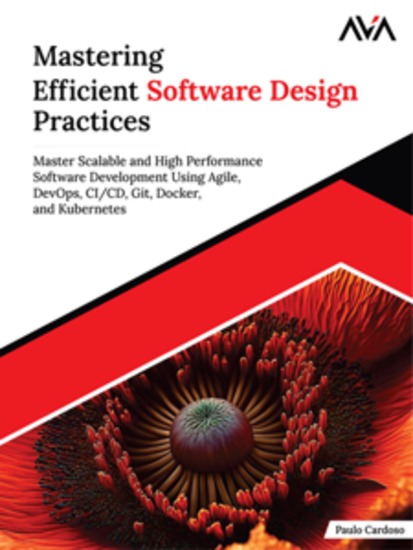
Mastering Efficient Software Design Practices: Master Scalable and High Performance Software Development using Agile DevOps CI CD Git Docker and Kubernetes - cover

Mastering Efficient Software Design Practices: Master Scalable and High Performance Software Development using Agile DevOps CI CD Git Docker and Kubernetes

Paulo Cardoso

Publisher: Orange Education Pvt Ltd

  • 0
  • 0
  • 0

Summary

Build Secure, Scalable, and Efficient Software with Modern Best Practices.Key Features● Master Agile, DevOps, CI/CD, and scalable software architectures● Ensure code quality, security, and high-performance computing● Apply real-world best practices with hands-on case studiesBook DescriptionIn today’s fast-paced digital era, efficient software design is the key to building secure, scalable, and high-performing applications. Mastering Efficient Software Design Practices serves as a comprehensive guide for developers, engineers, and architects seeking to enhance their technical expertise and streamline software development workflows.This book covers essential principles, from foundational coding methodologies and version control with Git to Agile, DevOps, and Test-Driven Development (TDD). Readers will learn how to implement Continuous Integration and Continuous Delivery (CI/CD), improve code quality, enforce security best practices, and optimize performance. Real-world examples, case studies, and best practices ensure that theoretical concepts translate into practical skills.By the end of this book, readers will have a solid grasp of modern software development methodologies and the confidence to build robust, maintainable, and future-proof software solutions. Whether you're an aspiring developer or an experienced engineer, this book equips you with the tools and insights needed to thrive in today’s evolving tech landscape. Stay ahead of the curve—master these essential practices before you get left behind!What you will learn● Apply Agile, DevOps, and CI/CD to streamline software development.● Design secure, scalable, and maintainable software architectures.● Use Git, Docker, and Kubernetes for seamless team collaboration.● Write high-quality, testable code with automated testing strategies.● Optimize software performance and ensure scalability under load.● Leverage user-centered design and analytics for better UX decisions.
Available since: 04/29/2025.
Print length: 438 pages.

Other books that might interest you

  • Introduction to Quantum Field Theory - A Beginner's Guide to Quantum Field Theory - cover

    Introduction to Quantum Field...

    Mark Hedges

    • 0
    • 0
    • 0
    Quantum Field Theory (QFT) is the framework that unifies quantum mechanics and special relativity, providing a theoretical foundation for describing fundamental particles and their interactions. Unlike quantum mechanics, which describes particles as wavefunctions evolving in time, QFT treats particles as excitations of underlying fields that pervade all of space. This shift in perspective is necessary to accommodate relativistic effects and to describe processes such as particle creation and annihilation, which are not possible in non-relativistic quantum mechanics. 
    The motivation for QFT arises from the limitations of single-particle quantum mechanics when applied to high-energy physics. In relativistic systems, particles can be created and destroyed in interactions, as seen in high-energy collisions and radioactive decays. Traditional quantum mechanics, which treats particles as fixed entities, cannot account for such processes. By formulating particles as field excitations, QFT allows for a consistent description of multi-particle interactions and naturally incorporates the principles of special relativity. 
    At its core, QFT extends the principles of classical field theory to quantum systems. Classical field theories, such as Maxwell’s electrodynamics, describe how physical quantities vary across space and time. In QFT, these fields are quantized, meaning that their excitations correspond to discrete particles. The simplest example is the Klein-Gordon field, which describes spin-zero particles like mesons. The quantization of this field leads to the interpretation of its solutions as particle states, obeying relativistic energy-momentum relations.
    Show book
  • Language Alchemy - Bridging the Gap Between Humans and Machines Through Language - cover

    Language Alchemy - Bridging the...

    Lillian Synthia

    • 0
    • 0
    • 0
    Embark on a captivating exploration of the evolution of language as the alchemical catalyst that binds humans and machines. "Language Alchemy" captivates your attention from the first page, beckoning you into a world where words and technology converge in a seamless dance. 
    Delve into the historical roots of communication evolution, from the early days of computing to the era of artificial intelligence. Uncover the fascinating interplay between natural language processing, social media dynamics, and the rising influence of artificial intelligence on our daily lives. Discover how language is the thread weaving together the fabric of this dynamic relationship. 
    As you navigate the pages of "Language Alchemy," a desire to understand this digital age's societal implications and ethical considerations will ignite. The book sparks contemplation about the responsible integration of technology into our lives, fostering a longing for a future where human-machine communication is both innovative and ethically grounded. 
    "Language Alchemy" is not merely a book but a call to action. Take the insights gained from its pages and apply them to your understanding of the evolving landscape of human-machine communication. Consider your role in this alchemical process and how, through conscious choices, you can contribute to a future where communication bridges the gap between the organic and the artificial. 
    In "Language Alchemy," the journey is not just about reading words but about experiencing the transformation that occurs when language becomes the bridge between humanity and technology. Are you ready to embark on this alchemical odyssey? The book awaits, inviting you to participate actively in the evolution of communication.
    Show book
  • E Book Success with AI : Grow Your Readership with Secret Tips - cover

    E Book Success with AI : Grow...

    Ismail Can Karademir

    • 0
    • 0
    • 0
    Unlock the Power of Artificial Intelligence to Write and Sell Your Next Bestseller  
      
    Make Sure You Have Never Come Across Such A Detailed Book That Will Earn You Passive Income Before. 
      
    You will be able to easily earn passive income using the information in this book. 
      
    E Book Success with AI : Grow Your Readership with Secret Tips and embrace the future of writing! 
      
    Are you an author ready to harness the power of artificial intelligence? 
      
    "E-Book Success with AI: Increase Your Readership with Secret Tips" is your definitive guide to revolutionising your writing process and reaching a wider audience. 
      
    This groundbreaking book will show you how to: 
      
    Overcome writer's block and generate new ideas with AI-powered tools. 
    Research like a pro, draft effortlessly, and edit meticulously with the help of AI. 
    Follow our 7-step process to expertly craft, format, and design a remarkable e-book. 
    Learn insider strategies to get your ebook listed on the best platforms and into the hands (and e-readers) of eager readers. 
      
    E Book Success with AI : Grow Your Readership with Secret Tips is not just a how-to guide; it's your key: 
      
    Reduce your writing time and focus on what matters - your story, your message. 
    Discover new writing styles and techniques made accessible through AI. 
    Reach a global audience and gain recognition with the help of targeted distribution and marketing techniques.
    Show book
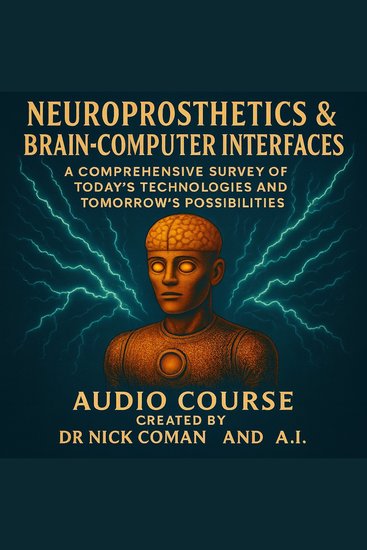
  • Neuroprosthetics and Brain-Computer Interfaces - A Comprehensive Survey of Today’s Technologies and Tomorrow’s Possibilities - cover

    Neuroprosthetics and...

    Dr. Nick Coman, I. A.I.

    • 0
    • 0
    • 0
    Welcome to the frontier where mind meets machine. 
    This 48-lecture audio course delivers a sweeping, PhD-level exploration of neuroprosthetics and brain–computer interfaces (BCIs), tracing the arc from early electrical experiments to the latest breakthroughs in neural decoding, cortical stimulation, and cognitive enhancement. It weaves together foundational neuroscience, cutting-edge engineering, landmark clinical use cases, and the emerging societal implications of brain–machine integration. 
    Listeners will journey through the biology of neurons and networks, the physics of electrodes and wireless implants, the clinical realities of stroke, ALS, and Parkinson’s disease, and the technological future of memory prosthetics, speech decoding, and real-time brain–AI symbiosis. Along the way, the course tackles the deepest questions: What happens when a mind is routed through a machine? Who owns neural data? And what does it mean to be augmented? 
    Rigorous, narrative-driven, and designed for the intellectually ambitious, this course is an essential guide to one of the most transformative domains in science and technology.
    Show book
  • What Are The Benefits Of ChatGPT Powered By The New Gpt-4 Technology Version 2 - ChatGPT: The Next Generation of AI-Powered Chatbots - cover

    What Are The Benefits Of ChatGPT...

    liquid ocelot

    • 0
    • 0
    • 0
    This book will examine ChatGPT's many advantages, which are made possible by the brand-new GPT-4 technology. It will be broken up into various chapters, each of which will concentrate on a distinct technology-related topic. We'll give a quick rundown of the technology's features in the introduction. Further particular subjects, such as the advantages of ChatGPT and GPT-4 technology, its influence on business, and its prospective applications, will be covered in later chapters. We will also look at ChatGPT's practical advantages and the strength of GPT-4 technology. The book will come to a close with a look at the direction that ChatGPT, powered by GPT-4 technology, will take AI in the future.
    Show book
  • Chemical Engineering - Design and Analysis of Chemical Process Engineering - cover

    Chemical Engineering - Design...

    Phil Gilberts

    • 0
    • 0
    • 0
    Chemical engineering is a multidisciplinary field that integrates principles from chemistry, physics, mathematics, and economics to tackle complex challenges across a diverse range of industries. At its core, chemical engineers focus on efficiently harnessing, transforming, and transporting chemicals, materials, and energy on a large scale. This involves not only designing and optimizing processes but also understanding the fundamental properties of substances and the underlying mechanisms governing their behavior. 
      
    One of the primary areas of focus for chemical engineers is process design and optimization. They develop innovative processes for the production of chemicals, fuels, pharmaceuticals, and materials, striving to maximize efficiency, minimize waste, and ensure safety. This often involves breaking down complex systems into manageable unit operations, such as distillation, reaction kinetics, heat transfer, and separation techniques, which are then studied and optimized individually to achieve specific goals within a larger process framework. 
      
    Environmental engineering is another critical aspect of chemical engineering. In today's world, sustainability and environmental impact are paramount considerations in any industrial process. Chemical engineers work on solutions for pollution control, waste management, and sustainable practices, aiming to minimize the ecological footprint of human activities and preserve our natural resources for future generations.
    Show book