Join us on a literary world trip!
Add this book to bookshelf
Grey
Write a new comment Default profile 50px
Grey
Subscribe to read the full book or read the first pages for free!
All characters reduced
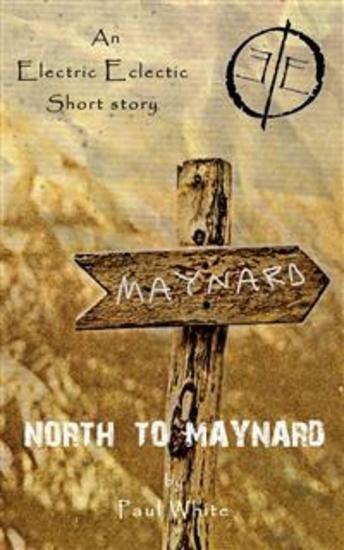
North to Maynard - An Electric Eclectic book - cover

North to Maynard - An Electric Eclectic book

Paul White

Publisher: BookRix

  • 0
  • 0
  • 0

Summary

North to Maynard is a tale of an urban spirit, a ghost in the machine story for these modern 'tech' times.
It exposes something which could happen to any one of us, at any time.... even during a road trip, when you are travelling North to Maynard.
North to Maynard is an Electric Eclectic Novelette, an introductory work to introduce you to the writing style and narration of the author, Paul White.
I hope you will enjoy this story so much it will encourage you to purchase one of Paul's prime titles. 
Available since: 12/19/2023.
Print length: 18 pages.

Other books that might interest you

  • Brooksmith - cover

    Brooksmith

    Henry James

    • 0
    • 0
    • 0
    "Brooksmith," a short story written by Henry James in 1891, tells the tale of Brooksmith, a retired diplomat's butler the 'narrator' had once known. Brooksmith was responsible for the preservation of the atmosphere the diplomat's salon where the guests enjoyed a high level of intellectual conversation. Brooksmith was regarded by the narrator as "the artist" who insured that the company at each gathering was the optimum number and mix of personalities to provide the highest level of conversation possible. 
     
    This was partially of benefit to Brooksmith himself, who would linger in the room on some pretext or other in order to eavesdrop on the exchanges. The diplomat was well aware of this, and alluded to it on occasion with dryly humorous remarks. With the diplomat's death, Brooksmith loses his vocation, which to him was almost a calling. At the end of the story, the narrator reveals that Brooksmith, lonely and dispirited, works a few odd jobs but falls into poverty and illness, and eventually disappears.
    Show book
  • Tombs Without Bodies - (Halfway to Better 4) - cover

    Tombs Without Bodies - (Halfway...

    Susan Kaye Quinn

    • 0
    • 0
    • 0
    SHORT STORY: Humanity has left the cities to live in the "greenbelt," but a young woman’s curiosity brings her back to the bot-patrolled streets where human beings used to live... until she gets caught.Tombs Without Bodies is one of six short solarpunk stories in the Halfway to Better collection.If you enjoyed the optimistic climate solutions in Kim Stanley Robinson’s Ministry for the Future or the cozy cooperative future in Becky Chambers’ Monk and Robot series, you will enjoy Halfway to Better.
    Show book
  • A Spectacular Event - cover

    A Spectacular Event

    Kimberly Thomas

    • 0
    • 0
    • 0
    In the coastal town of Oak Harbor there is a wedding for every season, and this is one that promises to be a spectacular event—a winter wonderland extravaganza. As long as there are no cold feet, that is. 


    You would think that being surrounded by the Hamilton family and preparing to marry the man of her dreams, that Rory would be happy . . . But she's not. 


    Dealing with a difficult mother-in-law and fighting for her fiancé's attention is proving to be a little more than what she signed up for. 


    Meanwhile . . . 


    Andrea struggles to accept her inability to help her sick and dying mother while trying to navigate her budding love life, and strengthening the bond of trust between her and her daughter. 


    Come along for the ride and find out how it all ends. Can the engagement survive the mother-in-law from hell? Or will the bride not make it down the aisle this holiday season?
    Show book
  • Canon Alberic's Scrap Book - From their pens to your ears genius in every story - cover

    Canon Alberic's Scrap Book -...

    M R James

    • 0
    • 0
    • 0
    Montague Rhodes James is cited as perhaps the greatest English writer of ghost stories, an opinion few would disagree with. 
    James was born on 1st August 1862 at Goodnestone Parsonage in Kent, where his father was Curate but at age 3 the family went to live at Livermere, near Bury St Edmunds in East Anglia.  
    From early childhood he had a passion for mediaeval books and antiques. He was educated initially as a boarder at Temple Grove School in East Sheen, west London, before gaining a scholarship to Eton and thence Cambridge where he gained a double first, becoming a distinguished linguist and mediaevalist.  
    Before the Great War vacations were usually spent touring Europe absorbing cultures and references for his later writing. 
    A man of enormous knowledge it was said he timed his breakfast egg whilst he completed the Times crossword.  
    Many of his elegant yet terrifying tales were created by discarding the prevailing gothic cliches and placing his characters and narrative in a realistic setting.  Thereby the stories gained atmosphere and menace on a grand scale and he was famed as the originator of the antiquarian ghost story. 
    Although story-telling and writing these 30 or so tales was a hobby, when published their effect transformed the genre and still chill the bones in our more modern times. 
    James was also a medievalist scholar and translator whose work remains highly respected. He was also Provost of Eton College between 1918 and 1936. 
    M R James died on 12th June 1936 at Eton in Buckinghamshire.  He was 73.
    Show book
  • Muckross Abbey and Other Stories - cover

    Muckross Abbey and Other Stories

    Sabina Murray

    • 0
    • 0
    • 0
    "I binge-read this book, savoring the gothic creepiness at the heart of each tale. Packed with compelling, nuanced lives and the deaths that haunt them, each story is a séance—an invitation for unsettled spirits to let their presence be known, 'desperate for someone to supply the narrative.' Murray supplies it with great style and an uncanny knowingness, leaving room for our imagination to fill in the suggestive spaces with our own dark dread." —MONA AWAD, author of All's Well 


    Sabina Murray has long been celebrated for her mastery of the gothic. Now in Muckross Abbey and Other Stories, she returns to the genre, bringing listeners to haunted sites from a West Australian convent school to the moors of England to the shores of Cape Cod in ten strange tales that are layered, meta, and unforgettable. 


    From a twisted recasting of Daphne du Maurier's Rebecca, to an actor who dies for his art only to haunt his mother's house, to the titular "Muckross Abbey," an Irish chieftain burial site cursed by the specter of a flesh-eating groom—in this collection Murray gives us painters, writers, historians, and nuns all confronting the otherworldly in fantastically creepy ways. With notes of Wharton and James, Stoker and Shelley, now drawn into the present, these macabre stories are sure to captivate and chill.
    Show book
  • A Successful Rehearsal - From their pens to your ears genius in every story - cover

    A Successful Rehearsal - From...

    Anthony Hope

    • 0
    • 0
    • 0
    Sir Anthony Hope Hawkins was born on 9th February 1863 in Clapton, London.  
    He was educated at St John's School, Leatherhead, Marlborough College and Balliol College, Oxford.  Hope trained as a lawyer and barrister and was called to the Bar by the Middle Temple in 1887. Despite what was thought to be a promising legal career he had literary ambitions and wrote in his spare time. 
    His early works appeared in various periodicals of the day but for his first book ‘A Man of Mark’ (1890), with no publisher interested, he published with his own resources.  
    More novels and short stories followed, including the mildly successful ‘Mr Witt's Widow’ in 1892. Hope even found time to run as the Liberal candidate for Wycombe in the election that same year but was unsuccessful. 
    His first major literary success came with ‘The Dolly Dialogues’, a collection of previously published magazine pieces followed very quickly by his instant classic, ‘The Prisoner of Zenda’. He now gave up the vestiges of his legal career to pursue writing full-time. 
    Despite never again reaching the same pinnacle of success he was popular and wrote prolifically across novels, plays and of course, short stories though his writing output rapidly diminished after the war. 
    In 1918 he was knighted for his contribution to propaganda efforts during World War I.  
    His short stories are delicate, mannered and often surprising with their wit, humour and interplay of characters who say one thing and usually mean another.  He was very definitely a writer of escapist rather than serious fare but they are no less enjoyable for that. 
    Anthony Hope died of throat cancer on 8th July 1933 at his country home, Heath Farm at Walton-on-the-Hill in Surrey. He was 70.
    Show book