Join us on a literary world trip!
Add this book to bookshelf
Grey
Write a new comment Default profile 50px
Grey
Subscribe to read the full book or read the first pages for free!
All characters reduced
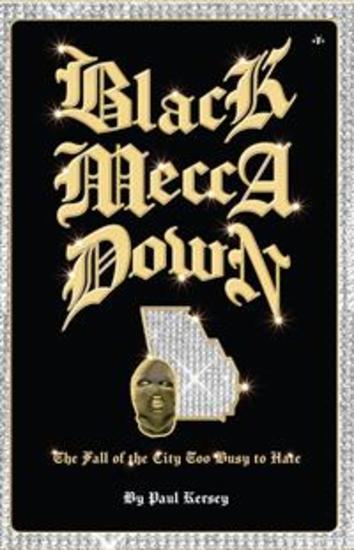
Black Mecca Down - The Fall of the City Too Busy to Hate - cover

Black Mecca Down - The Fall of the City Too Busy to Hate

Paul Kersey

Publisher: Antelope Hill Publishing LLC

  • 0
  • 0
  • 0

Summary

Are Blacks in America immune from criticism? Are they never responsible for their own failures? And most importantly, is Black rule the end for an American city? Paul Kersey answers these questions with an emphatic "yes" in this controversial account of the fall of Atlanta, through forty-five articles on the topic, originally posted to his SBPDL Blog at The Unz Review between 2011 and 2012. 

Black Mecca Down shows the tragic aftermath of the Civil Rights Movement in the decline of a once great city. Atlanta, GA, once dubbed "The City Too Busy To Hate," was supposed to be the model city for the New South, a thriving metropolis that would show the old Confederacy had moved beyond race and joined the global economy. Instead, Kersey argues, Atlanta became a Black dystopia dominated by corruption, incompetence, and crime. Starting with Maynard Jackson, Atlanta's first Black mayor, the greatest city in the South followed the pattern of Detroit, with basic institutions collapsing even as the cries of "racism" increased.

Paul Kersey's uproarious anthology, Black Mecca Down: The Fall of the City Too Busy to Hate, was originally published in 2012, has since fallen out of print, and is now being resurrected and preserved by Antelope Hill Publishing in a newly-edited and thoroughly cited edition.
 
Available since: 11/30/2023.

Other books that might interest you

  • Asphyxia - The Story of a Life Scripted in Parentheses - cover

    Asphyxia - The Story of a Life...

    Thomas Tomazo Pagonis

    • 0
    • 0
    • 0
    This audiobook is narrated by an AI Voice.   
    Asphyxia is a hauntingly lyrical novel that unfolds like a cinematic screenplay in parenthetical time and conditional mood. Told through the voice of Nefeli—a young woman observing her life on a mental screen—this work blurs the boundaries between memory, myth, narration, and madness. Set in a literary universe where authors are tyrants, muses are merciless, and reality is often just a rumour, the story follows Nefeli’s metaphysical descent into guilt, obsession, and poetic hallucination. 
    Through the echo of voices—narrators, poets, and ghosts—the book explores the invisible lives of the mentally fragile, those who vanish quietly between diagnoses and metaphors. With a cast of characters both archetypal and painfully human, Asphyxia is not a love story, nor a murder mystery, though it flirts with both. It is a philosophical narrative about stories themselves: who writes them, who performs them, and who suffers them. 
    Written by Tomazo Pagonis and originally crafted in Greek, this audiobook has been translated into rich British English by Marilu Pagoni. It is recommended for lovers of experimental fiction, metafictional narrative, and those who sense their own lives unfolding in parentheses.
    Show book
  • Enquiry Concerning the Principles of Morals and Other Works An - cover

    Enquiry Concerning the...

    David Hume

    • 0
    • 0
    • 0
    In his authobiography, David Hume declared unequivocally that this work, An Enquiry Concerning the Principles of Morals (1751) is ‘of all my writings, historical, philosophical, or literary, incomparably the best.’ In it, Hume takes the discussion away from traditional attitudes where either rational or metaphysical issues govern moral principles. Instead, he introduces the human factor, introducing the sentiments and passions inherent in human psychology.  
    In the opening paragraph of his Enquiry he states the ground clearly: ‘There has been a controversy started of late, much better worth examination, concerning the general foundation of Morals; whether they be derived from Reason, or from Sentiment; whether we attain the knowledge of them by a chain of argument and induction, or by an immediate feeling and finer internal sense; whether, like all sound judgement of truth and falsehood, they should be the same to every rational intelligent being; or whether, like the perception of beauty and deformity, they be founded entirely on the particular fabric and constitution of the human species.’ 
    He challenges the notion that reason can dictate moral principles independently of our desires and sentiments, arguing instead that reason serves as a tool to navigate and articulate our moral sentiments. 
    Central to Hume's thesis is the concept of moral approbation and disapprobation, which he contends stem from our natural inclination to feel pleasure or aversion in response to certain actions or traits. 
    He pursues his theme with characteristic clarity, concentrating on topics including benevolence, justice, utility, qualities useful to ourselves and others. He rejects moral absolutism which presumes the existence of immutable moral laws. Throughout, he emphasizes the importance of empathy and compassion as essential components of ethical behaviour.  
    Hume's "An Enquiry Concerning the Principles of Morals" stands as a testament to his profound insight into the complexities of human nature and morality. 
    This recording also contains two essays which also reflect the independence of his views for his time, On Suicide and On the Immortality of the Soul.
    Show book
  • Unbelievable True Facts From Across The Globe - A Clever Compendium of Incredible True Facts Weird and Random World History Hilarious Anecdotes and Crazy Things You Didn't Know - cover

    Unbelievable True Facts From...

    Owen Janssen

    • 0
    • 0
    • 0
    Did you know a Cow-Bison hybrid is called a Beefalo? Did you know that a U.S. Navy ship defeated a Japanese submarine during World War II by hurling potatoes at it? Did you know that around 16 million direct descendants of Genghis Khan are alive today? Did you know that people once ate arsenic to improve their skin? Did you know that “Running Amok” is a medically recognized mental condition? 
    ………………. 
    Bored at work and dreaming of something fun and engaging to pass the time? 
    Planning a vacation and looking for the ultimate travel trivia book or road trip reader? 
    Want to crush your opponents at the next trivia games night? 
    Or perhaps you are looking for the perfect gift book for mum, dad, kids, or a friend/family member of any age group? 
    Whatever the reason, Unbelievable True Facts From Across The Globe has it all - and even more! 
    Discover the reality behind those things you have always wondered about and learn crazy things you didn't know and won’t believe! 
    Find incredible trivia and fun facts on a variety of topics you can whip out in any conversation and amaze and entertain your loved ones. Satisfy your curious mind and share the pleasure of reading this compilation of jaw-dropping facts and funny true stories for hours and hours with friends and family, leaving them so intrigued they will Google the information to separate fact from fiction. 
    Unbelievable True Facts From Across The Globe is the most bewildering collection of unbelievable true stories and fascinating facts that will leave you astonished, baffled, and will change your perception of the world you live in.
    Show book
  • Free Speech and Turbulent Freedom - The Dangerous Allure of Censorship in the Digital Era - cover

    Free Speech and Turbulent...

    Michael J. Glennon

    • 0
    • 0
    • 0
    A vast censorship regime has smothered America's digital marketplace of ideas, squelching free speech on vital policy issues. Its supporters regard its benefits as morally and politically beyond question. They contend it's carried out by private social media platforms, not governmental authorities. 


    In Free Speech and Turbulent Freedom, Michael J. Glennon offers a timely and incisive response. The censors are short-sighted, he argues. Quibbling over outdated distinctions misses the real threat—which is the fusion of public and private power into a modern-day cartel able to overleap longstanding constitutional safeguards. American democracy, he argues, rests on a decentralized marketplace of ideas independent of the government. In crisp, trenchant terms, Glennon shows how concrete practical concerns justify protecting admittedly harmful online speech—even speech that advocates violence or embraces hatred or apparent falsehood. 


    To safely self-correct, democracy requires open channels of political communication. Glennon calls on the courts to unblock those channels—to measure such speech against enduring First Amendment precepts rather than pliable international norms—and to protect the speech interests not merely of the government and Big Tech, but of all participants in the marketplace of ideas.
    Show book
  • Revolting Prostitutes - The Fight for Sex Workers' Rights - cover

    Revolting Prostitutes - The...

    Juno Mac, Molly Smith

    • 0
    • 0
    • 0
    How the law harms sex workers—and what they want instead 


    Do you have to endorse prostitution in order to support sex worker rights? Should clients be criminalized, and can the police deliver justice? 


    In Revolting Prostitutes, sex workers Juno Mac and Molly Smith bring a fresh perspective to questions that have long been contentious. Speaking from a growing global sex worker rights movement, and situating their argument firmly within wider questions of migration, work, feminism, and resistance to white supremacy, they make it clear that anyone committed to working towards justice and freedom should be in support of the sex worker rights movement. 


    Contains mature themes.
    Show book
  • The Battle of Britain - How the RAF Defended the Skies and Changed the Course of the War - cover

    The Battle of Britain - How the...

    Sage Winters

    • 0
    • 0
    • 0
     The Battle of Britain was not an isolated event. It was the culmination of a series of escalating tensions, military buildups, and ideological confrontations that had been brewing for years. By 1939, Europe was on the brink of war. The world watched as Adolf Hitler's ambitions for territorial expansion grew, and the Nazi regime began implementing its aggressive policies across Europe. 
      
    The rise of Nazi Germany under Hitler was a response to the humiliation the country had suffered after World War I. With the Treaty of Versailles in 1919, Germany was burdened with harsh reparations, which led to economic instability and social unrest. In this environment, Hitler’s National Socialist party capitalized on the public’s desire for national renewal. He began rearming Germany in the early 1930s, violating the treaty’s restrictions and asserting military strength across Europe. 
      
    By the mid-1930s, Britain and France found themselves at odds with Germany’s expanding influence. In 1938, Hitler annexed Austria and then demanded control over Czechoslovakia’s Sudetenland. When the Munich Agreement failed to halt his expansionist ambitions, Britain began to realize that appeasement would not work. The threat of war was no longer theoretical; it was imminent.
    Show book