Join us on a literary world trip!
Add this book to bookshelf
Grey
Write a new comment Default profile 50px
Grey
Subscribe to read the full book or read the first pages for free!
All characters reduced
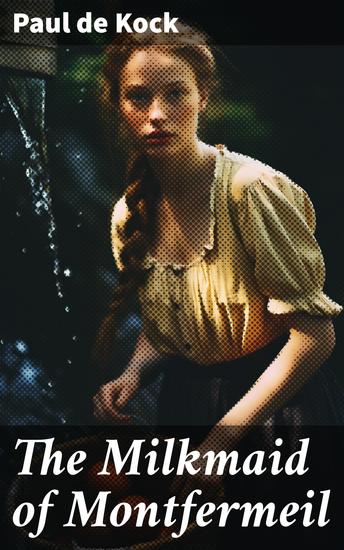
The Milkmaid of Montfermeil - Love Class Struggle and Village Life in 19th-Century France - cover

The Milkmaid of Montfermeil - Love Class Struggle and Village Life in 19th-Century France

Paul de Kock

Publisher: Good Press

  • 0
  • 0
  • 0

Summary

In "The Milkmaid of Montfermeil," Paul de Kock weaves a vibrant tapestry of rural life in 19th-century France, capturing the essence of pastoral charm and societal norms through a rich narrative style characterized by its humor and emotional depth. Set in the idyllic village of Montfermeil, the novel features a captivating protagonist, a milkmaid whose simple yet profound journey illustrates themes of love, class struggles, and the quest for personal happiness amidst societal expectations. De Kock's use of vivid descriptions and relatable characters evokes the tranquil yet tumultuous dynamics of village life, reflecting the social context of post-Napoleonic France where the idealization of peasant life contrasted with the harsh realities of urbanization and industrialization. Paul de Kock, a prominent figure in the 19th-century French literary scene, was known for his keen observation of everyday life and his ability to blend comedy with romance. His background as a Parisian and extensive travels across rural France deeply influenced his portrayal of pastoral life, leading him to write this endearing tale that resonates with authenticity. De Kock's literary prowess and his interest in the lives of ordinary people provide a rich backdrop that enhances the narrative of "The Milkmaid of Montfermeil." This enchanting novel is highly recommended for readers who appreciate insights into rural society and romantic escapades, as well as those who enjoy literary works that capture the intricate balance between personal aspiration and societal obligation. De Kock's delightful storytelling invites readers into a world where love flourishes amidst the simplicity of daily life, making it a timeless exploration of human connections.
Available since: 09/18/2023.
Print length: 321 pages.


Other books that might interest you

  • A midsummer's Night Dream - Full Cast Drama - cover

    A midsummer's Night Dream - Full...

    William Shakespeare

    • 0
    • 0
    • 0
    One of William Shakespeare's most beloved and whimsical comedies. This enchanting play weaves together the stories of several groups of characters as they navigate the magical and mischievous world of the fairy kingdom and the Athenian woods. The play opens in the court of Athens, where Duke Theseus is preparing for his upcoming marriage to Hippolyta, the Queen of the Amazons. The young lovers, Hermia and Lysander, are also introduced. However, Hermia's father, Egeus, insists that she marry Demetrius, whom she does not love. 
    Faced with the choice of marrying Demetrius, facing execution, or a life of chastity in a nunnery, Hermia and Lysander plan to escape to the nearby woods. They are pursued by Demetrius, who is himself pursued by Helena, Hermia's friend, who is infatuated with him. In the forest, a group of bumbling and amateurish actors led by the comical Bottom are preparing a play for the upcoming wedding of Duke Theseus and Hippolyta. Unbeknownst to them, the forest is also home to the fairy king Oberon, his queen Titania, and their mischievous servant, Puck. 
     
    Oberon and Puck, with the help of a magic flower, create a web of love and mischief in the forest. Puck mistakenly causes both Demetrius and Lysander to fall in love with Helena, leading to comical and chaotic misunderstandings. Titania, under the influence of Oberon's magic, falls in love with Bottom, who has been given the head of an ass. As the night unfolds, the characters' romantic entanglements and conflicts are resolved. Oberon releases Titania from her enchantment, and Demetrius and Lysander are restored to their proper loves. The lovers and the amateur actors return to the court, where their antics are performed as humorous entertainment. 


    Show book
  • Chimney Smoke - cover

    Chimney Smoke

    Christopher Morley

    • 0
    • 0
    • 0
    Before time as we know it began, gods and goddesses lived in the city of Asgard. Odin All Father crossed the Rainbow Bridge to walk among men in Midgard. Thor defended Asgard with his mighty hammer. Mischievous Loki was constantly getting into trouble with the other gods, and dragons and giants walked free. This collection of Norse sagas retold by author Padraic Colum gives us a sense of that magical time when the world was filled with powers and wonders we can hardly imagine.
    Show book
  • The Road to Oz - cover

    The Road to Oz

    L. Frank Baum

    • 0
    • 0
    • 0
    Dorothy sets out on a whimsical journey when an enchanted road appears near her home in Kansas. Along the way, she encounters new companions, including the mischievously charming Shaggy Man, the lively Button-Bright, and the elegant Polychrome. Together, they traverse magical lands, overcome bizarre challenges, and eventually reach the Emerald City just in time for Princess Ozma's grand birthday celebration, where friendship and festivity reign.
    Show book
  • Les Misérables - Volume 1: Fantine (Unabridged) - cover

    Les Misérables - Volume 1:...

    Victor Hugo

    • 0
    • 0
    • 0
    Victor-Marie Hugo (26 February 1802 - 22 May 1885) was a French poet, novelist, essayist, playwright, and dramatist of the Romantic movement. During a literary career that spanned more than sixty years, he wrote abundantly in an exceptional variety of genres: lyrics, satires, epics, philosophical poems, epigrams, novels, history, critical essays, political speeches, funeral orations, diaries, and letters public and private, as well as dramas in verse and prose.
    VOLUME 1: FANTINE: Although this detail has no connection whatever with the real substance of what we are about to relate, it will not be superfluous, if merely for the sake of exactness in all points, to mention here the various rumors and remarks which had been in circulation about him from the very moment when he arrived in the diocese. True or false, that which is said of men often occupies as important a place in their lives, and above all in their destinies, as that which they do.
    Show book
  • A Painful case - From their pens to your ears genius in every story - cover

    A Painful case - From their pens...

    James Joyce

    • 0
    • 0
    • 0
    James Augustine Aloysius Joyce was born on the 2nd February 1882 in Dublin into a middle-class family, and the eldest of ten surviving siblings 
    Admired as a brilliant student he briefly attended the Christian Brothers-run O'Connell School before excelling at the Jesuit schools of Clongowes and Belvedere.  From there he went on to attend University College Dublin from 1898, studying English, French and Italian 
    In 1902, Joyce was now in his early twenties, and went to Paris to study Medicine but soon abandoned his teachings.  Back in Dublin to attend to his dying Mother he met Nora Barnacle. They bonded immediately into a life-long match. Together they decided to emigrate to Europe.  The couple lived in Trieste, Rome, Paris, and finally Zürich where Joyce pursued a variety of jobs and ventures to supplement his literary pursuits but none of these paid off.  
    After publishing a poetry volume, ‘Chamber Music’, in 1907, his short story collection ‘The Dubliners’, in 1914, helped establish his talent in the rapidly changing world.  
    Although far from home Joyce’s literary heart and works were set in his recollections of Dublin.  Characters are close resemblances of family and friends and indeed enemies.  His landmark work ‘Ulysses’, published in 1922, is set in the streets and alleyways of the city as it parallels Homer’s Odyssey in a variety of styles including its famed stream of consciousness. 
    His pen continued to produce classics of the order of ‘A Portrait of the Artist as A Young Man’ and ‘Finnegan’s Wake’ together with several volumes of poetry and a play ‘The Exiles, in 1918.   
    On the 11th January 1941, Joyce underwent surgery in Zürich for a perforated duodenal ulcer. The next day he fell into a coma. On the 13th after a brief period of lucidity in which he called for his wife and son he passed.  He was 58.
    Show book
  • A Legend - From their pens to your ears genius in every story - cover

    A Legend - From their pens to...

    Alexander Kuprin

    • 0
    • 0
    • 0
    Alexander Kuprin was born in Narovchat, Penza in Russia on 7th September 1870. 
    At 3 his Father died and he and mother moved to Moscow. By 10 he was enrolled at the Second Moscow Military High School and there his interest in literature began. The Alexander Military Academy followed and two years later he was a sub-lieutenant and posted to an Infantry Regiment for a further four years. 
    Despite his duties he was a now a keen writer and published his first short story at this time. His military duties also garnered him experiences for his breakthrough work ‘The Duel’.  Leaving the military he left for Kiev to work for local newspapers.  He continued to publish both stories and novels and by 1901 he was in St Petersburg becoming part of a group that included Chekhov, Ivan Bunin, Maxim Gorky and Leonid Andreyev.  
    In the years that followed further controversial works and acclaim followed.  His comments on the regime meant he was also put under secret police surveillance.   
    As World War I erupted, Kuprin opened a military hospital but was then given command of an infantry company in Finland. He was soon discharged on grounds of ill health.  
    The October Revolution saw him praise Lenin, but he warned that the Bolsheviks threatened Russian culture and might cause further widespread suffering to the peasants.  As Civil War raged he took his family to Helsinki and then on to Paris. 
    Exile saw his talents decline further and his succumbing to alcoholism. He became lonely and withdrawn. The family's poverty increased his malaise.   
    In May 1937, the Kuprin’s returned to Moscow.  He now saw his work published but wrote almost nothing new.  In 1938 his health rapidly deteriorated.  Already suffering from a kidney problems and sclerosis, he had now developed cancer of the oesophagus.  
    Alexander Kuprin died on 25th August 1938.
    Show book