Join us on a literary world trip!
Add this book to bookshelf
Grey
Write a new comment Default profile 50px
Grey
Subscribe to read the full book or read the first pages for free!
All characters reduced
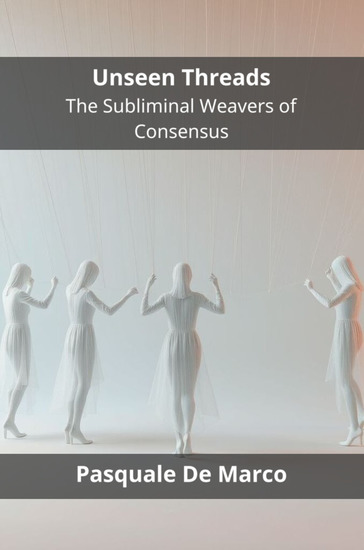
Unseen Threads - The Subliminal Weavers of Consensus - cover

Unseen Threads - The Subliminal Weavers of Consensus

Pasquale De Marco

Publisher: Publishdrive

  • 0
  • 0
  • 0

Summary

In the aftermath of the 9/11 attacks, America found itself at a crossroads, facing a profound test of its values, resilience, and unity. This book delves into the intricate relationship between language, politics, and culture that emerged in the wake of the tragedy, shedding light on the ways in which words were used to shape public opinion, justify actions, and navigate the treacherous terrain of national grief and fear.

Through a comprehensive analysis of speeches, news coverage, and cultural artifacts, this book unravels the complex interplay between language and power, revealing how words were weaponized to rally support, justify actions, and divide a nation. It examines the erosion of civil liberties in the name of security, the rise of surveillance technologies, and the transformation of the global political landscape in the post-9/11 era.

This book also explores the ways in which the attacks challenged America's sense of invincibility and forced a reckoning with its role in the world. It examines the cultural shifts that occurred in the wake of 9/11, the rise of Islamophobia and xenophobia, and the increasing polarization of American society.

Ultimately, this book is a cautionary tale about the dangers of manipulation and the importance of critical thinking in an age of disinformation. It is a call for vigilance in the face of those who would seek to divide and exploit us through the power of words. It is also a testament to the resilience of the human spirit and the enduring power of unity in the face of adversity.

This book is essential reading for anyone seeking to understand the profound impact of 9/11 on American society and the world at large. It is a valuable resource for scholars, journalists, policymakers, and anyone interested in the intersection of language, politics, and culture.


If you like this book, write a review!
Available since: 06/02/2025.
Print length: 164 pages.
Other books that might interest you

  • German Autumn - cover

    German Autumn

    Stig Dagerman

    • 0
    • 0
    • 0
    In the aftermath of World War II, Germany lay in ruins - its cities bombed, its people starving, its identity fractured. In German Autumn, Swedish journalist Stig Dagerman delivers a raw and unfiltered account of life in occupied Germany during the fall of 1946. 
    Through a series of deeply personal and vividly detailed reports, Dagerman goes beyond political narratives, capturing the human cost of war with compassion and insight. He walks through decimated cities, speaks with civilians, former soldiers, and refugees, and exposes the moral and physical struggles of a defeated nation. Neither excusing nor condemning, he presents an honest, haunting portrait of a society grappling with guilt, survival, and the slow process of rebuilding. 
    First published in 1947, German Autumn remains one of the most powerful works of war reportage - an urgent and poetic reflection on the consequences of destruction, the resilience of humanity, and the role of a writer in times of crisis. 
    A gripping and essential historical document—perfect for readers of war journalism, postwar history, and political literature.
    Show book
  • The Art of War - cover

    The Art of War

    Sun Tzu

    • 0
    • 0
    • 0
    The Art of War by Sun Tzu is the definitive ancient guide to military strategy, leadership, and psychological warfare — a masterpiece of timeless wisdom as relevant today as it was over 2,000 years ago. 
    Structured as a series of maxims, this foundational text offers insights into the nature of conflict, the value of preparation, and the dynamics of victory and defeat. In this authoritative English translation by Lionel Giles (first published in 1910), the text is presented with clarity, elegance, and scholarly precision. 
    From generals and CEOs to athletes and philosophers, The Art of War has been studied across disciplines for its profound understanding of power, discipline, and adaptability. This audiobook is essential listening for anyone interested in leadership, decision-making, and the strategy of life itself.
    Show book
  • The US Congress - A Very Short Introduction - cover

    The US Congress - A Very Short...

    Donald A. Ritchie

    • 0
    • 0
    • 0
    Donald A. Ritchie, a congressional historian for forty years, takes listeners on a fascinating, behind-the-scenes tour of Capitol Hill, pointing out the key players, explaining their behavior, and translating parliamentary language into plain English. He also explores the essential necessity of compromise to accomplish anything significant in the legislative arena. However, recent events show that political polarization has hardened and produced gridlock. The 2020 election also produced a more diverse membership in terms of gender, ethnicity, religion, and ideology, with primary elections resulting in the defeat of moderate candidates, making bipartisan compromise harder to achieve. 


    Among the most significant events, the Senate ignored President Obama's last nomination to the Supreme Court and then adopted a "nuclear option" to streamline future Supreme Court confirmations. The House also twice impeached President Trump, processes that starkly expose the differences between the majority-rule requirements of the House and the super-majority requirements of the Senate. This new edition explains how the parties have changed in light of the unprecedented politics of the past four years, culminating in the mob attack on the U.S. Capitol on January 6, 2021, and how this development has affected both the House and the Senate.
    Show book
  • The Next Century - cover

    The Next Century

    David Halberstam

    • 0
    • 0
    • 0
    What can we learn from the events of the 20th century? David Halberstam set out to answer that question in this perceptive and eye-opening work which examines the past in order to determine the future. From the rise of the Japanese economy to the startling changes that reshaped the Soviet Union and Eastern Europe, Halberstam argues that the American economy's survival depends on the rededication and continued education of the American worker. As pertinent in today's economy as it was when first published, The Next Century is a timeless call to arms, reminding us that we must continually better ourselves in order to compete on the world stage.
    Show book
  • Democracy - the political saga - cover

    Democracy - the political saga

    Ayele Teklemariam

    • 0
    • 0
    • 0
    "Democracy: The Political Tale" pulls readers into an exciting exploration of government complexities, directed by the author's own intimate experiences with democracy and tyranny. Leaning upon real-life events, the account digs deep into the profound effects of being forced out from a dictatorship nation and thereafter growing up in a democracy. The striking distinction between these structures influences the author's thorough study of representative democracy. 
    This book points out the issues in the way democratic systems currently work. It talks about how these systems struggle to handle the ever-changing, intricate demands of our present-day world. Elected officials becoming disconnected and a small group of people rule, despite a lack of public support, are clearly detailed—this reveals weakness in the system. The book uses smart examples to show times when agreement on vital matters couldn't be reached. It also delves into the trials presented by today's growth and society. All these details help champion the need for enhancements to our current system. 
    When the writer doubts the power of our representative democracy, a strong urge comes for decisions to include more folks and be more clear. The final parts of the book reveal personal stories, underlining the vital part democracy plays, but also being honest about its flaws. Calling for big fixes that can truly help society, "Democracy: The Political Saga" is a strong affirmation of the continuous search for a way to rule that fits well with today's complex world.
    Show book
  • Anarchy in Action - Case Studies of Anarchist Experiments and Their Outcomes - cover

    Anarchy in Action - Case Studies...

    Arlo Holders

    • 0
    • 0
    • 0
    Anarchism is often misunderstood and misrepresented, seen by many as synonymous with chaos and disorder. However, anarchism is a diverse and complex political philosophy that seeks to create a society free from oppressive hierarchies, such as the state, capitalism, and institutionalized authority. At its core, anarchism advocates for the dismantling of centralized power structures and the establishment of self-governed, voluntary communities based on mutual aid, solidarity, and direct action. Anarchists believe that individuals should have the freedom to organize their lives and work collectively without the interference of coercive institutions. 
    The history of anarchism traces back to the early 19th century, with influential thinkers such as Pierre-Joseph Proudhon, Mikhail Bakunin, and Peter Kropotkin shaping its development. Proudhon is often credited with coining the term “anarchy,” which he defined as “order without power.” Bakunin, one of the most prominent anarchist figures, argued that the state inherently oppresses the individual and stifles freedom, calling for a revolutionary transformation that would replace governmental authority with voluntary associations. Kropotkin, another major figure, emphasized the importance of mutual aid and cooperation, asserting that human beings are naturally inclined to work together for the common good, rather than being solely driven by competition and self-interest.
    Show book