Join us on a literary world trip!
Add this book to bookshelf
Grey
Write a new comment Default profile 50px
Grey
Subscribe to read the full book or read the first pages for free!
All characters reduced
The Paths of Power - Navigating Political Dynamics - cover

The Paths of Power - Navigating Political Dynamics

Pasquale De Marco

Publisher: Publishdrive

  • 0
  • 0
  • 0

Summary

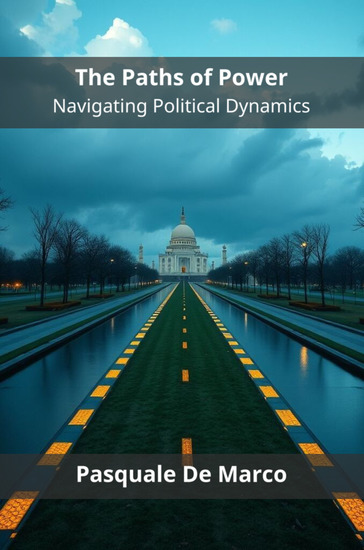
In this thought-provoking exploration of power, we delve into the intricate dynamics that shape our world. From the corridors of power to the intimate spaces of our personal lives, power exerts its influence in countless ways. This book offers a comprehensive examination of power, unraveling its complexities and revealing its profound implications for individuals and societies.

Through a multidisciplinary lens, we explore the nature of power, its origins, and its manifestations in various spheres of human existence. We examine the relationship between power and politics, economics, social structures, and personal relationships. By understanding the different dimensions of power, we gain insights into how decisions are made, how societies function, and how change can be effected.

With captivating storytelling and incisive analysis, this book delves into historical and contemporary examples of power dynamics. We encounter leaders who have wielded power for good and those who have abused it. We witness social movements that have challenged power structures and individuals who have stood up to oppression. These stories illuminate the complexities of power and inspire us to reflect on our own roles and responsibilities in shaping a more just and equitable world.

This book is essential reading for anyone seeking to understand the intricate workings of power. It is a valuable resource for students of politics, sociology, history, and psychology, as well as for anyone interested in personal development and social change. With its engaging writing style and thought-provoking insights, this book promises to deepen your understanding of power and empower you to navigate its challenges and opportunities.


If you like this book, write a review!
Available since: 06/02/2025.
Print length: 159 pages.
Other books that might interest you

  • The Contest for the Indian Ocean - And the Making of a New World Order - cover

    The Contest for the Indian Ocean...

    Darshana M. Baruah

    • 0
    • 0
    • 0
    A major new examination of the Indian Ocean, revealing how the region has become a hotly contested geopolitical flashpoint 


    Throughout history, the Indian Ocean has been an essential space for trade, commerce, and culture. Every European power has sought to dominate it. Now, after a lull in the postwar period, control of major shipping routes has once again become a critical aspect of every rising state's ambition to be a global power. 


    Darshana M. Baruah shows how governments from Washington, DC, to Nairobi and Canberra are expanding their interests in the region. The Indian Ocean is resource rich, strategically placed, and home to over two billion people. Island nations have become more important than ever, with Madagascar forming ties with Russia and the Comoros with Saudi Arabia. It is also through the region that China engages with Africa and the Middle East. This is a compelling account of the geopolitical significance of the Indian Ocean—showing how the region has taken center stage in a new global contest.
    Show book
  • Battleground - 10 Conflicts that Explain the New Middle East - cover

    Battleground - 10 Conflicts that...

    Christopher Phillips

    • 0
    • 0
    • 0
    The essential guide to geopolitics in the modern Middle East 


    The Middle East is in crisis. The shocking events of the war in Gaza have rocked the entire region. More than a decade ago, the Arab Spring had raised hopes of a new beginning but instead ushered in a series of civil wars, coups, and even harsher autocracies. Tensions were exacerbated by the meddling of outsiders, as regional and global powers sought to further their interests. The United States, for so long the dominant actor, had stepped back, leaving a vacuum behind it to be fought over. 


    Christopher Phillips explores geopolitical rivalries in the region, and the major external powers vying for influence: Russia, China, the European Union, and the United States. Moving through ten key flashpoints, from Syria to Palestine, Phillips argues that the United States' overextension after the Cold War, and retreat in the 2010s, has imbalanced the region. Today, the Middle East remains blighted by conflicts of unprecedented violence and a post-American scramble for power—leaving its fate in the balance.
    Show book
  • Coming to the King - cover

    Coming to the King

    Frances Ridley Havergal

    • 0
    • 0
    • 0
    A collection of poems by Frances Ridley Havergal and others, all describing different aspects of our walk with God, from 'Coming to the King' to 'Under the Shadow.' Summary by Esther ben Simonides.
    Show book
  • Duct-tape Community - Hope for Neighborliness in an Unequal World - cover

    Duct-tape Community - Hope for...

    Jim Herbst

    • 0
    • 0
    • 0
    In a country of critics and where shouting and snarky tweets dominate public communication, neighborliness is in short supply.  Duct-tape Community - Hope for Neighborliness in an Unequal World finds it in the most unexpected places, from public housing janitors to farmers in overalls. Hope for better community can be found from the inspiring stories of the seemingly powerless and unknown. Duct-tape Community is a declaration that community takes two resolves: one to make the world a fairer place and a second to be neighborly in one that isn't.
    Show book
  • The Presidential Fringe - Questing and Jesting for the Oval Office - cover

    The Presidential Fringe -...

    Mark Stein

    • 0
    • 0
    • 0
    This offbeat slice of American history places the story of our great republic beneath an unexpected lens: that of fringe candidates for president of the United States. Mark Stein explores how their quest for our nation’s highest office helped to amplify voices otherwise quashed during their day. His careening tour through elections past includes the efforts of true pioneers in the quest for social equality in our country: the first woman to run for president, Victoria Woodhull in 1872; the first African American to run for president, George E. Taylor, in 1904; and the first openly gay cross-dressing candidate for president, Joan Jett Blakk in 1992. 
    But The Presidential Fringe also takes a look at those who would jest their way into the Oval Office, from comedians such as Will Rogers and Gracie Allen to Pat Paulsen and Stephen Colbert. Along the way, Stein shows how even seemingly zany candidates, such as “Live Forever” Jones, Vegetarian Party candidate John Maxwell, Flying Saucer Party candidate Gabriel Green, or most recently, Vermin Supreme, provide extraordinary insights of clarity into who we were when they ran for president and how we became who we are today. Ultimately, Stein’s examination reveals that it was often precisely these fringe candidates who planted the seeds from which mainstream candidates later harvested genuine, positive change. 
    Written in Stein’s direct and witty style, The Presidential Fringe surveys and portrays an American landscape rife with the unlikely, unassuming, unexpected, and (in a few cases) unbalanced presidential hopefuls who, in their own way, have contributed to this nation’s founding quest to form a more perfect Union.
    Show book
  • The Impeachment Power - The Law Politics and Purpose of an Extraordinary Constitutional Tool - cover

    The Impeachment Power - The Law...

    Keith E. Whittington

    • 0
    • 0
    • 0
    We are witnessing an unprecedented moment in American politics in which impeachments are increasingly common. In today's partisan environment, it is more vital than ever that government officials, scholars, and ordinary citizens understand what an impeachment can reasonably be expected to accomplish. In this incisive and accessible book, Keith Whittington provides needed clarity on the constitutional power of impeachment. 


    Drawing insights from American and British history, congressional practice, and the language of the Constitution itself, Whittington shows how impeachment is a tool for checking abuses of elective office and defending constitutional norms. While we have come to associate impeachment with the presidency, it can be used to remedy gross misconduct by an array of officers of the federal government. Whittington cautions against abusing this immense and consequential power to settle political scores, demonstrating how it undermines the independence of the branches and makes Congress the seat of political power. 


    A must-listen for the informed citizen, The Impeachment Power argues that impeachment is ultimately a political instrument and gives us the perspective we need to recognize when an impeachment might be useful and when we are better served by looking for alternative ways to solve our political problems.
    Show book