Join us on a literary world trip!
Add this book to bookshelf
Grey
Write a new comment Default profile 50px
Grey
Subscribe to read the full book or read the first pages for free!
All characters reduced
The Law of Armed Conflict - Guidelines and Applications - cover

The Law of Armed Conflict - Guidelines and Applications

Pasquale De Marco

Publisher: Publishdrive

  • 0
  • 0
  • 0

Summary

**The Law of Armed Conflict: Guidelines and Applications** provides a comprehensive overview of the legal framework governing armed conflict, offering a clear and accessible guide to the principles, rules, and practices that seek to limit the effects of armed conflict and protect those who are not or are no longer participating in hostilities.

Written by an experienced legal scholar and practitioner, this book covers a wide range of topics, including the historical development of the law of armed conflict, its sources and principles, and the rights and obligations of combatants and non-combatants. It also examines the definition of legitimate military objectives, the methods of warfare that are permitted and prohibited, and the protection of civilians, cultural property, and the environment in armed conflict.

With a focus on real-world applications, the book explores the challenges and complexities of implementing the law of armed conflict in modern warfare, including the rise of new technologies and the increasing involvement of non-state actors. It also considers the issue of war crimes and the enforcement of the law of armed conflict, examining the role of international criminal tribunals and national courts.

This book is an essential resource for students of law, political science, and international relations, as well as members of the military, policymakers, and anyone else who is interested in the law of armed conflict. It is written in a clear and accessible style, making it an ideal introduction to this important field of law.

Through this book, readers will gain a deeper understanding of the law of armed conflict and its role in protecting the rights of those affected by armed conflict. They will also learn about the challenges and complexities of implementing the law of armed conflict in modern warfare and the role of the international community in enforcing it.

Whether you are a student, a practitioner, or simply someone who is interested in the law of armed conflict, this book is an invaluable resource that will provide you with a comprehensive understanding of this vital field of law.


If you like this book, write a review!
Available since: 06/02/2025.
Print length: 165 pages.

Other books that might interest you

  • Advanced English Collocations and Phrases in Dialogues - Master English Collocations and Phrases with the Aid of Functional Dialogues once and for all - cover

    Advanced English Collocations...

    Robert Allans

    • 0
    • 0
    • 0
    Why is it important to learn collocations and idioms? 
    An appreciation of collocations and idioms will help you to use the words you know more accurately. In other words, you’ll make (NOT do) fewer mistakes. 
    Sound more natural when you speak and write. 
    By saying, for example, go blank, rather than forget everything, you won’t just be understood, you will – quite rightly – sound like a fluent user of English. 
    Vary your speech and, probably more importantly, your writing 
    Instead of repeating everyday words like very, good or nice, you will be able to get access to wider range of language. 
    Mastering collocations, idioms and phrases means no more struggle, pausing or confusion while dealing with any of the major skills of the language (writing, reading, speaking and listening). This is the most effective method to use English words in a correct but natural way.
    Show book
  • Redneck Resilience - A Country Boy’s Journey To Prosperity - cover

    Redneck Resilience - A Country...

    James Harold Webb

    • 0
    • 0
    • 0
    RESILIENCE FINDS A WAY 
     
    James Webb’s life is the American dream in a nutshell. Born to teenage parents in Laurel, Mississippi, and faced with a future working in the town’s only two factories, James chose to change his fate and forge his own path—to become a titan of business, a mentor, and a philanthropist. 
     
    In Redneck Resilience, James shares stories of amazing wins and devastating losses, of sin and redemption, of recovery and forward momentum. Most importantly, he discusses the benefits and advantages of resilience. 
     
    James uses his own life to illustrate truths about success in life and in business, including: 
    • Failures happen, and resilience vanquishes failure. 
    • No lesson or experience is ever wasted. 
    • When opportunity presents itself, take the risk. 
    • A true entrepreneur works for no one. 
    • You cannot succeed on your own. 
    • And much more. 
     
    Resilient people never take their eye off where they’re going, even when they get knocked down. They refocus. Resilience isn’t worried about the odds. Resilience finds a way.
    Show book
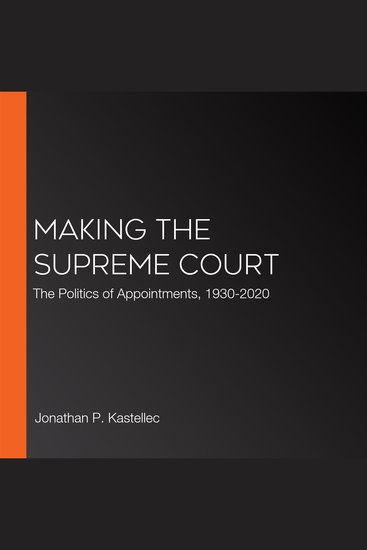
  • Making the Supreme Court - The Politics of Appointments 1930-2020 - cover

    Making the Supreme Court - The...

    Jonathan P. Kastellec, Charles...

    • 0
    • 0
    • 0
    Appointments to the United States Supreme Court are now central events in American political life. However, this has not always been the case. As late as the middle of the twentieth century, presidents invested little time and effort in finding and vetting nominees. Media coverage was desultory, public opinion was largely non-existent, and the justices often voted independently and erratically. 


    In Making the Supreme Court, Charles M. Cameron and Jonathan P. Kastellec show how the growth of federal judicial power from the 1930s onward inspired a multitude of groups struggling to shape judicial policy. Over time, some groups moved beyond lobbying the Court to changing who sits on it. Other groups formed expressly to influence appointments. These activists and organized groups penetrated the national party system so that after about 1980, presidential candidates increasingly pledged to select and confirm nominees who conformed to specific policy and ideological litmus tests. Once in office, these presidents reshaped the executive selection system to deliver on their promises. As Cameron and Kastellec argue, the result is a new politics aimed squarely at selecting and placing judicial ideologues on the Court. They make the case that this new model gradually transformed how the Court itself operates, turning it into an ideologically driven and polarized branch.
    Show book
  • Summary - My Name Is Lucy Barton - Based On The Book By Elizabeth Strout - cover

    Summary - My Name Is Lucy Barton...

    Fastbooks Publishing

    • 0
    • 0
    • 0
    SUMMARY 
      
    MY NAME IS LUCY BARTON 
    BASED ON THE BOOK BY ELIZABETH STROUT 
      
    SUMMARY WRITTEN BY: FASTBOOKS PUBLISHING 
      
    CONTENT 
    Hospital Stay and Isolation 
    Mother’s Unexpected Visit 
    Stories from the Past 
    Memories of Poverty 
    Strained Family Dynamics 
    Path to Writing and Self-Discovery 
    Marriage and Children 
    Friendships in New York City 
    Mother’s Departure and Lingering Questions 
    General Analysis of the Book 
      
    ABOUT THE ORIGINAL BOOK 
    “My Name is Lucy Barton” by Elizabeth Strout tells the story of Lucy Barton, a woman reflecting on her complicated past while recovering from an illness in a New York City hospital. Estranged from her family, especially her emotionally distant mother, Lucy grapples with her childhood in poverty and her search for connection. Through the lens of her relationships, particularly with her mother and husband, the novel explores themes of loneliness, memory, trauma, and the desire for love and forgiveness. Strout’s writing delicately examines the complexities of family dynamics and personal healing.
    Show book
  • Empower Your Child - Elevate your child's education! Access compelling audio lessons that boost their test-taking skills and confidence" - cover

    Empower Your Child - Elevate...

    Sullivan Darnell

    • 0
    • 0
    • 0
    Empower Your Child 
    ⭐⭐ A Simplified Guide with Innovative Strategies ⭐⭐ 
    Are you eager to foster your child's development and effectively enhance their growth with innovative brain strategies?  
    Searching for an all-encompassing guide that offers the essential tools for nurturing your child's potential?  
    Look no further! 
    This audiobook serves as your ultimate companion for expanding your knowledge, applying effective techniques, and engaging in practical exercises tailored to empower your child’s growth. With this resource, you're set for success. 
    Updated with the latest strategies for child development. 
    Key Features of This Comprehensive Guide: 
    - In-depth insights into empowering your child’s growth 
    - Thorough explanations of innovative brain strategies 
    - Effective methods for preparation and implementation 
    Our guide stands out with its extensive coverage, which is crucial for your child’s development journey. Concepts are explored in detail, ensuring a deep understanding. 
    Please note that this guide is an independent resource and is not affiliated with any official entities. 
    Crafted with a straightforward structure and accessible language, our guide ensures smooth transitions between topics. Say goodbye to complex terminology and embrace clear, precise, and technically accurate information. 
    So, why wait? Click the BUY NOW button, secure your copy, and embark on the path to successfully empowering your child! 
    Empower Your Child
    Show book
  • Science in the Ancient World - cover

    Science in the Ancient World

    Dr. Jay L. Wile

    • 0
    • 0
    • 0
    This audiobook is a companion to the Science in the Ancient World Textbook. 
    While it is possible to learn a lot of science by just listening to the audiobook on it's own, the textbook is required to gain the full value from this course. 
    Science in the Ancient World is the second book in a hands-on, multilevel elementary science series that introduces scientific concepts using history as its guide. Because each lesson is built around an activity or experiment, it is engaging for all K-6 students. In addition, there are three levels of review for each lesson, so the parent/teacher can choose the depth at which each student is expected to grasp the material. The course contains roughly 90 hours of instruction, 35 of which are composed of hands-on activities. 
    The course covers the scientific work of natural philosophers who lived from about 600 BC to the early AD 1500s. It concentrates mostly on what these ancient scientists got right, but it does spend some time discussing what they got wrong, because even the mistakes that scientists make can sometimes advance our understanding of the natural world. Of course, when the students are taught something that is now known to be incorrect, they are made aware of this fact! 
    Because the course covers science as it was developed, it covers a wide range of topics including human anatomy, medicine, optics, heliocentrism, geocentrism, sound, music, magnets, how steam is used to generate power, the motion of objects through a medium, combustion, levers, pulleys, plant growth, plant anatomy, tree ring dating, the atmosphere, astronomy, the basics of graphing, plastics, density, water flow, friction, and erosion. Throughout the course, students learn that most of the great scientists who lived from AD 500 to the end of this time period were devout Christians who did science because they thought they could learn more about God by studying His handiwork.
    Show book