Join us on a literary world trip!
Add this book to bookshelf
Grey
Write a new comment Default profile 50px
Grey
Subscribe to read the full book or read the first pages for free!
All characters reduced
The Digital Tapestry - Exploring the Philosophy of Information - cover

The Digital Tapestry - Exploring the Philosophy of Information

Pasquale De Marco

Publisher: Publishdrive

  • 0
  • 0
  • 0

Summary

In the digital age, computing has become an essential part of our lives. From the way we communicate to the way we do business, from the way we learn to the way we entertain ourselves, computing has transformed our world in ways that were unimaginable just a few decades ago.

But what exactly is computing? And what are the philosophical implications of this new technology?

In this thought-provoking book, we explore the relationship between philosophy and computing, examining the ways in which computing has changed our understanding of the world and our place in it. We consider the nature of information itself, the different types of computing devices, and the limits of our ability to process and understand information. We also examine the impact of computing on society, the ethical implications of these changes, and the future of computing.

This book is essential reading for anyone who wants to understand the profound impact of computing on our world. Whether you are a philosopher, a computer scientist, or simply someone who is interested in the role of technology in society, this book will challenge your assumptions and open your eyes to new ways of thinking about the digital age.

In this book, you will learn about:

* The history of computing
* The different types of computing devices
* The nature of information
* The limits of computing
* The impact of computing on society
* The ethical implications of computing
* The future of computing

With its clear and engaging writing style, this book is accessible to readers of all backgrounds. It is a must-read for anyone who wants to understand the digital age and its implications for our future.


If you like this book, write a review!
Available since: 06/02/2025.
Print length: 165 pages.
Other books that might interest you

  • Stop Procrastinating & Get Rid of Laziness - Manage Time Wisely and Boost Your Productivity - cover

    Stop Procrastinating & Get Rid...

    360K Pro Publishing

    • 0
    • 0
    • 0
    Goal of this Book is to help you recognize these flaws in the first place, pinpoint which areas are being affected by them, and then go over the methods we provide in order to get over the bad habit. You can use practical mind tricks in order to stop procrastinating, and force yourself to work on the things you know you have pending, instead of pushing them over and over to a side until they start to pile up and cause a mess. Practicing positive affirmations on a daily basis will boost your overall confidence and will help you feel motivated to get things done in less time than before, gradually helping you go from being a lazy mess, to an utterly productive person who is proud of themselves and confident in their abilities and decisions every single day. 
    You must be wondering what’s inside this book, before buying it. This audiobook consists of 6 chapters. Let’s have a look at the table of contents. 
    Table of Contents 
    Chapter 1 : Reasons for Laziness and Procrastination 
    Chapter 2 : How to Stop Being Lazy and Procrastinating In the Long Run 
    Chapter 3 : Quick Tips to Stop Procrastinating Right Now 
    Chapter 4 : Psychology of Bad Habits and Addictions 
    Chapter 5 : How to Break Bad Habits and Addictions Faster 
    Chapter 6 : Affirmations Section 
    This book is a worthy investment for your life, if you can change your habits and be more productive, that will worth Billions. 
    Why are you waiting? Go ahead and click the buy button now!
    Show book
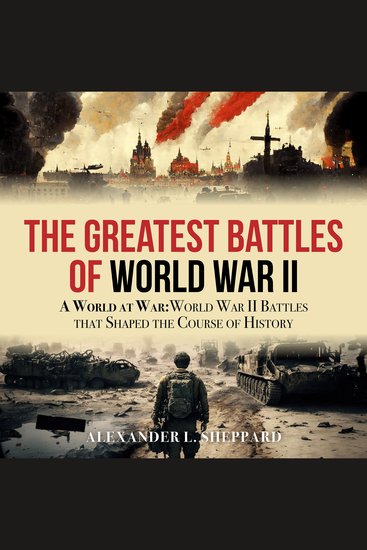
  • The Greatest Battles of World War II - A World at War:World War II Battles that Shaped the Course of History - cover

    The Greatest Battles of World...

    Alexander L. Sheppard

    • 0
    • 0
    • 0
    Harrowing stories of Auschwitz, Pearl Harbor, and D-Day continue to live on, but this unbridled look at The Greatest Battles of World War II explores the lesser-known monstrosities unlike other World War 2 books. 
    World war II did more than just change the fate of world history—in just six years, every corner of the globe became involved in some of the most violent crimes against humanity to ever occur. 
    Whether you have a great fascination for history, or you’re just looking to uncover new facts, The Greatest Battles of World War II paints a picture of the battles of World War 2 and the impact of each on the course of the war and the future of global affairs. 
    Inside The Greatest Battles of World War II, you will discover: 
    ●      major events and battle from the invasion of Poland and Dunkirk to Operation Overlord and the fateful day of June 6, 1944, when Nazi efforts all came crashing down. 
    ●      the intricately planned military and intelligence efforts on the part of the US and its allies, which were key to the victory and end of the war. 
    ●      what the fate of the war might have been if these battles had gone differently, and how even the minutest details enabled the takedown of Hitler and the Nazi Party. 
    ●      how each and every event contributed to the drawn-out war, the eventual victory of the Allied Powers, and their far-reaching impact on the world, politics, and modern history. 
    …plus key facts of every battle and military move for a well-rounded WWII education without the distracting and unnecessary details.
    Show book
  • Paul Joseph Goebbels - Minister of Propaganda for the Third Reich - cover

    Paul Joseph Goebbels - Minister...

    Kelly Mass

    • 0
    • 0
    • 0
    There are doers and there are preachers. The people who were executing orders or abusing people in World War 2 wouldn’t have been able to commit any atrocities if the country hadn’t warmed up to an inhumane narrative. That’s where propaganda came in. Propaganda has long been part of various countries and societies to make the population believe something, and to find culprits, create feelings of animosity, and glorify local leaders or military campaigns. In World War 2, it was obviously used to promote the supposed inferiority of the Jewish race and convince a big part of the German population that they were better off dead. Goebbels was one of those brainwashers who advocated that narrative with propaganda material in the media. 
    From 1933 through 1945, Paul Joseph Goebbels functioned as the Gauleiter (district head) of Berlin, the Nazi Party's senior propagandist, and the Reich Minister of Propaganda. He was another one of Adolf Hitler's closest and most dedicated acolytes, acknowledged for his public speaking capabilities and his extreme antisemitism, which he often uttered. He promoted for gradually even worse discrimination, including but not limited to the Holocaust's killing of Jews. 
    What led to all this? How did he become so good at it? Why was he so fanatic? And what did he do that led to the terrible acts during the Holocaust others committed against the Jews in Europe? 
    Read about it or listen to an audio version of this book to find out what made Joseph Goebbels gruesomely unique in his lies.
    Show book
  • The Ethics of Rhetoric - cover

    The Ethics of Rhetoric

    Richard M. Weaver

    • 0
    • 0
    • 0
    In The Ethics of Rhetoric, Richard M. Weaver evaluates the ethical and cultural role of rhetoric and its reflection on society. Weaver draws upon classical notions of rhetoric in Plato's Phaedrus, and he examines the effectiveness and implications of the manipulation of language in the works of Lincoln, Burke, and Milton. In this collection of essays, Weaver examines how different types of rhetoric persuade, their varying levels of effectiveness and credibility, and how one's manner of argumentation and style of persuasion are indicative of character. Ultimately, Weaver argues that the cultivation of pure language creates pure people. Initially published in 1953, The Ethics of Rhetoric remains timeless in its evaluation of rhetoric's role in society. 
    Richard M. Weaver (1910-1963) an esteemed scholar, humanist, cultural critic, and political philosopher, revolutionized conservativism of the mid-twentieth century. Weaver's original scholarship produced groundbreaking insight on human nature and society.
    Show book
  • Tales of Faith - A Guide to Sharing the Gospel through Literature - cover

    Tales of Faith - A Guide to...

    Holly Ordway

    • 0
    • 0
    • 0
    How can we share the Gospel and make disciples in our modern culture? Many people, including young people from Christian homes, are walking away from the faith, or have never had it presented to them in a compelling manner. However, our polemical, distracted media environment makes it difficult to have thoughtful discussions about anything. In this context, literature and the arts have a powerful role to play by providing an engaging and inviting way to share the Christian faith.  In Tales of Faith, Holly Ordway shows how literature—and especially old literature—can foster fruitful discussions that allow us to meet people where they are and help them move closer to knowing Christ, or to knowing and loving him more fully and deeply. Here, readers will find a practical, accessible guide to using literature to discuss topics such as the nature of God, virtues and vices, the Crucifixion, longing and sadness, and much more. For each literary text, Ordway provides an introductory essay, a selection from the text (or the whole poem for short pieces), questions for discussion or personal reflection, activities, and recommended resources.  Drawing from ancient classics like the Odyssey and the Aeneid and medieval masterpieces like Beowulf and the Divine Comedy, and providing both practical advice and spiritual guidance for the reader, Tales of Faith offers teachers, parents, and all lovers of classic literature an invaluable resource for sharing the faith through story.
    Show book
  • SAT Vocabulary AudioLearn - Complete Review the Top 500 SAT Vocabulary Words You Need to Know! - cover

    SAT Vocabulary AudioLearn -...

    AudioLearn Content Team

    • 0
    • 0
    • 0
    Improve your spelling. Gain a better understanding of sentence structure. Increase your SAT scores. SAT AudioLearn includes more than 500 words that commonly appear on the SAT, making it your indispensable study guide when it comes to SAT vocabulary! 
    Key Topics:SpellingSyntaxSentence UsagePronunciation 
    With its convenient format, SAT AudioLearn fits your busy lifestyle, enabling you to study anywhere, anytime. Best of all, you'll significantly increase learning and retention with AudioLearn's proven study format.
    Show book